Transmisión UDP de reSpeaker XVF3800 44mm con XIAO ESP32-S3 Plus
Descripción general
Este proyecto transmite audio en tiempo real desde la matriz reSpeaker XVF3800 44mm por Wi‑Fi. El XIAO ESP32-S3 Plus captura la salida estéreo procesada por I2S, la divide en paquetes UDP numerados y los envía a un receptor en Python en tu PC, que vuelve a ensamblar el flujo y lo guarda como un archivo WAV.
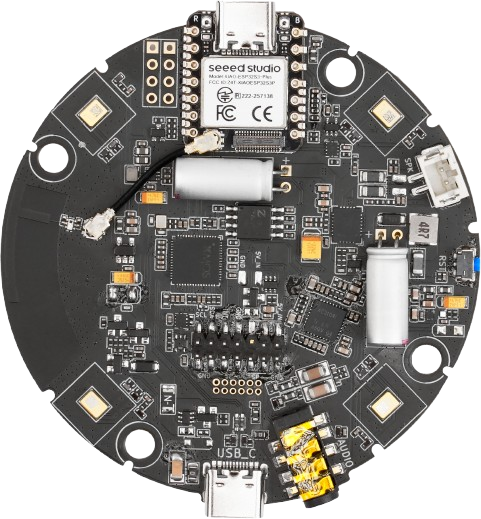
Descripción de la funcionalidad
- Conecta el XIAO a una red Wi‑Fi en modo estación.
- Captura audio estéreo de 48 kHz y 32 bits desde el XVF3800 mediante I2S.
- Envía cinco segundos de audio al PC como paquetes UDP, cada uno con una cabecera de 8 bytes (magic
AUD0+ número de secuencia). - El receptor en Python vuelve a ensamblar el flujo, detecta paquetes perdidos o duplicados, inserta silencio en los huecos y escribe
respeaker_recording.wav.
Este ejemplo requiere el firmware I2S en el XVF3800, a 48 kHz. Si la placa sigue ejecutando la imagen USB no generará relojes I2S. Consulta Update Firmware.
Antes de empezar
- Conecta la placa a la misma red que tu PC.
- Configura en el sketch tus credenciales Wi‑Fi y la dirección IPv4 de tu PC.
- Obtén la dirección del PC con
ipconfig(Windows) oip addr(Linux/macOS). - Permite el puerto UDP de entrada
12345en el firewall, o los paquetes se descartarán silenciosamente.
Código de Arduino
Actualiza estos valores antes de subir:
// WiFi credentials
const char* ssid     = "Your-SSID";
const char* password = "Your-PASSWORD";

// Your PC's IP address and the UDP port the Python script listens on
IPAddress pcIP(192, 168, 1, 100);
const uint16_t udpPort = 12345;
Código completo (transmite 5 segundos de audio)
#include <WiFi.h>
#include <WiFiUdp.h>
#include "AudioTools.h"

// =====================================================
// WIFI CONFIGURATION
// =====================================================

const char* ssid = "Your-SSID";
const char* password = "Your-PASSWORD";

// Your Windows PC IP address
IPAddress pcIP(192, 168, 1, 100);

const uint16_t udpPort = 12345;

WiFiUDP udp;


// =====================================================
// I2S CONFIGURATION
// =====================================================

#define SAMPLE_RATE       48000
#define CHANNELS          2
#define BITS_PER_SAMPLE   32

#define I2S_BCK_PIN       8
#define I2S_WS_PIN        7
#define I2S_TX_PIN        44
#define I2S_RX_PIN        43

AudioInfo info(
    SAMPLE_RATE,
    CHANNELS,
    BITS_PER_SAMPLE
);

I2SStream i2s;
I2SConfig i2sConfig;


// =====================================================
// RECORDING CONFIGURATION
// =====================================================

#define RECORD_SECONDS   5

#define BUFFER_SIZE      1024

#define FRAME_BYTES      8

#define BYTES_PER_SECOND \
    (SAMPLE_RATE * CHANNELS * (BITS_PER_SAMPLE / 8))

#define TOTAL_BYTES \
    (BYTES_PER_SECOND * RECORD_SECONDS)


// =====================================================
// UDP PACKET CONFIGURATION
// =====================================================

// Header: 4-byte magic + 4-byte sequence
#define HEADER_SIZE 8

#define PACKET_MAGIC "AUD0"

uint8_t audioBuffer[BUFFER_SIZE];

uint8_t packetBuffer[HEADER_SIZE + BUFFER_SIZE];

uint32_t sequenceNumber = 0;


// =====================================================
// WIFI CONNECTION
// =====================================================

bool connectWiFi() {

    Serial.printf(
        "Connecting to WiFi: %s\n",
        ssid
    );

    WiFi.mode(WIFI_STA);

    WiFi.begin(ssid, password);

    unsigned long start = millis();

    while (WiFi.status() != WL_CONNECTED) {

        delay(500);
        Serial.print(".");

        if (millis() - start > 30000) {

            Serial.println("\nWiFi connection timeout!");

            return false;
        }
    }

    Serial.println("\nWiFi connected!");

    Serial.print("ESP32 IP: ");
    Serial.println(WiFi.localIP());

    Serial.print("PC destination: ");
    Serial.println(pcIP);

    Serial.print("UDP port: ");
    Serial.println(udpPort);

    return true;
}


// =====================================================
// I2S INITIALIZATION
// =====================================================

bool setupI2SInput() {

    Serial.println("\nInitializing I2S...");

    i2sConfig = i2s.defaultConfig(RX_MODE);

    i2sConfig.copyFrom(info);

    i2sConfig.pin_bck = I2S_BCK_PIN;
    i2sConfig.pin_ws = I2S_WS_PIN;

    i2sConfig.pin_data = I2S_TX_PIN;
    i2sConfig.pin_data_rx = I2S_RX_PIN;

    // XVF3800 supplies BCLK and LRCLK
    i2sConfig.is_master = false;

    if (!i2s.begin(i2sConfig)) {

        Serial.println("I2S initialization failed!");

        return false;
    }

    Serial.println("I2S initialized successfully");

    Serial.println("Sample rate: 48000 Hz");
    Serial.println("Channels: 2");
    Serial.println("Bit depth: 32-bit");

    return true;
}


// =====================================================
// SEND ONE UDP AUDIO PACKET
// =====================================================

bool sendAudioPacket(
    const uint8_t* data,
    size_t length
) {

    if (length == 0 || length > BUFFER_SIZE) {
        return false;
    }

    // Header magic
    memcpy(
        packetBuffer,
        PACKET_MAGIC,
        4
    );

    // Sequence number, little-endian
    memcpy(
        packetBuffer + 4,
        &sequenceNumber,
        4
    );

    // Audio payload
    memcpy(
        packetBuffer + HEADER_SIZE,
        data,
        length
    );

    if (!udp.beginPacket(pcIP, udpPort)) {
        return false;
    }

    size_t headerWritten = udp.write(
        packetBuffer,
        HEADER_SIZE
    );

    size_t audioWritten = udp.write(
        packetBuffer + HEADER_SIZE,
        length
    );

    int result = udp.endPacket();

    if (headerWritten != HEADER_SIZE ||
        audioWritten != length ||
        result != 1) {

        Serial.printf(
            "UDP send failed at packet %lu\n",
            (unsigned long)sequenceNumber
        );

        return false;
    }

    sequenceNumber++;

    return true;
}


// =====================================================
// RECORD AND TRANSMIT AUDIO
// =====================================================

void recordAndSendAudio() {

    Serial.println("\n================================");
    Serial.println("STARTING AUDIO TRANSMISSION");
    Serial.println("================================");

    Serial.printf(
        "Recording duration: %d seconds\n",
        RECORD_SECONDS
    );

    Serial.printf(
        "Expected audio: %lu bytes\n",
        (unsigned long)TOTAL_BYTES
    );

    size_t totalSent = 0;

    uint32_t successfulPackets = 0;
    uint32_t failedPackets = 0;

    unsigned long startTime = millis();

    while (totalSent < TOTAL_BYTES) {

        size_t remaining = TOTAL_BYTES - totalSent;

        size_t requestSize =
            (remaining > BUFFER_SIZE)
            ? BUFFER_SIZE
            : remaining;

        // Read I2S audio
        size_t bytesRead = i2s.readBytes(
            audioBuffer,
            requestSize
        );

        if (bytesRead == 0) {
            delay(1);
            continue;
        }

        // Preserve complete stereo frames
        bytesRead -= bytesRead % FRAME_BYTES;

        if (bytesRead == 0) {
            continue;
        }

        // Send via UDP
        if (sendAudioPacket(audioBuffer, bytesRead)) {

            totalSent += bytesRead;

            successfulPackets++;

        } else {

            failedPackets++;

            // Do not advance totalSent.
            // The same audio data will be retried.
        }

        static size_t lastProgress = 0;

        if (totalSent - lastProgress >= BYTES_PER_SECOND) {

            lastProgress = totalSent;

            Serial.printf(
                "Sent: %lu / %lu bytes (%.2f sec)\n",
                (unsigned long)totalSent,
                (unsigned long)TOTAL_BYTES,
                (float)totalSent / BYTES_PER_SECOND
            );
        }
    }

    unsigned long elapsed = millis() - startTime;

    Serial.println("\n================================");
    Serial.println("TRANSMISSION COMPLETE");
    Serial.println("================================");

    Serial.printf(
        "Total audio bytes: %lu\n",
        (unsigned long)totalSent
    );

    Serial.printf(
        "Successful packets: %lu\n",
        (unsigned long)successfulPackets
    );

    Serial.printf(
        "Failed packets: %lu\n",
        (unsigned long)failedPackets
    );

    Serial.printf(
        "Elapsed time: %.2f seconds\n",
        elapsed / 1000.0
    );

    Serial.printf(
        "Average data rate: %.2f KB/s\n",
        elapsed > 0
            ? (float)totalSent / elapsed
            : 0.0f
    );

    Serial.println("UDP transmission finished.");
}


// =====================================================
// SETUP
// =====================================================

void setup() {

    Serial.begin(115200);

    while (!Serial) {
        delay(10);
    }

    AudioLogger::instance().begin(
        Serial,
        AudioLogger::Info
    );

    Serial.println("\nReSpeaker 44mm UDP Audio Test");

    // 1. Connect WiFi
    if (!connectWiFi()) {
        while (true) delay(1000);
    }

    // 2. Initialize UDP
    if (!udp.begin(0)) {
        Serial.println("UDP initialization failed!");
        while (true) delay(1000);
    }

    Serial.println("UDP initialized");

    // 3. Initialize I2S
    if (!setupI2SInput()) {
        while (true) delay(1000);
    }

    delay(500);

    // 4. Record and transmit
    recordAndSendAudio();
}


// =====================================================
// LOOP
// =====================================================

void loop() {

    // One-time recording test
    delay(1000);
}
Abre el Monitor Serie a 115200 baudios para confirmar la conexión Wi‑Fi y el progreso de la transmisión.
Formato de paquete
| Bytes | Campo | Valor |
|---|---|---|
| 0–3 | Magic | AUD0 (ASCII) |
| 4–7 | Número de secuencia | uint32 little-endian, comienza en 0 |
| 8–1031 | Carga útil de audio | 1024 bytes de PCM estéreo sin procesar de 32 bits |
Con 48 kHz × 2 canales × 4 bytes, un segundo son 384.000 bytes; cinco segundos son 1.920.000 bytes, o 1.875 paquetes de 1024 bytes.
Script de Python (recibir y guardar el audio)
Guarda esto como udp_receiver.py y ejecútalo en el PC antes de reiniciar la placa.
import socket
import struct
import wave
import time

# ==========================================
# UDP CONFIGURATION
# ==========================================

UDP_IP = "0.0.0.0"
UDP_PORT = 12345

PC_IP = "192.168.1.100"

# ==========================================
# AUDIO CONFIGURATION
# ==========================================

SAMPLE_RATE = 48000
CHANNELS = 2
SAMPLE_WIDTH = 4

RECORD_SECONDS = 5

BYTES_PER_SECOND = (
    SAMPLE_RATE * CHANNELS * SAMPLE_WIDTH
)

EXPECTED_BYTES = BYTES_PER_SECOND * RECORD_SECONDS

# Arduino sends 1024-byte audio chunks
CHUNK_SIZE = 1024

EXPECTED_PACKETS = EXPECTED_BYTES // CHUNK_SIZE

# Packet header:
# 4 bytes magic + 4 bytes sequence number
HEADER_SIZE = 8

OUTPUT_FILE = "respeaker_recording.wav"

# ==========================================
# UDP SOCKET
# ==========================================

sock = socket.socket(
    socket.AF_INET,
    socket.SOCK_DGRAM
)

# Allow reuse of port
sock.setsockopt(
    socket.SOL_SOCKET,
    socket.SO_REUSEADDR,
    1
)

sock.bind((UDP_IP, UDP_PORT))

sock.settimeout(5.0)

print("======================================")
print("ReSpeaker 44mm UDP Audio Receiver")
print("======================================")

print(f"Listening on: {UDP_IP}:{UDP_PORT}")
print(f"PC IP: {PC_IP}")
print(f"Sample rate: {SAMPLE_RATE}")
print(f"Channels: {CHANNELS}")
print(f"Bit depth: {SAMPLE_WIDTH * 8}")
print(f"Expected duration: {RECORD_SECONDS} seconds")
print(f"Expected packets: {EXPECTED_PACKETS}")

print("\nWaiting for ESP32 audio transmission...")

# ==========================================
# AUDIO STORAGE
# ==========================================

audio_data = bytearray()

expected_sequence = 0

received_packets = 0
missing_packets = 0
duplicate_packets = 0
invalid_packets = 0

end_received = False

last_packet_time = time.time()

# ==========================================
# RECEIVE UDP PACKETS
# ==========================================

try:

    while True:

        try:

            data, addr = sock.recvfrom(2048)

            last_packet_time = time.time()

            # Check packet size
            if len(data) < HEADER_SIZE:
                invalid_packets += 1
                continue

            # Decode packet header
            magic, sequence = struct.unpack(
                "<4sI",
                data[:HEADER_SIZE]
            )

            # End-of-transmission marker
            if magic == b"END0":
                print("\nEnd-of-transmission received.")
                end_received = True
                break

            # Check packet identifier
            if magic != b"AUD0":
                invalid_packets += 1
                print("Invalid packet identifier")
                continue

            payload = data[HEADER_SIZE:]

            if len(payload) != CHUNK_SIZE:
                invalid_packets += 1
                print(
                    f"Unexpected payload size: {len(payload)}"
                )
                continue

            # Handle missing packets
            if sequence > expected_sequence:

                lost = sequence - expected_sequence

                missing_packets += lost

                print(
                    f"Missing {lost} packet(s) before "
                    f"sequence {sequence}"
                )

                # Insert silence for missing audio
                audio_data.extend(
                    bytes(lost * CHUNK_SIZE)
                )

            # Ignore duplicate or out-of-order packets
            elif sequence < expected_sequence:

                duplicate_packets += 1

                print(
                    f"Duplicate/late packet: {sequence}"
                )

                continue

            # Store audio payload
            audio_data.extend(payload)

            expected_sequence = sequence + 1

            received_packets += 1

            # Progress
            if received_packets % 375 == 0:

                duration = (
                    len(audio_data) / BYTES_PER_SECOND
                )

                print(
                    f"Received: {received_packets} packets | "
                    f"{duration:.2f} seconds"
                )

        except socket.timeout:

            if received_packets > 0:

                print("\nReceiver timeout.")

                break

            print("Still waiting for ESP32...")

except KeyboardInterrupt:

    print("\nRecording stopped by user.")

finally:

    sock.close()


# ==========================================
# SAVE WAV FILE
# ==========================================

print("\n======================================")
print("RECORDING STATISTICS")
print("======================================")

print(f"Received packets: {received_packets}")
print(f"Missing packets: {missing_packets}")
print(f"Duplicate packets: {duplicate_packets}")
print(f"Invalid packets: {invalid_packets}")
print(f"End marker received: {end_received}")

print(f"Total audio bytes: {len(audio_data)}")

print(
    f"Audio duration: "
    f"{len(audio_data) / BYTES_PER_SECOND:.2f} seconds"
)

if len(audio_data) > 0:

    # Ensure complete stereo frames
    audio_data = audio_data[
        :len(audio_data) - len(audio_data) % 8
    ]

    print(f"\nSaving WAV: {OUTPUT_FILE}")

    with wave.open(OUTPUT_FILE, "wb") as wav:

        wav.setnchannels(CHANNELS)
        wav.setsampwidth(SAMPLE_WIDTH)
        wav.setframerate(SAMPLE_RATE)

        wav.writeframes(audio_data)

    print("WAV saved successfully!")

else:

    print("No audio received!")

print("\nReceiver finished.")
El receptor termina con el tiempo de espera del socket de 5 segundos en lugar de con un marcador de fin, porque el sketch no envía el paquete opcional END0. Por lo tanto, End marker received: False en las estadísticas es normal.
Salida esperada
Monitor Serie de Arduino:
ReSpeaker 44mm UDP Audio Test
Connecting to WiFi: Your-SSID
....
WiFi connected!
ESP32 IP: 192.168.1.42
PC destination: 192.168.1.100
UDP port: 12345
UDP initialized

Initializing I2S...
I2S initialized successfully
Sample rate: 48000 Hz
Channels: 2
Bit depth: 32-bit

================================
STARTING AUDIO TRANSMISSION
================================
Recording duration: 5 seconds
Expected audio: 1920000 bytes
Sent: 384000 / 1920000 bytes (1.00 sec)
Sent: 768000 / 1920000 bytes (2.00 sec)
Sent: 1152000 / 1920000 bytes (3.00 sec)
Sent: 1536000 / 1920000 bytes (4.00 sec)
Sent: 1920000 / 1920000 bytes (5.00 sec)

================================
TRANSMISSION COMPLETE
================================
Total audio bytes: 1920000
Successful packets: 1875
Failed packets: 0
Elapsed time: 5.02 seconds
Average data rate: 382.47 KB/s
UDP transmission finished.
Receptor de Python:
======================================
ReSpeaker 44mm UDP Audio Receiver
======================================
Listening on: 0.0.0.0:12345
PC IP: 192.168.1.100
Sample rate: 48000
Channels: 2
Bit depth: 32
Expected duration: 5 seconds
Expected packets: 1875

Waiting for ESP32 audio transmission...
Received: 375 packets | 1.00 seconds
Received: 750 packets | 2.00 seconds
Received: 1125 packets | 3.00 seconds
Received: 1500 packets | 4.00 seconds
Received: 1875 packets | 5.00 seconds

Receiver timeout.

======================================
RECORDING STATISTICS
======================================
Received packets: 1875
Missing packets: 0
Duplicate packets: 0
Invalid packets: 0
End marker received: False
Total audio bytes: 1920000
Audio duration: 5.00 seconds

Saving WAV: respeaker_recording.wav
WAV saved successfully!

Receiver finished.
Escuchar el audio
Abre respeaker_recording.wav en cualquier reproductor de audio — VLC, Windows Media Player o Audacity para su inspección. Es de 48 kHz, estéreo, PCM de 32 bits.
Soporte técnico y debate sobre el producto
Gracias por elegir nuestros productos. Estamos aquí para ofrecerte diferentes tipos de soporte para garantizar que tu experiencia con nuestros productos sea lo más fluida posible. Ofrecemos varios canales de comunicación para adaptarnos a distintas preferencias y necesidades.