Transmisión de audio por WebSocket con reSpeaker XVF3800 USB Mic Array y XIAO ESP32S3
Introducción
Esta guía describe cómo capturar audio desde una matriz de micrófonos XVF3800 usando un ESP32-S3 (XIAO ESP32S3), grabar 5 segundos de audio PCM estéreo de 32 bits a 48 kHz y almacenar los datos en la PSRAM para manejar búferes de audio grandes. El audio grabado se transmite luego por Wi-Fi a un servidor WebSocket basado en Python, donde se recibe y se guarda como un archivo WAV estándar. Este enfoque es muy adecuado para aplicaciones como captura de voz, registro de audio remoto y flujos de procesamiento de voz que incluyen conversión de voz a texto (STT) y análisis de audio basado en aprendizaje automático.
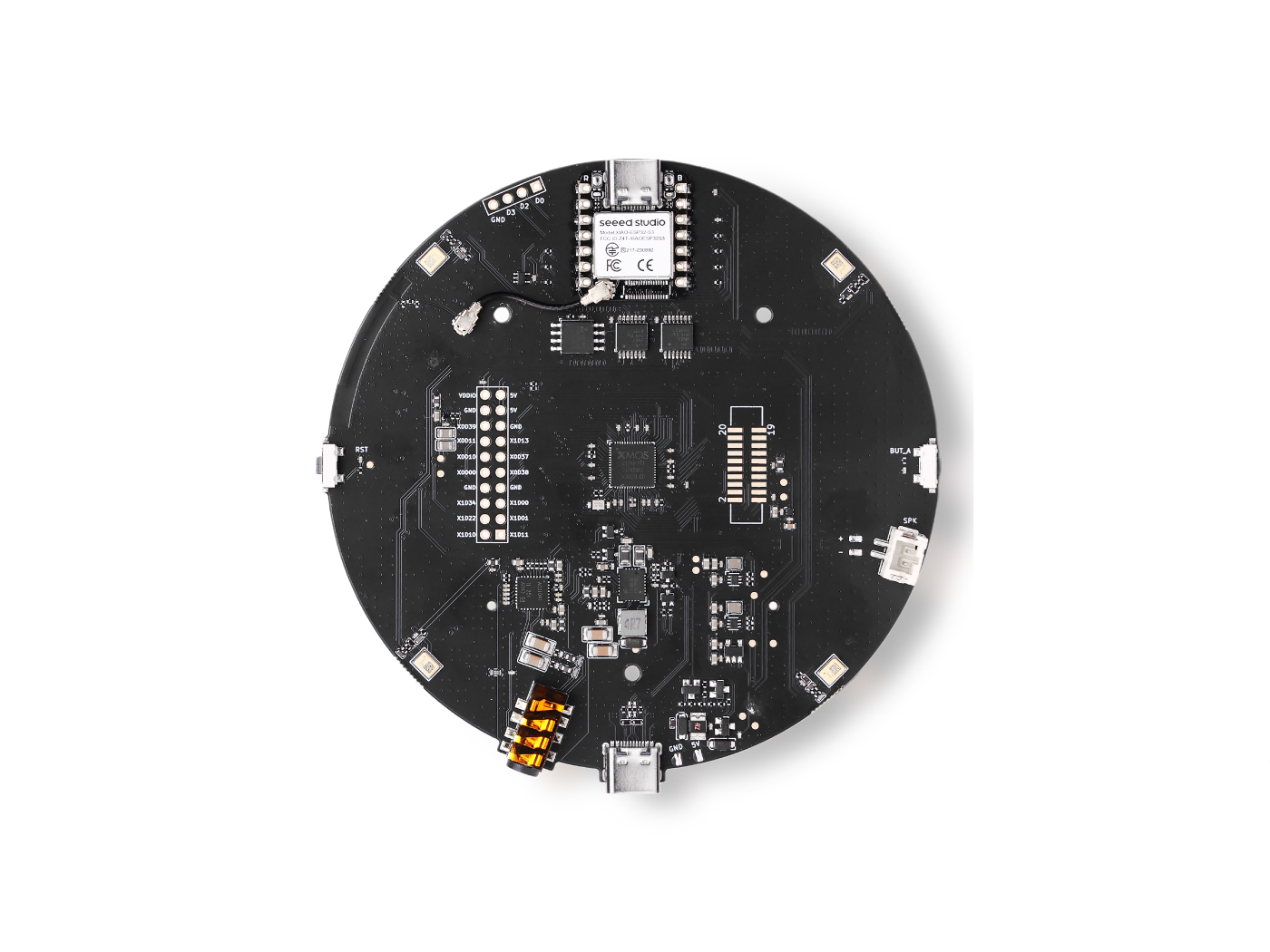
Código de Arduino
Debes habilitar la PSRAM, de lo contrario malloc() fallará.
Este sketch utiliza el firmware XVF3800 para actuar como maestro I2S. Flashea el siguiente firmware DFU en el XVF3800 antes de subirlo:
respeaker_xvf3800_i2s_master_dfu_firmware_v1.0.x_48k_test5.bin
Actualiza estos campos antes de subir:
// WiFi credentials
const char* ssid = "your SSID";
const char* password = "your password";

// WebSocket server (your PC)
const char* wsHost = "192.168.x.xx";  // replace with your PC IP
const uint16_t wsPort = 12345;
Código completo de Arduino
#include "WiFi.h"
#include "AudioTools.h"
#include <WebSocketsClient.h>

const char* ssid = "your SSID";
const char* password = "your password";

const char* wsHost = "192.168.x.xx";
const uint16_t wsPort = 12345;
const char* wsPath = "/";

WebSocketsClient webSocket;

AudioInfo info(48000, 2, 32);
I2SStream i2s_in;
I2SConfig i2s_config;

#define BUFFER_SIZE 1024
#define TOTAL_BYTES 1920000  // 5 sec @ 48 kHz, stereo, 32-bit

uint8_t* audio_buffer = nullptr;
bool wsConnected = false;

void webSocketEvent(WStype_t type, uint8_t * payload, size_t length) {
  if (type == WStype_CONNECTED) {
    Serial.println("WebSocket connected");
    wsConnected = true;
  } else if (type == WStype_DISCONNECTED) {
    Serial.println("WebSocket disconnected");
    wsConnected = false;
  }
}

void connectWiFi() {
  Serial.printf("Connecting to WiFi: %s\n", ssid);
  WiFi.begin(ssid, password);
  while (WiFi.status() != WL_CONNECTED) {
    delay(1000);
    Serial.print(".");
  }
  Serial.println("\nConnected!");
  Serial.printf("IP Address: %s\n", WiFi.localIP().toString().c_str());
}

void setupI2SInput() {
  i2s_config = i2s_in.defaultConfig(RX_MODE);
  i2s_config.copyFrom(info);
  i2s_config.pin_bck = 8;
  i2s_config.pin_ws = 7;
  i2s_config.pin_data = 44;
  i2s_config.pin_data_rx = 43;
  i2s_config.is_master = false;
  i2s_in.begin(i2s_config);
  Serial.println("I2S input started.");
}

void setup() {
  Serial.begin(115200);
  while (!Serial);
  AudioLogger::instance().begin(Serial, AudioLogger::Info);

  connectWiFi();

  if (psramFound()) {
    audio_buffer = (uint8_t*) ps_malloc(TOTAL_BYTES);
    Serial.println("Using PSRAM for audio buffer.");
  } else {
    audio_buffer = (uint8_t*) malloc(TOTAL_BYTES);
    Serial.println("WARNING: no PSRAM found - allocation may fail.");
  }
  if (!audio_buffer) {
    Serial.println("Failed to allocate audio buffer!");
    return;
  }

  setupI2SInput();
  delay(500);

  // ---- PHASE 1: capture only ----
  Serial.println("Capturing 5 seconds of audio...");
  size_t total_captured = 0;

  while (total_captured < TOTAL_BYTES) {
    size_t to_read = min((size_t)BUFFER_SIZE, (size_t)TOTAL_BYTES - total_captured);
    size_t bytes_read = i2s_in.readBytes(audio_buffer + total_captured, to_read);
    if (bytes_read > 0) {
      total_captured += bytes_read;
      if (total_captured % 64000 == 0) {
        Serial.printf("Captured %d bytes (%.1f sec)\n", total_captured, total_captured / 384000.0);
      }
    } else {
      delay(1);
    }
  }
  Serial.printf("Capture complete: %d bytes\n", total_captured);

  // ---- PHASE 2: connect WebSocket and send ----
  webSocket.begin(wsHost, wsPort, wsPath);
  webSocket.onEvent(webSocketEvent);
  webSocket.setReconnectInterval(2000);

  Serial.println("Waiting for WebSocket connection...");
  unsigned long waitStart = millis();
  while (!wsConnected && millis() - waitStart < 10000) {
    webSocket.loop();
    delay(10);
  }
  if (!wsConnected) {
    Serial.println("Failed to connect to WebSocket server!");
    return;
  }

  Serial.printf("Sending %d bytes via WebSocket...\n", total_captured);
  const size_t SEND_CHUNK = 4096;
  size_t total_sent = 0;

  while (total_sent < total_captured) {
    size_t chunk = min(SEND_CHUNK, (size_t)(total_captured - total_sent));
    webSocket.sendBIN(audio_buffer + total_sent, chunk);
    webSocket.loop();
    total_sent += chunk;
  }

  Serial.printf("Finished! Sent %d bytes total\n", total_sent);
  webSocket.disconnect();
  free(audio_buffer);
}

void loop() {
  webSocket.loop();
}
Código del servidor Python (WebSocket)
Necesitas instalar la biblioteca websockets: pip install websockets
import asyncio
import websockets
import wave

WS_HOST = "0.0.0.0"
WS_PORT = 12345

SAMPLE_RATE = 48000
CHANNELS = 2
SAMPLE_WIDTH = 4  # 32-bit = 4 bytes

BYTES_PER_SEC = SAMPLE_RATE * CHANNELS * SAMPLE_WIDTH  # 384000

async def handle_connection(websocket):
    print(f"Client connected: {websocket.remote_address}")
    audio_data = bytearray()

    async for message in websocket:
        if isinstance(message, (bytes, bytearray)):
            audio_data.extend(message)
            if len(audio_data) % 64000 < len(message):
                print(f"Received {len(audio_data)} bytes ({len(audio_data) / BYTES_PER_SEC:.1f} seconds)")
        else:
            print(f"Received text: {message}")

    print(f"\nClient disconnected. Total received: {len(audio_data)} bytes")

    if len(audio_data) > 0:
        print("Saving to output.wav...")
        with wave.open("output.wav", "wb") as wav_file:
            wav_file.setnchannels(CHANNELS)
            wav_file.setsampwidth(SAMPLE_WIDTH)
            wav_file.setframerate(SAMPLE_RATE)
            wav_file.writeframes(bytes(audio_data))
        print("Done! Audio saved to output.wav")
    else:
        print("No data received!")

async def main():
    print(f"WebSocket server listening on {WS_HOST}:{WS_PORT}...")
    async with websockets.serve(handle_connection, WS_HOST, WS_PORT):
        await asyncio.Future()  # run forever

if __name__ == "__main__":
    asyncio.run(main())
Soporte técnico y debate sobre el producto
Gracias por elegir nuestros productos. Estamos aquí para ofrecerte diferentes tipos de soporte y garantizar que tu experiencia con nuestros productos sea lo más fluida posible. Ofrecemos varios canales de comunicación para adaptarnos a distintas preferencias y necesidades.