SO-Arm con Respeaker
Introducción
El Lekiwi Robot Kit, integrado con el ReSpeaker Mic Array v2.0, adquiere capacidades de interacción por voz y navegación por sonido. Esta guía detalla el proceso paso a paso para configurar tanto el hardware como los entornos de software a fin de lograr la funcionalidad de seguimiento de sonido en el robot.
| Lekiwi Robot Kit | ReSpeaker Mic Array v2.0 | reComputer Mini J4012 |
|---|---|---|
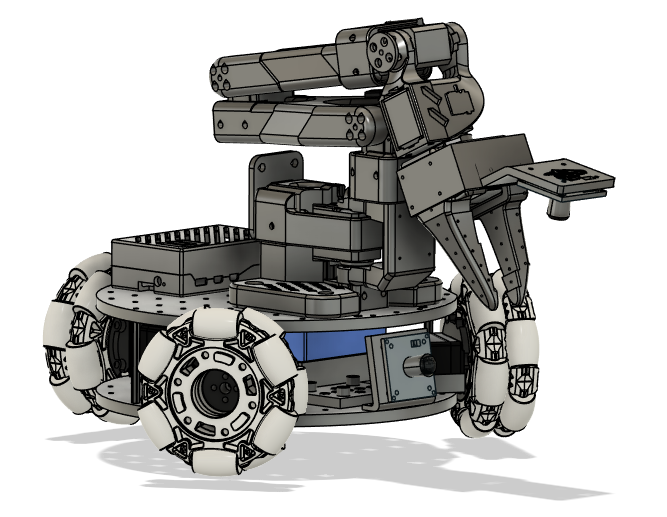 |  |  |
Requisitos previos
- Lekiwi Robot Kit
- ReSpeaker Mic Array v2.0
Teniendo en cuenta futuras ampliaciones de funciones, este wiki utiliza el reComputer Jetson Mini J4012 como dispositivo de control principal del robot. También puedes lograr todas las funcionalidades descritas en este wiki utilizando una Raspberry Pi 5.
Conexión de hardware
- Consulta este wiki para preparar el robot Lekiwi, incluida la instalación de la estructura mecánica y la configuración de los motores.
- Utiliza conectores impresos en 3D para montar el reSpeaker en el Lekiwi.
- Utiliza cables USB para conectar el reSpeaker y el controlador de servos al reComputer.

Preparar el entorno de software
Entorno virtual de Lerobot
Si ya has configurado el entorno virtual de Lerobot en tu reComputer durante el proceso de montaje de Lekiwi, puedes pasar a la siguiente sección. De lo contrario, puedes configurar el entorno virtual de Lerobot utilizando los siguientes comandos:
Paso 1. Instalar Miniconda
mkdir -p ~/miniconda3
wget https://repo.anaconda.com/miniconda/Miniconda3-latest-Linux-aarch64.sh -O ~/miniconda3/miniconda.sh
bash ~/miniconda3/miniconda.sh -b -u -p ~/miniconda3
rm ~/miniconda3/miniconda.sh
source ~/.bashrc
Paso 2. Crear un entorno conda para lerobot
conda create -y -n lerobot python=3.12
conda activate lerobot
git clone https://github.com/huggingface/lerobot.git ~/lerobot
conda install ffmpeg -c conda-forge
cd ~/lerobot && pip install -e ".[feetech]"
Dependencias de reSpeaker
Instala las dependencias de reSpeaker en el entorno virtual de lerobot.
Paso 1. Instalar pyusb
pip install pyusb==1.0.2
Paso 2. Configurar los permisos de acceso al dispositivo USB
echo 'SUBSYSTEM=="usb", ATTRS{idVendor}=="2886", MODE="0666"' | sudo tee /etc/udev/rules.d/51-mic-usb.rules
sudo chmod +x /etc/udev/rules.d/51-mic-usb.rules
sudo udevadm control --reload-rules && sudo udevadm trigger
Instalar el software de la aplicación
Navega al directorio lerobot/lerobot/common/robots/lekiwi/ y crea un nuevo script de Python llamado sound_follow.py en esta ubicación.
Luego, copia el siguiente contenido en sound_follow.py.
sound_follow.py
#!/usr/bin/env python3


import logging
import time
import sys
import struct
import usb.core
import usb.util

from .config_lekiwi import LeKiwiConfig
from .lekiwi import LeKiwi

class Tuning:
    TIMEOUT = 100000

    def __init__(self, dev):
        self.dev = dev
        self.PARAMETERS = {
            'AECFREEZEONOFF': (18, 7, 'int', 1, 0, 'rw', 'Adaptive Echo Canceler updates inhibit.', '0 = Adaptation enabled', '1 = Freeze adaptation, filter only'),
            'AECNORM': (18, 19, 'float', 16, 0.25, 'rw', 'Limit on norm of AEC filter coefficients'),
            'AECPATHCHANGE': (18, 25, 'int', 1, 0, 'ro', 'AEC Path Change Detection.', '0 = false (no path change detected)', '1 = true (path change detected)'),
            'RT60': (18, 26, 'float', 0.9, 0.25, 'ro', 'Current RT60 estimate in seconds'),
            'HPFONOFF': (18, 27, 'int', 3, 0, 'rw', 'High-pass Filter on microphone signals.', '0 = OFF', '1 = ON - 70 Hz cut-off', '2 = ON - 125 Hz cut-off', '3 = ON - 180 Hz cut-off'),
            'RT60ONOFF': (18, 28, 'int', 1, 0, 'rw', 'RT60 Estimation for AES. 0 = OFF 1 = ON'),
            'AECSILENCELEVEL': (18, 30, 'float', 1, 1e-09, 'rw', 'Threshold for signal detection in AEC [-inf .. 0] dBov (Default: -80dBov = 10log10(1x10⁻⁸))'),
            'AECSILENCEMODE': (18, 31, 'int', 1, 0, 'ro', 'AEC far-end silence detection status. ', '0 = false (signal detected) ', '1 = true (silence detected)'),
            'AGCONOFF': (19, 0, 'int', 1, 0, 'rw', 'Automatic Gain Control. ', '0 = OFF ', '1 = ON'),
            'AGCMAXGAIN': (19, 1, 'float', 1000, 1, 'rw', 'Maximum AGC gain factor. ', '[0 .. 60] dB (default 30dB = 20log10(31.6))'),
            'AGCDESIREDLEVEL': (19, 2, 'float', 0.99, 1e-08, 'rw', 'Target power level of the output signal. ', '[-inf .. 0] dBov (default: -23dBov = 10log10(0.005))'),
            'AGCGAIN': (19, 3, 'float', 1000, 1, 'rw', 'Current AGC gain factor. ', '[0 .. 60] dB (default: 0.0dB = 20log10(1.0))'),
            'AGCTIME': (19, 4, 'float', 1, 0.1, 'rw', 'Ramps-up / down time-constant in seconds.'),
            'CNIONOFF': (19, 5, 'int', 1, 0, 'rw', 'Comfort Noise Insertion.', '0 = OFF', '1 = ON'),
            'FREEZEONOFF': (19, 6, 'int', 1, 0, 'rw', 'Adaptive beamformer updates.', '0 = Adaptation enabled', '1 = Freeze adaptation, filter only'),
            'STATNOISEONOFF': (19, 8, 'int', 1, 0, 'rw', 'Stationary noise suppression.', '0 = OFF', '1 = ON'),
            'GAMMA_NS': (19, 9, 'float', 3, 0, 'rw', 'Over-subtraction factor of stationary noise. min .. max attenuation'),
            'MIN_NS': (19, 10, 'float', 1, 0, 'rw', 'Gain-floor for stationary noise suppression.', '[-inf .. 0] dB (default: -16dB = 20log10(0.15))'),
            'NONSTATNOISEONOFF': (19, 11, 'int', 1, 0, 'rw', 'Non-stationary noise suppression.', '0 = OFF', '1 = ON'),
            'GAMMA_NN': (19, 12, 'float', 3, 0, 'rw', 'Over-subtraction factor of non- stationary noise. min .. max attenuation'),
            'MIN_NN': (19, 13, 'float', 1, 0, 'rw', 'Gain-floor for non-stationary noise suppression.', '[-inf .. 0] dB (default: -10dB = 20log10(0.3))'),
            'ECHOONOFF': (19, 14, 'int', 1, 0, 'rw', 'Echo suppression.', '0 = OFF', '1 = ON'),
            'GAMMA_E': (19, 15, 'float', 3, 0, 'rw', 'Over-subtraction factor of echo (direct and early components). min .. max attenuation'),
            'GAMMA_ETAIL': (19, 16, 'float', 3, 0, 'rw', 'Over-subtraction factor of echo (tail components). min .. max attenuation'),
            'GAMMA_ENL': (19, 17, 'float', 5, 0, 'rw', 'Over-subtraction factor of non-linear echo. min .. max attenuation'),
            'NLATTENONOFF': (19, 18, 'int', 1, 0, 'rw', 'Non-Linear echo attenuation.', '0 = OFF', '1 = ON'),
            'NLAEC_MODE': (19, 20, 'int', 2, 0, 'rw', 'Non-Linear AEC training mode.', '0 = OFF', '1 = ON - phase 1', '2 = ON - phase 2'),
            'SPEECHDETECTED': (19, 22, 'int', 1, 0, 'ro', 'Speech detection status.', '0 = false (no speech detected)', '1 = true (speech detected)'),
            'FSBUPDATED': (19, 23, 'int', 1, 0, 'ro', 'FSB Update Decision.', '0 = false (FSB was not updated)', '1 = true (FSB was updated)'),
            'FSBPATHCHANGE': (19, 24, 'int', 1, 0, 'ro', 'FSB Path Change Detection.', '0 = false (no path change detected)', '1 = true (path change detected)'),
            'TRANSIENTONOFF': (19, 29, 'int', 1, 0, 'rw', 'Transient echo suppression.', '0 = OFF', '1 = ON'),
            'VOICEACTIVITY': (19, 32, 'int', 1, 0, 'ro', 'VAD voice activity status.', '0 = false (no voice activity)', '1 = true (voice activity)'),
            'STATNOISEONOFF_SR': (19, 33, 'int', 1, 0, 'rw', 'Stationary noise suppression for ASR.', '0 = OFF', '1 = ON'),
            'NONSTATNOISEONOFF_SR': (19, 34, 'int', 1, 0, 'rw', 'Non-stationary noise suppression for ASR.', '0 = OFF', '1 = ON'),
            'GAMMA_NS_SR': (19, 35, 'float', 3, 0, 'rw', 'Over-subtraction factor of stationary noise for ASR. ', '[0.0 .. 3.0] (default: 1.0)'),
            'GAMMA_NN_SR': (19, 36, 'float', 3, 0, 'rw', 'Over-subtraction factor of non-stationary noise for ASR. ', '[0.0 .. 3.0] (default: 1.1)'),
            'MIN_NS_SR': (19, 37, 'float', 1, 0, 'rw', 'Gain-floor for stationary noise suppression for ASR.', '[-inf .. 0] dB (default: -16dB = 20log10(0.15))'),
            'MIN_NN_SR': (19, 38, 'float', 1, 0, 'rw', 'Gain-floor for non-stationary noise suppression for ASR.', '[-inf .. 0] dB (default: -10dB = 20log10(0.3))'),
            'GAMMAVAD_SR': (19, 39, 'float', 1000, 0, 'rw', 'Set the threshold for voice activity detection.', '[-inf .. 60] dB (default: 3.5dB 20log10(1.5))'),
            # 'KEYWORDDETECT': (20, 0, 'int', 1, 0, 'ro', 'Keyword detected. Current value so needs polling.'),
            'DOAANGLE': (21, 0, 'int', 359, 0, 'ro', 'DOA angle. Current value. Orientation depends on build configuration.')
        }

    def write(self, name, value):
        try:
            data = self.PARAMETERS[name]
        except KeyError:
            return

        if data[5] == 'ro':
            raise ValueError('{} is read-only'.format(name))

        id = data[0]

        # 4 bytes offset, 4 bytes value, 4 bytes type
        if data[2] == 'int':
            payload = struct.pack(b'iii', data[1], int(value), 1)
        else:
            payload = struct.pack(b'ifi', data[1], float(value), 0)

        self.dev.ctrl_transfer(
            usb.util.CTRL_OUT | usb.util.CTRL_TYPE_VENDOR | usb.util.CTRL_RECIPIENT_DEVICE,
            0, 0, id, payload, self.TIMEOUT)

    def read(self, name):
        try:
            data = self.PARAMETERS[name]
        except KeyError:
            return

        id = data[0]

        cmd = 0x80 | data[1]
        if data[2] == 'int':
            cmd |= 0x40

        length = 8

        response = self.dev.ctrl_transfer(
            usb.util.CTRL_IN | usb.util.CTRL_TYPE_VENDOR | usb.util.CTRL_RECIPIENT_DEVICE,
            0, cmd, id, length, self.TIMEOUT)

        # response = struct.unpack(b'ii', response.tostring())
        response = struct.unpack(b'ii', response.tobytes() if sys.version_info[1]>=2 else response.tostring())

        if data[2] == 'int':
            result = response[0]
        else:
            result = response[0] * (2.**response[1])

        return result

    def set_vad_threshold(self, db):
        self.write('GAMMAVAD_SR', db)

    def is_voice(self):
        return self.read('VOICEACTIVITY')

    @property
    def direction(self):
        return self.read('DOAANGLE')

    @property
    def version(self):
        return self.dev.ctrl_transfer(
            usb.util.CTRL_IN | usb.util.CTRL_TYPE_VENDOR | usb.util.CTRL_RECIPIENT_DEVICE,
            0, 0x80, 0, 1, self.TIMEOUT)[0]

    def close(self):
        """
        close the interface
        """
        usb.util.dispose_resources(self.dev)


class SoundFollowingRobot:
    def __init__(self):
        logging.info("Configuring LeKiwi")
        self.robot = LeKiwi(LeKiwiConfig())
        logging.info("Connecting LeKiwi")
        self.robot.connect(False)

        # scale factor
        self.scale_factor = 2
        self.angle_threshold = 5.0

        self.mic = self.find()

    def find(self, vid=0x2886, pid=0x0018):
        dev = usb.core.find(idVendor=vid, idProduct=pid)
        if not dev:
            return

        return Tuning(dev)

    def get_sound_direction(self):
        return self.mic.read("DOAANGLE")

    def robot_turn(self, speed):
        data = {'x.vel': 0.0, 'y.vel': 0.0, 'theta.vel': int(speed/self.scale_factor)}
        _action_sent = self.robot.send_action(data)

    def run(self):
        try:
            self.mic.set_vad_threshold(5)
            while True:
                if robot.mic.is_voice():
                    sound_angle = self.get_sound_direction()
                    angle_diff = sound_angle - 90
                    if angle_diff > 180:
                        angle_diff -= 360
                    elif angle_diff < -180:
                        angle_diff += 360
                    if abs(angle_diff) < self.angle_threshold:
                        self.robot_turn(0)
                    else:
                        self.robot_turn(angle_diff)
                    print(f"voice angle: {sound_angle}")
                else:
                    print('No voice detected!')
                time.sleep(0.2)
        except KeyboardInterrupt:
            print("Finish")
        except Exception as e:
            print(f"Exception occurred: {e}")
        finally:
            self.close()

    def close(self):
        self.robot_turn(0)
        self.robot.disconnect()
        self.mic.close()


if __name__ == "__main__":
    robot = SoundFollowingRobot()
    robot.run()
Dado que nuestra configuración de hardware no utiliza una cámara ni el brazo robótico SOArm101, necesitamos comentar las configuraciones relacionadas.
lerobot/lerobot/common/robots/lekiwi/config_lekiwi.py
...
def lekiwi_cameras_config() -> dict[str, CameraConfig]:
    return {
        # "front": OpenCVCameraConfig(
        #     index_or_path="/dev/video0", fps=30, width=640, height=480, rotation=Cv2Rotation.ROTATE_180
        # ),
        # "wrist": OpenCVCameraConfig(
        #     index_or_path="/dev/video2", fps=30, width=480, height=640, rotation=Cv2Rotation.ROTATE_90
        # ),
    }
...
lerobot/lerobot/common/robots/lekiwi/lekiwi.py
motors={
    # # arm
    # "arm_shoulder_pan": Motor(1, "sts3215", norm_mode_body),
    # "arm_shoulder_lift": Motor(2, "sts3215", norm_mode_body),
    # "arm_elbow_flex": Motor(3, "sts3215", norm_mode_body),
    # "arm_wrist_flex": Motor(4, "sts3215", norm_mode_body),
    # "arm_wrist_roll": Motor(5, "sts3215", norm_mode_body),
    # "arm_gripper": Motor(6, "sts3215", MotorNormMode.RANGE_0_100),
    # base
    "base_left_wheel": Motor(7, "sts3215", MotorNormMode.RANGE_M100_100),
    "base_back_wheel": Motor(8, "sts3215", MotorNormMode.RANGE_M100_100),
    "base_right_wheel": Motor(9, "sts3215", MotorNormMode.RANGE_M100_100),
},
Modifica la función send_action para deshabilitar/eliminar las secciones de código relacionadas con el brazo robótico.
lerobot/lerobot/common/robots/lekiwi/lekiwi.py
def send_action(self, action: dict[str, Any]) -> dict[str, Any]:
    if not self.is_connected:
        raise DeviceNotConnectedError(f"{self} is not connected.")

    base_goal_vel = {k: v for k, v in action.items() if k.endswith(".vel")}
    base_wheel_goal_vel = self._body_to_wheel_raw(base_goal_vel["x.vel"], base_goal_vel["y.vel"], base_goal_vel["theta.vel"])

    # Send goal position to the actuators
    self.bus.sync_write("Goal_Velocity", base_wheel_goal_vel)

    return {**base_goal_vel}
Iniciar la aplicación
Ejecuta el siguiente comando para iniciar el robot:
conda activate lerobot
sudo chmod 666 /dev/ttyACM*
python -m lerobot.common.robots.lekiwi.sound_follow
Demostración del efecto
Después de iniciar el programa, el robot girará hacia las fuentes de sonido, alineando continuamente su "cabeza" con la dirección del audio entrante.
Referencias
- https://wiki.seeedstudio.com/es/ReSpeaker_Mic_Array_v2.0/#version
- https://github.com/respeaker/usb_4_mic_array
Soporte técnico y debate sobre el producto
Gracias por elegir nuestros productos. Estamos aquí para ofrecerte diferentes tipos de soporte y garantizar que tu experiencia con nuestros productos sea lo más fluida posible. Ofrecemos varios canales de comunicación para adaptarnos a distintas preferencias y necesidades.