ORB-SLAM3 with Orbbec Gemini2
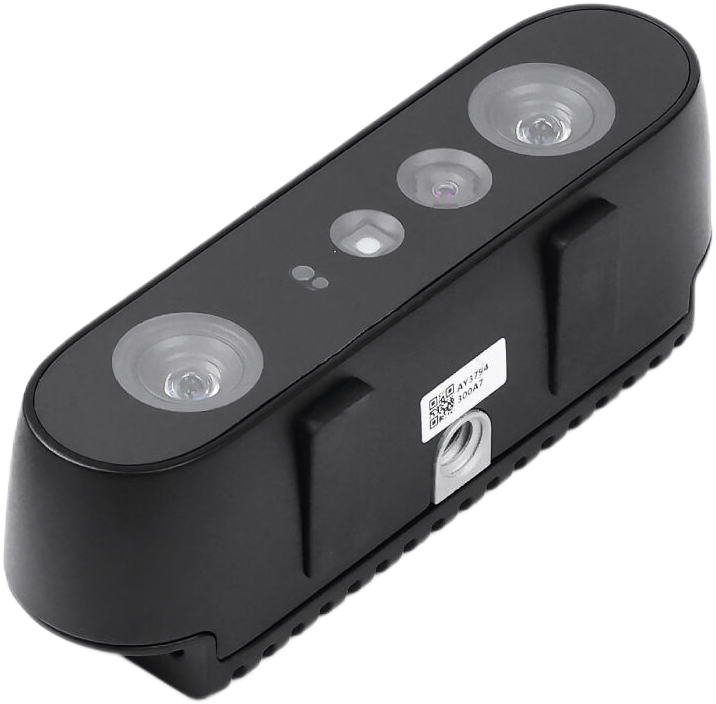
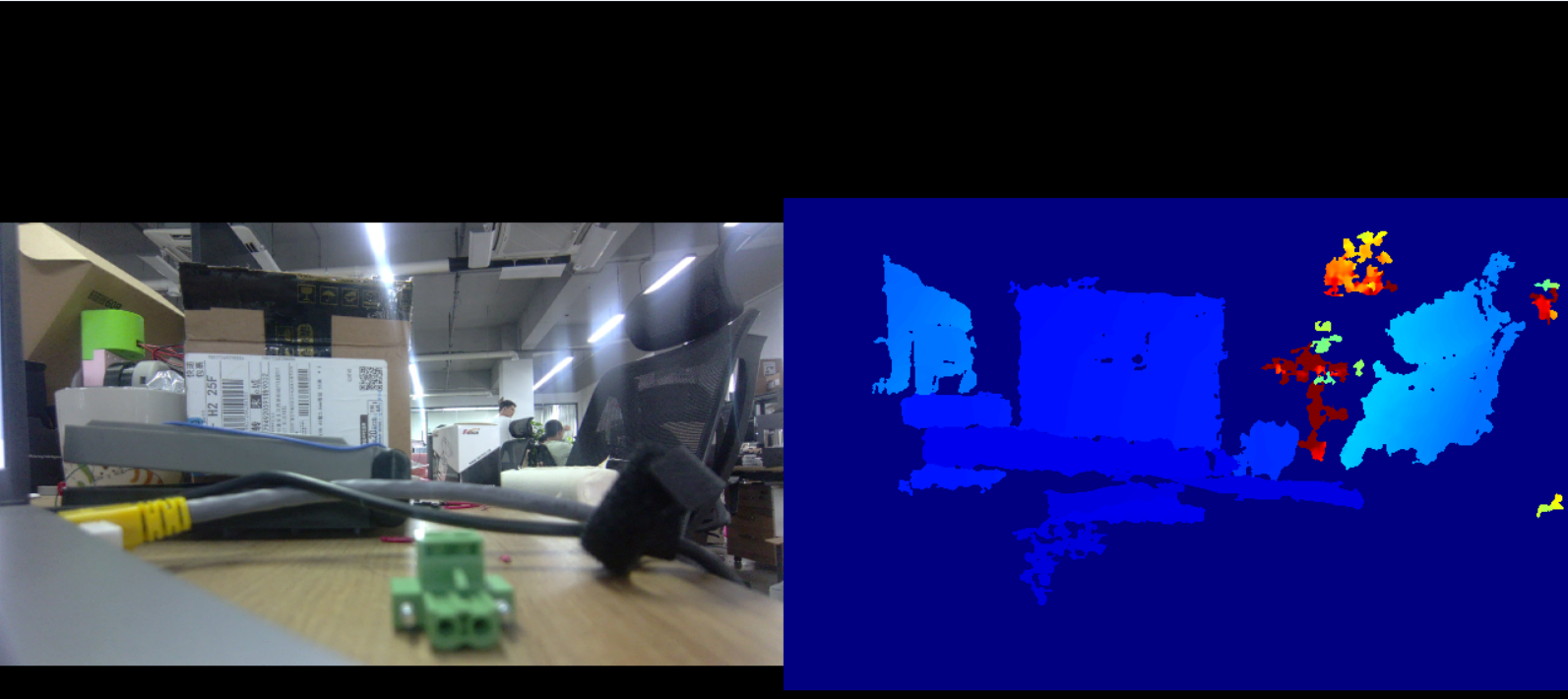
The Orbbec Gemini 2 is a high-performance RGB-D camera featuring a dual-eye structured light depth sensor and an integrated 6-axis IMU. It provides fully synchronized RGB and depth data streams, ensuring precise real-time Depth-to-Color alignment, which is essential for accurate 3D perception. This combination of features makes the Gemini 2 ideal for robotics, computer vision, and other 3D applications, enabling tasks such as object detection, mapping, navigation, and spatial analysis with high reliability and accuracy. The camera is compact, easy to set up, and fully supported by the Orbbec SDK, making it suitable for both research and industrial deployments.
Introduction
ORB-SLAM3 is an advanced visual SLAM algorithm for monocular, stereo, and RGB-D cameras. It uses ORB features for robust tracking and mapping, supports loop closure and relocalization, and delivers high accuracy and efficiency for robotics, AR/VR, and autonomous navigation.The steps below build ORB-SLAM3 on reComputer against the Orbbec SDK and Pangolin, patch the C++ clock calls, calibrate the Gemini 2, and launch the RGB-D mode.
Prerequisites
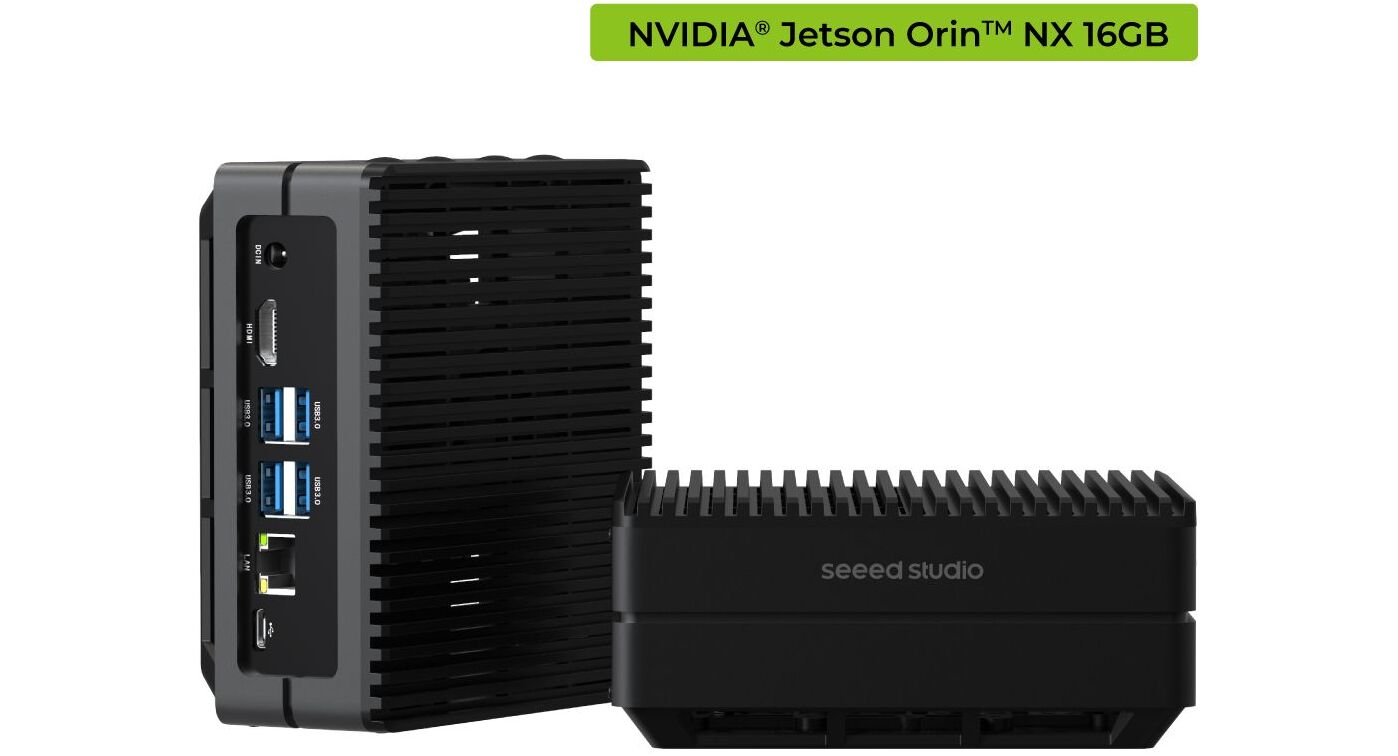
- reComputer J30/40 preinstalled Jetpack 6.2
- Orbbec Gemini2 3D Camera
- ROS2 Humble environment installed
Install Orbbec SDK
Step 1. Download and install the Orbbec SDK for ARM64 architecture:
# Download Orbbec SDK
wget https://github.com/orbbec/OrbbecSDK_v2/releases/download/v2.4.11/OrbbecSDK_v2.4.11_202508040936_058db73_linux_aarch64.zip

# Unzip the SDK
unzip OrbbecSDK_v2.4.11_202508040936_058db73_linux_aarch64.zip
Step 2. Build examples and test:
# Install udev rules
cd OrbbecSDK_v2.4.11_202508040936_058db73_linux_aarch64/shared/
sudo chmod +x ./install_udev_rules.sh
sudo ./install_udev_rules.sh
sudo udevadm control --reload-rules && sudo udevadm trigger
# Build examples and setup
cd ..
./build_examples.sh
./setup.sh
Building ORB-SLAM3
Step 1. Install System Dependencies:
sudo apt update && sudo apt install -y \
    cmake build-essential libeigen3-dev libopencv-dev \
    libglew-dev libpython2.7-dev ffmpeg libavcodec-dev \
    libavutil-dev libavformat-dev libswscale-dev \
    libavdevice-dev libdc1394-22-dev libraw1394-dev \
    libjpeg-dev libpng-dev libtiff5-dev libopenexr-dev \
    libepoxy-dev python3-dev libboost-serialization-dev
Step 2. Install Pangolin which is required for ORB-SLAM3 visualization:
git clone --recursive https://github.com/stevenlovegrove/Pangolin.git
cd Pangolin
git submodule update --init --recursive

# Install prerequisites
./scripts/install_prerequisites.sh recommended

# Remove conflicting packages and install OpenEXR
sudo apt remove libilmbase-dev -y
sudo apt install libopenexr-dev libimath-dev -y

# Build and install
mkdir build && cd build
cmake ..
make -j$(nproc)
sudo make install
If you encounter OpenEXR-related compilation errors, you may need to modify the source code:
In ./components/pango_image/src/image_io_exr.cpp, replace:
#include <ImfChannelList.h>
#include <ImfFrameBuffer.h>
#include <ImfInputFile.h>
#include <ImfOutputFile.h>
with:
#include <OpenEXR/ImfChannelList.h>
#include <OpenEXR/ImfFrameBuffer.h>
#include <OpenEXR/ImfInputFile.h>
#include <OpenEXR/ImfOutputFile.h>
Step 3. Configuration for compiling ORB-SLAM3
cd ~
git clone https://github.com/UZ-SLAMLab/ORB_SLAM3.git
cd ORB_SLAM3
ORB-SLAM3 may have compatibility issues with newer C++ standards. Fix the monotonic_clock issue:
# Replace monotonic_clock with steady_clock in all source files
find Examples -name "*.cc" -exec sed -i 's/monotonic_clock/steady_clock/g' {} \;
For example, in Examples/Stereo/stereo_euroc.cc:
// Change from:
std::chrono::monotonic_clock::time_point t1 = std::chrono::monotonic_clock::now();

// To:
std::chrono::steady_clock::time_point t1 = std::chrono::steady_clock::now();
Step 4. Test whether Pangolin is installed properly:
./examples/SimpleDisplay/SimpleDisplay
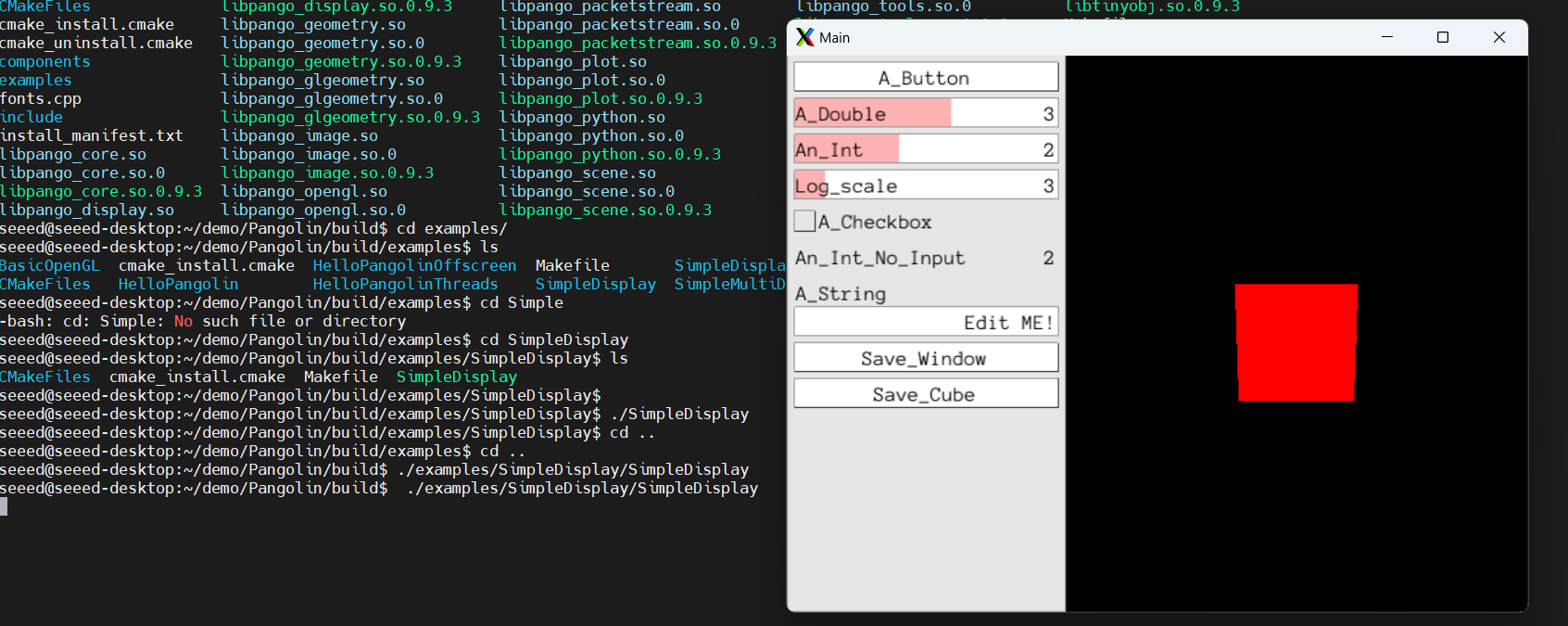
If the installation is done correctly, the window as shown in the above picture can be opened normally.
Step 5. Modify CMakeLists.txt
Modify the CMakeLists.txt file to make the project compatible with the Orbbec SDK.Copy the following complete CMakeList.txt configuration directly:
You need to modify: set(ORBBEC_SDK_PATH "/home/seeed/demo/OrbbecSDK_v2.4.11_202508040936_058db73_linux_aarch64") to the path where you installed your own SDK.
CMakeLists.txt
cmake_minimum_required(VERSION 2.8)
project(ORB_SLAM3)

IF(NOT CMAKE_BUILD_TYPE)
  SET(CMAKE_BUILD_TYPE Release)
ENDIF()

MESSAGE("Build type: " ${CMAKE_BUILD_TYPE})

set(CMAKE_C_FLAGS "${CMAKE_C_FLAGS}  -Wall   -O3")
set(CMAKE_CXX_FLAGS "${CMAKE_CXX_FLAGS} -Wall   -O3")
set(CMAKE_C_FLAGS_RELEASE "${CMAKE_C_FLAGS_RELEASE} -march=native")
set(CMAKE_CXX_FLAGS_RELEASE "${CMAKE_CXX_FLAGS_RELEASE} -march=native")

# Check C++14, C++11 or C++0x support

include(CheckCXXCompilerFlag)
CHECK_CXX_COMPILER_FLAG("-std=c++14" COMPILER_SUPPORTS_CXX14)
CHECK_CXX_COMPILER_FLAG("-std=c++11" COMPILER_SUPPORTS_CXX11)
CHECK_CXX_COMPILER_FLAG("-std=c++0x" COMPILER_SUPPORTS_CXX0X)
if(COMPILER_SUPPORTS_CXX14)
   set(CMAKE_CXX_FLAGS "${CMAKE_CXX_FLAGS} -std=c++14")
   add_definitions(-DCOMPILEDWITHC14)
   message(STATUS "Using flag -std=c++14.")
elseif(COMPILER_SUPPORTS_CXX11)
   set(CMAKE_CXX_FLAGS "${CMAKE_CXX_FLAGS} -std=c++11")
   add_definitions(-DCOMPILEDWITHC11)
   message(STATUS "Using flag -std=c++11.")
elseif(COMPILER_SUPPORTS_CXX0X)
   set(CMAKE_CXX_FLAGS "${CMAKE_CXX_FLAGS} -std=c++0x")
   add_definitions(-DCOMPILEDWITHC0X)
   message(STATUS "Using flag -std=c++0x.")
else()
   message(FATAL_ERROR "The compiler ${CMAKE_CXX_COMPILER} has no C++14/11 support. Please use a different C++ compiler.")
endif()

LIST(APPEND CMAKE_MODULE_PATH ${PROJECT_SOURCE_DIR}/cmake_modules)

find_package(OpenCV 4.4)
   if(NOT OpenCV_FOUND)
      message(FATAL_ERROR "OpenCV > 4.4 not found.")
   endif()

MESSAGE("OPENCV VERSION:")
MESSAGE(${OpenCV_VERSION})

find_package(Eigen3 3.1.0 REQUIRED)
find_package(Pangolin REQUIRED)
find_package(realsense2)

include_directories(
${PROJECT_SOURCE_DIR}
${PROJECT_SOURCE_DIR}/include
${PROJECT_SOURCE_DIR}/include/CameraModels
${PROJECT_SOURCE_DIR}/Thirdparty/Sophus
${EIGEN3_INCLUDE_DIR}
${Pangolin_INCLUDE_DIRS}
)

set(CMAKE_LIBRARY_OUTPUT_DIRECTORY ${PROJECT_SOURCE_DIR}/lib)

add_library(${PROJECT_NAME} SHARED
src/System.cc
src/Tracking.cc
src/LocalMapping.cc
src/LoopClosing.cc
src/ORBextractor.cc
src/ORBmatcher.cc
src/FrameDrawer.cc
src/Converter.cc
src/MapPoint.cc
src/KeyFrame.cc
src/Atlas.cc
src/Map.cc
src/MapDrawer.cc
src/Optimizer.cc
src/Frame.cc
src/KeyFrameDatabase.cc
src/Sim3Solver.cc
src/Viewer.cc
src/ImuTypes.cc
src/G2oTypes.cc
src/CameraModels/Pinhole.cpp
src/CameraModels/KannalaBrandt8.cpp
src/OptimizableTypes.cpp
src/MLPnPsolver.cpp
src/GeometricTools.cc
src/TwoViewReconstruction.cc
src/Config.cc
src/Settings.cc
include/System.h
include/Tracking.h
include/LocalMapping.h
include/LoopClosing.h
include/ORBextractor.h
include/ORBmatcher.h
include/FrameDrawer.h
include/Converter.h
include/MapPoint.h
include/KeyFrame.h
include/Atlas.h
include/Map.h
include/MapDrawer.h
include/Optimizer.h
include/Frame.h
include/KeyFrameDatabase.h
include/Sim3Solver.h
include/Viewer.h
include/ImuTypes.h
include/G2oTypes.h
include/CameraModels/GeometricCamera.h
include/CameraModels/Pinhole.h
include/CameraModels/KannalaBrandt8.h
include/OptimizableTypes.h
include/MLPnPsolver.h
include/GeometricTools.h
include/TwoViewReconstruction.h
include/SerializationUtils.h
include/Config.h
include/Settings.h)

add_subdirectory(Thirdparty/g2o)

target_link_libraries(${PROJECT_NAME}
${OpenCV_LIBS}
${EIGEN3_LIBS}
${Pangolin_LIBRARIES}
${PROJECT_SOURCE_DIR}/Thirdparty/DBoW2/lib/libDBoW2.so
${PROJECT_SOURCE_DIR}/Thirdparty/g2o/lib/libg2o.so
-lboost_serialization
-lcrypto
)

# If RealSense SDK is found the library is added and its examples compiled

if(realsense2_FOUND)
    include_directories(${PROJECT_NAME}
    ${realsense_INCLUDE_DIR}
    )
    target_link_libraries(${PROJECT_NAME}
    ${realsense2_LIBRARY}
    )
endif()

# Check for Orbbec SDK

# Try to find OrbbecSDK in the local directory first

set(ORBBEC_SDK_PATH "/home/seeed/demo/OrbbecSDK_v2.4.11_202508040936_058db73_linux_aarch64")
if(EXISTS ${ORBBEC_SDK_PATH})
    set(ORBBEC_FOUND TRUE)
    set(ORBBEC_INCLUDE_DIRS ${ORBBEC_SDK_PATH}/include)
    set(ORBBEC_LIBRARIES ${ORBBEC_SDK_PATH}/lib/libOrbbecSDK.so)
    message(STATUS "Orbbec SDK found at: ${ORBBEC_SDK_PATH}")
    message(STATUS "Orbbec SDK include dirs: ${ORBBEC_INCLUDE_DIRS}")
    message(STATUS "Orbbec SDK library: ${ORBBEC_LIBRARIES}")
else()
    # Fallback to pkg-config
    find_package(PkgConfig)
    if(PkgConfig_FOUND)
        pkg_check_modules(ORBBEC ob_api)
        if(ORBBEC_FOUND)
            message(STATUS "Orbbec SDK found via pkg-config: ${ORBBEC_VERSION}")
        endif()
    endif()
endif()

if(ORBBEC_FOUND)
    include_directories(${PROJECT_NAME}
    ${ORBBEC_INCLUDE_DIRS}
    )
    target_link_libraries(${PROJECT_NAME}
    ${ORBBEC_LIBRARIES}
    )
else()
    message(WARNING "Orbbec SDK not found. Orbbec examples will not be compiled.")
endif()

# Build examples

# RGB-D examples

set(CMAKE_RUNTIME_OUTPUT_DIRECTORY ${PROJECT_SOURCE_DIR}/Examples/RGB-D)

add_executable(rgbd_tum
        Examples/RGB-D/rgbd_tum.cc)
target_link_libraries(rgbd_tum ${PROJECT_NAME})

if(realsense2_FOUND)
    add_executable(rgbd_realsense_D435i
            Examples/RGB-D/rgbd_realsense_D435i.cc)
    target_link_libraries(rgbd_realsense_D435i ${PROJECT_NAME})
endif()

if(ORBBEC_FOUND)
    add_executable(rgbd_orbbec_gemini2
            Examples/RGB-D/rgbd_orbbec_gemini2_cpp.cc)
    target_link_libraries(rgbd_orbbec_gemini2 ${PROJECT_NAME})
endif()

# RGB-D inertial examples

set(CMAKE_RUNTIME_OUTPUT_DIRECTORY ${PROJECT_SOURCE_DIR}/Examples/RGB-D-Inertial)

if(realsense2_FOUND)
    add_executable(rgbd_inertial_realsense_D435i
            Examples/RGB-D-Inertial/rgbd_inertial_realsense_D435i.cc)
    target_link_libraries(rgbd_inertial_realsense_D435i ${PROJECT_NAME})
endif()

# Stereo examples

set(CMAKE_RUNTIME_OUTPUT_DIRECTORY ${PROJECT_SOURCE_DIR}/Examples/Stereo)

add_executable(stereo_kitti
        Examples/Stereo/stereo_kitti.cc)
target_link_libraries(stereo_kitti ${PROJECT_NAME})

add_executable(stereo_euroc
        Examples/Stereo/stereo_euroc.cc)
target_link_libraries(stereo_euroc ${PROJECT_NAME})

add_executable(stereo_tum_vi
        Examples/Stereo/stereo_tum_vi.cc)
target_link_libraries(stereo_tum_vi ${PROJECT_NAME})

if(realsense2_FOUND)
    add_executable(stereo_realsense_t265
            Examples/Stereo/stereo_realsense_t265.cc)
    target_link_libraries(stereo_realsense_t265 ${PROJECT_NAME})

    add_executable(stereo_realsense_D435i
            Examples/Stereo/stereo_realsense_D435i.cc)
    target_link_libraries(stereo_realsense_D435i ${PROJECT_NAME})
endif()

# Monocular examples

set(CMAKE_RUNTIME_OUTPUT_DIRECTORY ${PROJECT_SOURCE_DIR}/Examples/Monocular)

add_executable(mono_tum
        Examples/Monocular/mono_tum.cc)
target_link_libraries(mono_tum ${PROJECT_NAME})

add_executable(mono_kitti
        Examples/Monocular/mono_kitti.cc)
target_link_libraries(mono_kitti ${PROJECT_NAME})

add_executable(mono_euroc
        Examples/Monocular/mono_euroc.cc)
target_link_libraries(mono_euroc ${PROJECT_NAME})

add_executable(mono_tum_vi
        Examples/Monocular/mono_tum_vi.cc)
target_link_libraries(mono_tum_vi ${PROJECT_NAME})

if(realsense2_FOUND)
    add_executable(mono_realsense_t265
            Examples/Monocular/mono_realsense_t265.cc)
    target_link_libraries(mono_realsense_t265 ${PROJECT_NAME})

    add_executable(mono_realsense_D435i
            Examples/Monocular/mono_realsense_D435i.cc)
    target_link_libraries(mono_realsense_D435i ${PROJECT_NAME})
endif()

# Monocular inertial examples

set(CMAKE_RUNTIME_OUTPUT_DIRECTORY ${PROJECT_SOURCE_DIR}/Examples/Monocular-Inertial)

add_executable(mono_inertial_euroc
        Examples/Monocular-Inertial/mono_inertial_euroc.cc)
target_link_libraries(mono_inertial_euroc ${PROJECT_NAME})

add_executable(mono_inertial_tum_vi
        Examples/Monocular-Inertial/mono_inertial_tum_vi.cc)
target_link_libraries(mono_inertial_tum_vi ${PROJECT_NAME})

if(realsense2_FOUND)
    add_executable(mono_inertial_realsense_t265
            Examples/Monocular-Inertial/mono_inertial_realsense_t265.cc)
    target_link_libraries(mono_inertial_realsense_t265 ${PROJECT_NAME})

    add_executable(mono_inertial_realsense_D435i
            Examples/Monocular-Inertial/mono_inertial_realsense_D435i.cc)
    target_link_libraries(mono_inertial_realsense_D435i ${PROJECT_NAME})
endif()

# Stereo Inertial examples

set(CMAKE_RUNTIME_OUTPUT_DIRECTORY ${PROJECT_SOURCE_DIR}/Examples/Stereo-Inertial)

add_executable(stereo_inertial_euroc
        Examples/Stereo-Inertial/stereo_inertial_euroc.cc)
target_link_libraries(stereo_inertial_euroc ${PROJECT_NAME})

add_executable(stereo_inertial_tum_vi
        Examples/Stereo-Inertial/stereo_inertial_tum_vi.cc)
target_link_libraries(stereo_inertial_tum_vi ${PROJECT_NAME})

if(realsense2_FOUND)
    add_executable(stereo_inertial_realsense_t265
            Examples/Stereo-Inertial/stereo_inertial_realsense_t265.cc)
    target_link_libraries(stereo_inertial_realsense_t265 ${PROJECT_NAME})

    add_executable(stereo_inertial_realsense_D435i
            Examples/Stereo-Inertial/stereo_inertial_realsense_D435i.cc)
    target_link_libraries(stereo_inertial_realsense_D435i ${PROJECT_NAME})
endif()

set(CMAKE_RUNTIME_OUTPUT_DIRECTORY ${PROJECT_SOURCE_DIR}/Examples/Calibration)
if(realsense2_FOUND)
    add_executable(recorder_realsense_D435i
            Examples/Calibration/recorder_realsense_D435i.cc)
    target_link_libraries(recorder_realsense_D435i ${PROJECT_NAME})

    add_executable(recorder_realsense_T265
            Examples/Calibration/recorder_realsense_T265.cc)
    target_link_libraries(recorder_realsense_T265 ${PROJECT_NAME})
endif()

# Old examples - DISABLED to avoid compilation issues

# Uncomment the following lines if you need the old examples

# # RGB-D examples

# set(CMAKE_RUNTIME_OUTPUT_DIRECTORY ${PROJECT_SOURCE_DIR}/Examples_old/RGB-D)

#

# add_executable(rgbd_tum_old

# Examples_old/RGB-D/rgbd_tum.cc)

# target_link_libraries(rgbd_tum_old ${PROJECT_NAME})

#

# if(realsense2_FOUND)

# add_executable(rgbd_realsense_D435i_old

# Examples_old/RGB-D/rgbd_realsense_D435i.cc)

# target_link_libraries(rgbd_realsense_D435i_old ${PROJECT_NAME})

# endif()

#

# # RGB-D inertial examples

# set(CMAKE_RUNTIME_OUTPUT_DIRECTORY ${PROJECT_SOURCE_DIR}/Examples_old/RGB-D-Inertial)

#

# if(realsense2_FOUND)

# add_executable(rgbd_inertial_realsense_D435i_old

# Examples_old/RGB-D-Inertial/rgbd_inertial_realsense_D435i.cc)

# target_link_libraries(rgbd_inertial_realsense_D435i_old ${PROJECT_NAME})

# endif()

#

# #Stereo examples

# set(CMAKE_RUNTIME_OUTPUT_DIRECTORY ${PROJECT_SOURCE_DIR}/Examples_old/Stereo)

#

# add_executable(stereo_kitti_old

# Examples_old/Stereo/stereo_kitti.cc)

# target_link_libraries(stereo_kitti_old ${PROJECT_NAME})

#

# add_executable(stereo_euroc_old

# Examples_old/Stereo/stereo_euroc.cc)

# target_link_libraries(stereo_euroc_old ${PROJECT_NAME})

#

# add_executable(stereo_tum_vi_old

# Examples_old/Stereo/stereo_tum_vi.cc)

# target_link_libraries(stereo_tum_vi_old ${PROJECT_NAME})

#

# if(realsense2_FOUND)

# add_executable(stereo_realsense_t265_old

# Examples_old/Stereo/stereo_realsense_t265.cc)

# target_link_libraries(stereo_realsense_t265_old ${PROJECT_NAME})

#

# add_executable(stereo_realsense_D435i_old

# Examples_old/Stereo/stereo_realsense_D435i.cc)

# target_link_libraries(stereo_realsense_D435i_old ${PROJECT_NAME})

# endif()

#

# #Monocular examples

# set(CMAKE_RUNTIME_OUTPUT_DIRECTORY ${PROJECT_SOURCE_DIR}/Examples_old/Monocular)

#

# add_executable(mono_tum_old

# Examples_old/Monocular/mono_tum.cc)

# target_link_libraries(mono_tum_old ${PROJECT_NAME})

#

# add_executable(mono_kitti_old

# Examples_old/Monocular/mono_kitti.cc)

# target_link_libraries(mono_tum_old ${PROJECT_NAME})

#

# add_executable(mono_euroc_old

# Examples_old/Monocular/mono_euroc.cc)

# target_link_libraries(mono_euroc_old ${PROJECT_NAME})

#

# add_executable(mono_tum_vi_old

# Examples_old/Monocular/mono_tum_vi.cc)

# target_link_libraries(mono_tum_vi_old ${PROJECT_NAME})

#

# if(realsense2_FOUND)

# add_executable(mono_realsense_t265_old

# Examples_old/Monocular/mono_realsense_t265.cc)

# target_link_libraries(mono_realsense_t265_old ${PROJECT_NAME})

#

# add_executable(mono_realsense_D435i_old

# Examples_old/Monocular/mono_realsense_D435i.cc)

# target_link_libraries(mono_realsense_D435i_old ${PROJECT_NAME})

# endif()

#

# #Monocular inertial examples

# set(CMAKE_RUNTIME_OUTPUT_DIRECTORY ${PROJECT_SOURCE_DIR}/Examples_old/Monocular-Inertial)

#

# add_executable(mono_inertial_euroc_old

# Examples_old/Monocular-Inertial/mono_inertial_euroc.cc)

# target_link_libraries(mono_inertial_euroc_old ${PROJECT_NAME})

#

# add_executable(mono_inertial_tum_vi_old

# Examples_old/Monocular-Inertial/mono_inertial_tum_vi.cc)

# target_link_libraries(mono_inertial_tum_vi_old ${PROJECT_NAME})

#

# if(realsense2_FOUND)

# add_executable(mono_inertial_realsense_t265_old

# Examples_old/Monocular-Inertial/mono_inertial_realsense_t265.cc)

# target_link_libraries(mono_inertial_realsense_t265_old ${PROJECT_NAME})

#

# add_executable(mono_inertial_realsense_D435i_old

# Examples_old/Monocular-Inertial/mono_inertial_realsense_D435i.cc)

# target_link_libraries(mono_inertial_realsense_D435i_old ${PROJECT_NAME})

# endif()

#

# #Stereo Inertial examples

# set(CMAKE_RUNTIME_OUTPUT_DIRECTORY ${PROJECT_SOURCE_DIR}/Examples_old/Stereo-Inertial)

#

# add_executable(stereo_inertial_euroc_old

# Examples_old/Stereo-Inertial/stereo_inertial_realsense_t265.cc)

# target_link_libraries(stereo_inertial_realsense_t265_old ${PROJECT_NAME})

#

# add_executable(stereo_inertial_tum_vi_old

# Examples_old/Stereo-Inertial/stereo_inertial_tum_vi.cc)

# target_link_libraries(stereo_inertial_tum_vi_old ${PROJECT_NAME})

#

# if(realsense2_FOUND)

# add_executable(stereo_inertial_realsense_t265_old

# Examples_old/Stereo-Inertial/stereo_inertial_realsense_t265.cc)

# target_link_libraries(stereo_inertial_realsense_t265_old ${PROJECT_NAME})

#

# add_executable(stereo_inertial_realsense_D435i_old

# Examples_old/Stereo-Inertial/stereo_inertial_realsense_D435i.cc)

# target_link_libraries(stereo_inertial_realsense_D435i_old ${PROJECT_NAME})

# endif()
Step 6. Create a script that uses the Orbbec Gemini2 adapter for the ORB-SLAM3 RGB-D mode
Create a file named rgbd_orbbec_gemini2_cpp.cc under the Examples/RGB-D/ directory as follows:
rgbd_orbbec_gemini2_cpp.cc
/**
* This file is part of ORB-SLAM3
*
* Copyright (C) 2017-2021 Carlos Campos, Richard Elvira, Juan J. Gómez Rodríguez, José M.M. Montiel and Juan D. Tardós, University of Zaragoza.
* Copyright (C) 2014-2016 Raúl Mur-Artal, José M.M. Montiel and Juan D. Tardós, University of Zaragoza.
*
* ORB-SLAM3 is free software: you can redistribute it and/or modify it under the terms of the GNU General Public
* License as published by the Free Software Foundation, either version 3 of the License, or
* (at your option) any later version.
*
* ORB-SLAM3 is distributed in the hope that it will be useful, but WITHOUT ANY WARRANTY; without even the
* implied warranty of MERCHANTABILITY or PARTICULAR PURPOSE. See the
* GNU General Public License for more details.
*
* You should have received a copy of the GNU General Public License along with ORB-SLAM3.
* If not, see <http://www.gnu.org/licenses/>.
*/

# include <signal.h>
# include <stdlib.h>
# include <iostream>
# include <algorithm>
# include <fstream>
# include <chrono>
# include <ctime>
# include <sstream>

# include <condition_variable>
# include <mutex>
# include <thread>

# include <opencv2/core/core.hpp>

# include <libobsensor/ObSensor.hpp>
# include <libobsensor/h/ObTypes.h>

# include <System.h>

using namespace std;

bool b_continue_session;

void exit_loop_handler(int s){
    cout << "Finishing session" << endl;
    b_continue_session = false;
}

// Orbbec Gemini 2 camera parameters
const int WIDTH = 640;
const int HEIGHT = 480;
const int FPS = 30;

// Global variables for camera data
cv::Mat imCV, depthCV;
double timestamp_image = -1.0;
bool image_ready = false;
int count_im_buffer = 0;

// Mutex and condition variable for thread synchronization
std::mutex imu_mutex;
std::condition_variable cond_image_rec;

// Orbbec pipeline and config using C++ API
std::shared_ptr<ob::Pipeline> pipeline = nullptr;
std::shared_ptr<ob::Config> config = nullptr;

// Callback function for receiving frames from Orbbec Gemini 2
void orbbec_frame_callback(std::shared_ptr<ob::FrameSet> frameSet) {
    std::unique_lock<std::mutex> lock(imu_mutex);

    if (frameSet == nullptr) {
        return;
    }

    count_im_buffer++;

    // Get current timestamp
    double new_timestamp_image = std::chrono::duration_cast<std::chrono::milliseconds>(
        std::chrono::system_clock::now().time_since_epoch()).count() * 1e-3;

    // Limit frame rate to 15 FPS to reduce processing load
    if (abs(timestamp_image - new_timestamp_image) < 0.067) { // 1/15 = 0.067 seconds
        count_im_buffer--;
        return;
    }

    try {
                    // Process color frame
            auto colorFrame = frameSet->getFrame(OB_FRAME_COLOR);
            if (colorFrame != nullptr) {
                auto videoFrame = colorFrame->as<ob::VideoFrame>();
                uint32_t width = videoFrame->getWidth();
                uint32_t height = videoFrame->getHeight();
                OBFormat format = videoFrame->getFormat();

                // Convert to OpenCV Mat
                if (format == OB_FORMAT_RGB || format == OB_FORMAT_BGR) {
                    uint8_t* data = (uint8_t*)videoFrame->getData();
                    imCV = cv::Mat(height, width, CV_8UC3, data);
                    if (format == OB_FORMAT_RGB) {
                        cv::cvtColor(imCV, imCV, cv::COLOR_RGB2BGR);
                    }

                    // Resize image for better performance (smaller size for faster processing)
                    cv::resize(imCV, imCV, cv::Size(640, 360));

                    // Add small delay to prevent overwhelming the system
                    std::this_thread::sleep_for(std::chrono::milliseconds(10));
                }
            }

        // Process depth frame
        auto depthFrame = frameSet->getFrame(OB_FRAME_DEPTH);
        if (depthFrame != nullptr) {
            auto videoFrame = depthFrame->as<ob::VideoFrame>();
            uint32_t width = videoFrame->getWidth();
            uint32_t height = videoFrame->getHeight();

            uint8_t* data = (uint8_t*)videoFrame->getData();
            // Convert to OpenCV Mat (depth is 16-bit)
            depthCV = cv::Mat(height, width, CV_16U, data);

            // Resize depth image for better performance (smaller size for faster processing)
            cv::resize(depthCV, depthCV, cv::Size(640, 360));
        }

        timestamp_image = new_timestamp_image;
        image_ready = true;

    } catch (const ob::Error& e) {
        std::cerr << "Error processing frames: " << e.what() << std::endl;
    }

    lock.unlock();
    cond_image_rec.notify_all();
}

int main(int argc, char **argv)
{
    if(argc != 3)
    {
        cerr << endl << "Usage: ./rgbd_orbbec_gemini2_cpp path_to_vocabulary path_to_settings" << endl;
        return 1;
    }

    // Check if vocabulary file exists
    if (strcmp(argv[1], "-") == 0) {
        cerr << "Vocabulary file not found." << endl;
        exit(-1);
    }

    // Check if settings file exists
    if (strcmp(argv[2], "-") == 0) {
        cerr << "Settings file not found." << endl;
        exit(-1);
    }

    try {
        // Create pipeline using C++ API
        pipeline = std::make_shared<ob::Pipeline>();
        cout << "✓ Pipeline created successfully" << endl;

        // Get device info
        auto device = pipeline->getDevice();
        if (device) {
            auto deviceInfo = device->getDeviceInfo();
            cout << "✓ Device name: " << deviceInfo->getName() << endl;
            cout << "✓ Device serial: " << deviceInfo->getSerialNumber() << endl;
        }

        // Create config
        config = std::make_shared<ob::Config>();

        // Enable color stream
        config->enableVideoStream(OB_STREAM_COLOR, OB_WIDTH_ANY, OB_HEIGHT_ANY, OB_FPS_ANY, OB_FORMAT_RGB);
        cout << "✓ Color stream enabled" << endl;

        // Enable depth stream
        config->enableVideoStream(OB_STREAM_DEPTH, OB_WIDTH_ANY, OB_HEIGHT_ANY, OB_FPS_ANY, OB_FORMAT_Y16);
        cout << "✓ Depth stream enabled" << endl;

        // Start pipeline with callback
        pipeline->start(config, orbbec_frame_callback);
        cout << "✓ Orbbec Gemini 2 pipeline started successfully!" << endl;

    } catch (const ob::Error& e) {
        cerr << "Failed to initialize Orbbec SDK: " << e.what() << endl;
        return -1;
    } catch (const std::exception& e) {
        cerr << "Exception during initialization: " << e.what() << endl;
        return -1;
    }

    // Create SLAM system
    ORB_SLAM3::System SLAM(argv[1], argv[2], ORB_SLAM3::System::RGBD, true, 0, "");
    float imageScale = SLAM.GetImageScale();

    double timestamp;
    cv::Mat im, depth;

    double t_resize = 0.f;
    double t_track = 0.f;

    cout << "Starting SLAM system..." << endl;

    // Main loop
    while (!SLAM.isShutDown())
    {
        {
            std::unique_lock<std::mutex> lk(imu_mutex);
            if (!image_ready)
                cond_image_rec.wait(lk);

            if (count_im_buffer > 1)
                cout << count_im_buffer - 1 << " dropped frames\n";
            count_im_buffer = 0;

            timestamp = timestamp_image;
            im = imCV.clone();
            depth = depthCV.clone();

            image_ready = false;
        }

        if (imageScale != 1.f)
        {
            int width = im.cols * imageScale;
            int height = im.rows * imageScale;
            cv::resize(im, im, cv::Size(width, height));
            cv::resize(depth, depth, cv::Size(width, height));
        }

        // Pass the image to the SLAM system
        SLAM.TrackRGBD(im, depth, timestamp);
    }

    cout << "System shutdown!" << endl;

    // Cleanup
    if (pipeline) {
        pipeline->stop();
        cout << "✓ Pipeline stopped" << endl;
    }

    return 0;
}
Step 7. Build ORB-SLAM3
chmod +x build.sh
./build.sh
Camera Calibration
Before running ORB-SLAM3, it is necessary to calibrate the Camera to obtain the camera's parameter configuration. Here, we demonstrate using the camera calibration tool provided by ROS to calibrate the camera and obtain its parameters.
Step 1. Install Orbbec ROS2 Driver
mkdir -p ~/ros2_ws/src
cd ~/ros2_ws/src
git clone https://github.com/orbbec/OrbbecSDK_ROS2.git

# Install dependencies
sudo apt install libgflags-dev nlohmann-json3-dev \
    ros-$ROS_DISTRO-image-transport ros-${ROS_DISTRO}-image-transport-plugins \
    ros-${ROS_DISTRO}-compressed-image-transport ros-$ROS_DISTRO-image-publisher \
    ros-$ROS_DISTRO-camera-info-manager ros-$ROS_DISTRO-diagnostic-updater \
    ros-$ROS_DISTRO-diagnostic-msgs ros-$ROS_DISTRO-statistics-msgs \
    ros-$ROS_DISTRO-backward-ros libdw-dev

# Install udev rules
cd ~/ros2_ws/src/OrbbecSDK_ROS2/orbbec_camera/scripts
sudo bash install_udev_rules.sh
sudo udevadm control --reload-rules && sudo udevadm trigger

# Build
cd ~/ros2_ws/
colcon build --event-handlers console_direct+ --cmake-args -DCMAKE_BUILD_TYPE=Release

# Source and launch
source ./install/setup.bash
ros2 launch orbbec_camera gemini2.launch.py
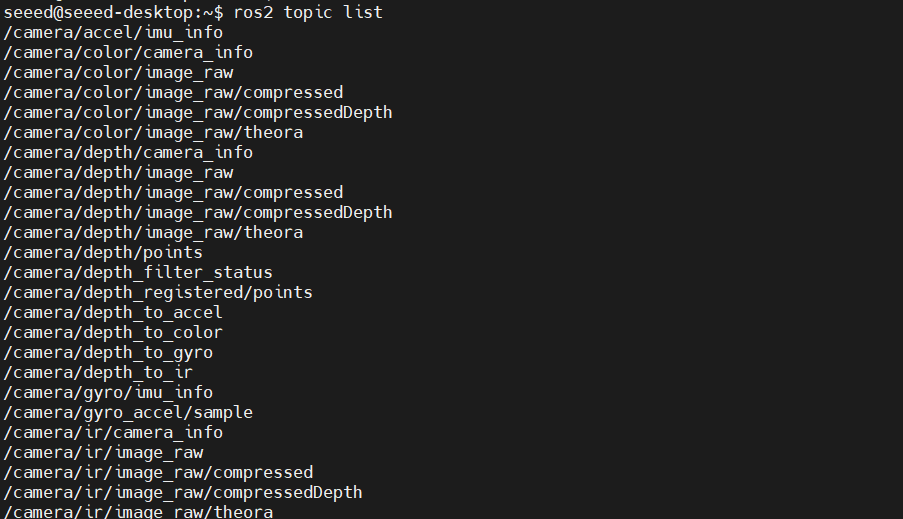
You can check whether the camera node can start normally by observing whether the camera data topic is published normally.
Step 2. Install Camera Calibration Package
sudo apt install ros-humble-camera-calibration
Step 3. Download Calibration Checkerboard
Download the calibration checkerboard from Checkerboard Collection and print it out.
Step 4. Run Camera Calibration
# For 8x6 checkerboard with 25mm squares
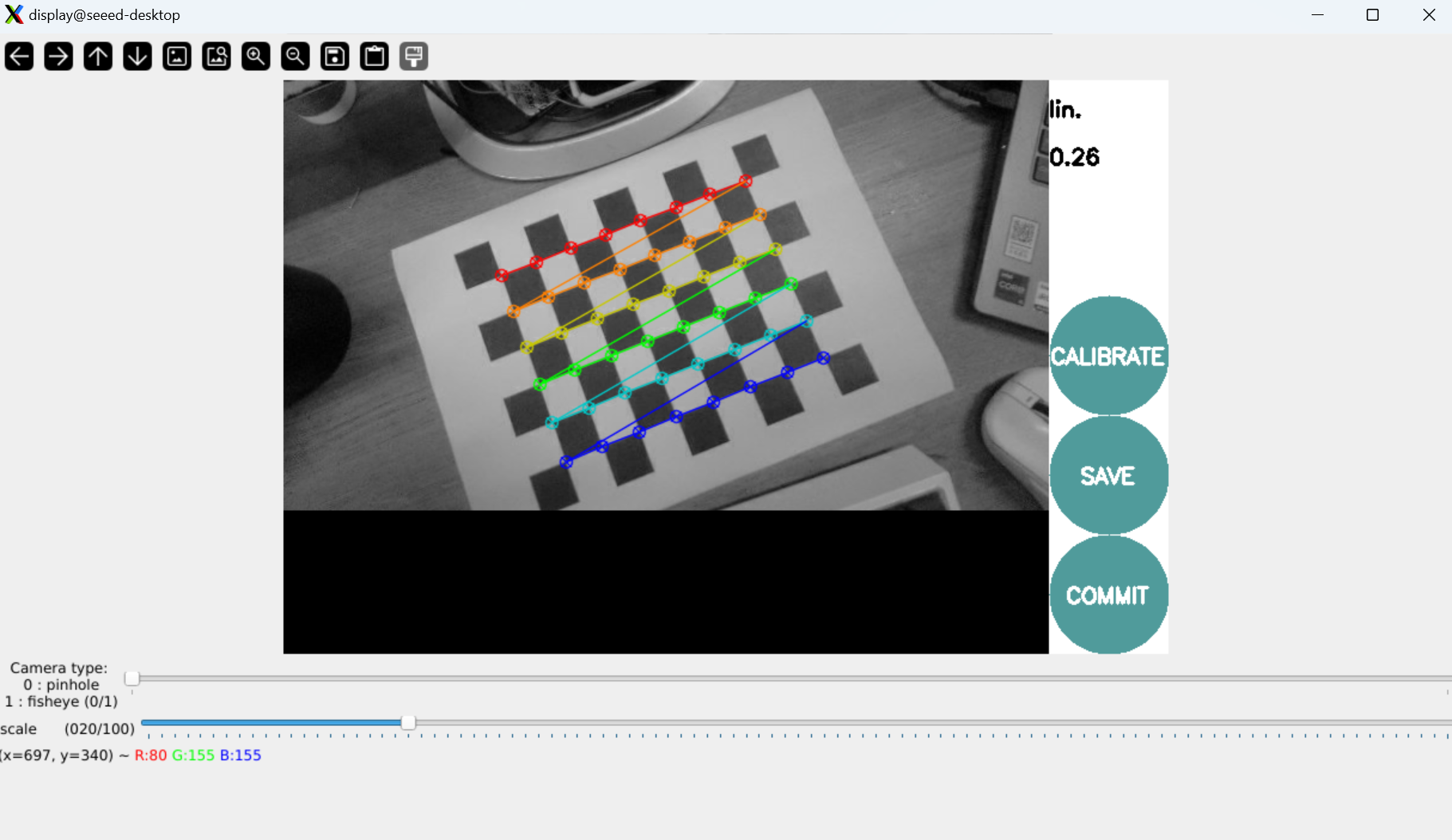
ros2 run camera_calibration cameracalibrator --size 8x6 --square 0.025 \
  --ros-args --remap image:=/camera/color/image_raw --remap camera:=/camera/color
--size 8x6refers to the number of inner corners (8×6 = 48 corners for a 9×7 grid)--square 0.025refers to the square size in meters (25mm)- Move the camera around to capture images from different angles
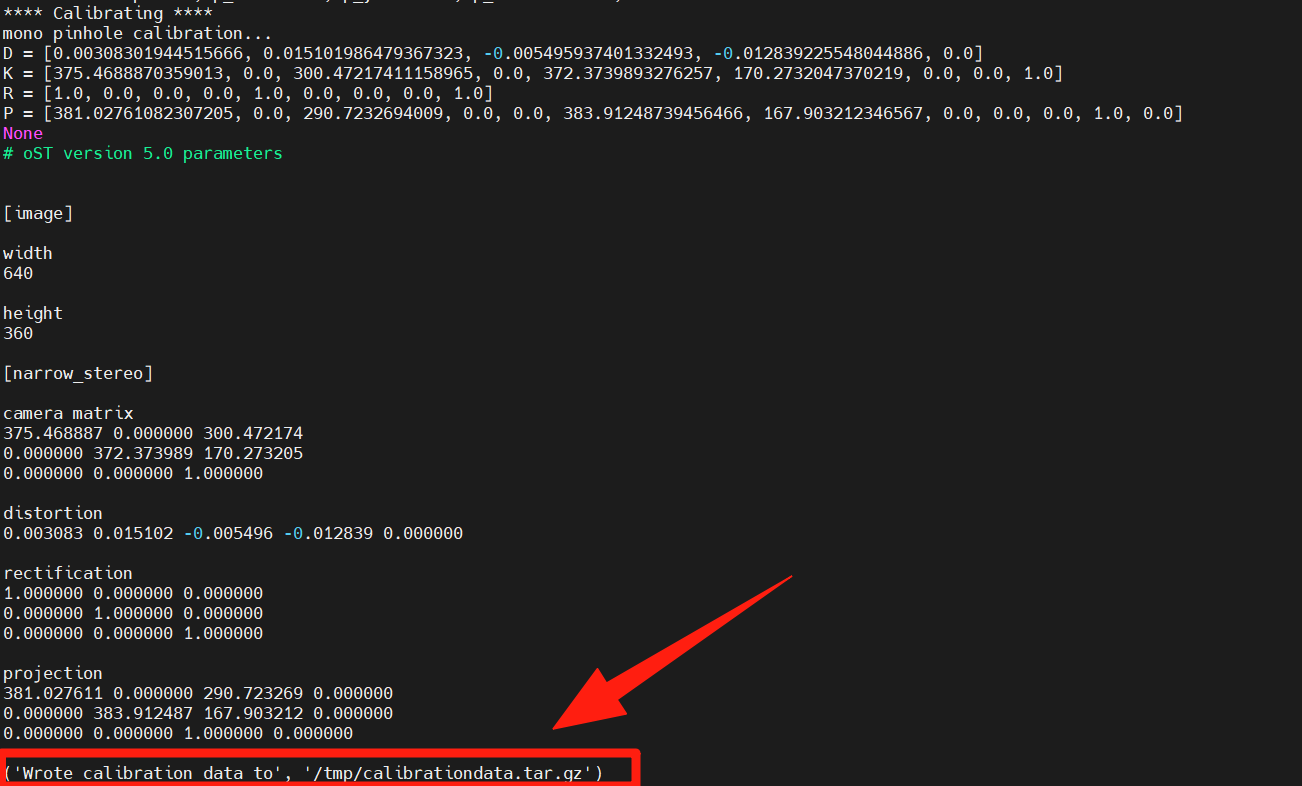
Collect images from different angles, automatically calculate the camera parameters, and save the calibration data in a tooltip.
Step 5. Configure the camera YAML file
Create a parameter configuration.yaml file named Orbbec_Gemini2.yaml for the Orbbec Gemini2 camera under the Examples/RGB-D/folder in your ORB-SLAM3 project.
Orbbec_Gemini2.yaml
%YAML:1.0

# --------------------------------------------------------------------------------------------

# Camera Parameters

# --------------------------------------------------------------------------------------------

File.version: "1.0"

Camera.type: "PinHole"

# Camera calibration and distortion parameters

Camera1.fx: 375.46889
Camera1.fy: 372.37399
Camera1.cx: 300.47217
Camera1.cy: 170.2732

# distortion parameters

Camera1.k1: 0.003083
Camera1.k2: 0.015102
Camera1.p1: -0.005496
Camera1.p2: -0.012839
Camera1.k3: 0.0

# Camera resolution

Camera.width: 640
Camera.height: 360

# Camera frames per second

Camera.fps: 30

# Color order of the images (0: BGR, 1: RGB)

Camera.RGB: 1

# Stereo/Depth 参数(如果是单目,可以不用)

Stereo.ThDepth: 40.0
Stereo.b: 0.0745

# Depth map scale

RGBD.DepthMapFactor: 1000.0

# --------------------------------------------------------------------------------------------

# ORB Parameters

# --------------------------------------------------------------------------------------------

ORBextractor.nFeatures: 800
ORBextractor.scaleFactor: 1.2
ORBextractor.nLevels: 6
ORBextractor.iniThFAST: 20
ORBextractor.minThFAST: 7

# --------------------------------------------------------------------------------------------

# Viewer Parameters

# --------------------------------------------------------------------------------------------

Viewer.KeyFrameSize: 0.05
Viewer.KeyFrameLineWidth: 1.0
Viewer.GraphLineWidth: 0.9
Viewer.PointSize: 2.0
Viewer.CameraSize: 0.08
Viewer.CameraLineWidth: 3.0
Viewer.ViewpointX: 0.0
Viewer.ViewpointY: -0.7
Viewer.ViewpointZ: -3.5
Viewer.ViewpointF: 500.0
Running ORB-SLAM3
# Set Library Path
export LD_LIBRARY_PATH=/usr/local/lib:$LD_LIBRARY_PATH
# Run RGB-D mode slam
./Examples/RGB-D/rgbd_orbbec_gemini2 Vocabulary/ORBvoc.txt Examples/RGB-D/Orbbec_Gemini2.yaml
Resources
FAQ
Which host and JetPack version does this build target? A reComputer from the J30/J40 series (J4012 in the photos) with JetPack 6.2 and ROS 2 Humble, plus an Orbbec Gemini 2. ORB-SLAM3 itself is built from source on that machine, so the JetPack version decides which CUDA and OpenCV you compile against.
Does it run in monocular or RGB-D mode?
RGB-D. The launch command uses Examples/RGB-D/rgbd_orbbec_gemini2 with the Orbbec_Gemini2.yaml parameter file, because the Gemini 2 publishes synchronized colour and depth streams and the depth stream removes the scale ambiguity of monocular SLAM.
Which Orbbec SDK version should I install?
SDK v2.4.11 for aarch64 (OrbbecSDK_v2.4.11_202508040936_058db73_linux_aarch64). The CMakeLists example points at that path, so if you install a different version, update set(ORBBEC_SDK_PATH ...) to match.
The build fails with monotonic_clock errors. What do I change?
The guide replaces std::chrono::monotonic_clock with std::chrono::steady_clock in the ORB-SLAM3 sources and targets C++14 in CMakeLists. Both changes are needed on JetPack 6.2, where the C++ standard library no longer ships monotonic_clock.
Do I have to calibrate the camera before running SLAM?
Yes. Run camera_calibration with the 8×6 / 25 mm checkerboard, save the result, and copy the intrinsics into Examples/RGB-D/Orbbec_Gemini2.yaml. Tracking is unstable with the factory parameters.
Related Resources
- Orbbec Gemini 2 3D camera on ROS 2
- Deploy Depth Anything V3 on Jetson AGX Orin
- PyCuVSLAM on reComputer
- Orbbec Gemini 2 product page
- ORB-SLAM3 repository
Tech Support & Product Discussion
Thank you for choosing our products! We are here to provide you with different support to ensure that your experience with our products is as smooth as possible. We offer several communication channels to cater to different preferences and needs.