Grove - I2C FM Receiver

Grove - I2C FM Receiver é um módulo receptor FM de banda larga, este módulo é baseado no RDA5807M. A série RDA5807M é a mais recente geração de sintonizador de rádio FM estéreo de radiodifusão em chip único com sintetizador totalmente integrado. A série RDA5807M possui um poderoso processador de áudio digital low-IF. O Grove - I2C FM Receiver possui um conector para fones de ouvido, portanto pode ser conectado a fones de ouvido ou áudio.

Versão
| Version | Change | Release date |
|---|---|---|
| Grove - I2C FM Receiver v1.0 | Inicial | 18 de maio de 2017 |
| Grove - I2C FM Receiver v1.1 | Alterar alguns componentes para tornar a placa mais estável | 17 de abril de 2018 |
Recursos
- Interface Grove
- Suporta faixa de frequência mundial: 50 - 115MHz
- Suporta RDS/RBDS
- Menor consumo de energia
- Interface para fones de ouvido
- Controle automático de ganho digital
- Tensão de entrada: 3,3V - 5V
Para mais detalhes sobre os módulos Grove, consulte o Sistema Grove
Plataformas Suportadas
| Arduino | Raspberry Pi | |||
|---|---|---|---|---|
 |  |  |  |  |
As plataformas mencionadas acima como suportadas são uma indicação da compatibilidade de software ou teórica do módulo. Na maioria dos casos, fornecemos apenas biblioteca de software ou exemplos de código para a plataforma Arduino. Não é possível fornecer biblioteca de software / código de demonstração para todas as possíveis plataformas de MCU. Portanto, os usuários precisam escrever sua própria biblioteca de software.
Primeiros Passos
Se esta é a primeira vez que você trabalha com Arduino, recomendamos fortemente que veja Primeiros Passos com Arduino antes de começar.
Brincar com Arduino
Hardware
Materiais necessários
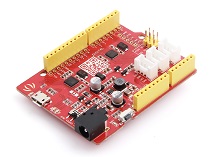
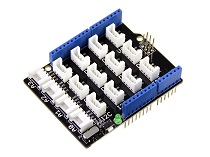
| Seeeduino V4.2 | Base Shield | Grove - I2C FM Receiver v1.1 | Grove - Button x 2 | Grove - Rotary Angle Sensor |
|---|---|---|---|---|
 |  |  |  |  |
| Adquira agora | Adquira agora | Adquira agora | Adquira agora | Adquira agora |
1 Conecte o cabo USB com cuidado, caso contrário você pode danificar a porta. Use o cabo USB com 4 fios internos, o cabo de 2 fios não consegue transferir dados. Se você não tiver certeza sobre o cabo que possui, pode clicar aqui para comprar
2 Cada módulo Grove vem com um cabo Grove quando você o compra. Caso você perca o cabo Grove, pode clicar aqui para comprar
-
Step 1. Conecte o Grove - I2C FM Receiver à porta IIC do Grove-Base Shield.
-
Step 2. Conecte o Grove - Button 1 à porta D2 e conecte o Grove - Button 2 à porta D3.
-
Step 3. Conecte o Grove - Base Shield ao Seeeduino.
-
Step 4. Conecte o Seeeduino ao PC por meio de um cabo USB.

Se não tivermos o Grove Base Shield, também podemos conectar diretamente o Grove - Temperature and Humidity Sensor Pro ao Seeeduino como abaixo.
| Seeeduino | Grove - I2C FM Receiver v1.1 |
|---|---|
| 5V | Vermelho |
| GND | Preto |
| SDA | Branco |
| SCL | Amarelo |
| Seeeduino | Grove - Button 1 |
|---|---|
| 5V | Vermelho |
| GND | Preto |
| Null | Branco |
| D2 | Amarelo |
| Seeeduino | Grove - Button 2 |
|---|---|
| 5V | Vermelho |
| GND | Preto |
| Null | Branco |
| D3 | Amarelo |
| Seeeduino | Grove - Rotary Angle Sensor |
|---|---|
| 5V | Vermelho |
| GND | Preto |
| Null | Branco |
| A0 | Amarelo |
Software
-
Step 1. Baixe a biblioteca Grove-I2C FM Receiver e então instale a biblioteca.
-
Step 2. Consulte How to install library para instalar a biblioteca para Arduino.
-
Step 3. Copie o código a seguir para a sua IDE do Arduino, depois salve e compile.
/*
 * I2C_FM.ino
 * Demo code for the Grove-I2C_FM_Receiver module
 *
 * Copyright (c) 2012 seeed technology inc.
 * Author     : Jack Shao (jacky.shaoxg@gmail.com)
 * Create Time: Jul 2014
 * Change Log :
 *
 * The MIT License (MIT)
 *
 * Permission is hereby granted, free of charge, to any person obtaining a copy
 * of this software and associated documentation files (the "Software"), to deal
 * in the Software without restriction, including without limitation the rights
 * to use, copy, modify, merge, publish, distribute, sublicense, and/or sell
 * copies of the Software, and to permit persons to whom the Software is
 * furnished to do so, subject to the following conditions:
 *
 * The above copyright notice and this permission notice shall be included in
 * all copies or substantial portions of the Software.
 *
 * THE SOFTWARE IS PROVIDED "AS IS", WITHOUT WARRANTY OF ANY KIND, EXPRESS OR
 * IMPLIED, INCLUDING BUT NOT LIMITED TO THE WARRANTIES OF MERCHANTABILITY,
 * FITNESS FOR A PARTICULAR PURPOSE AND NONINFRINGEMENT. IN NO EVENT SHALL THE
 * AUTHORS OR COPYRIGHT HOLDERS BE LIABLE FOR ANY CLAIM, DAMAGES OR OTHER
 * LIABILITY, WHETHER IN AN ACTION OF CONTRACT, TORT OR OTHERWISE, ARISING FROM,
 * OUT OF OR IN CONNECTION WITH THE SOFTWARE OR THE USE OR OTHER DEALINGS IN
 * THE SOFTWARE.
 */
//
/*
 * Modifications to the I2C_FM.ino by Mel Patrick - Wabbit Wanch Design
 * Modified routines for scanning UP or DOWN through the FM band
 * Modified routine to test for signal strength of received station
 * Modified routines to support bass boost and MONO signal
 * RSSI, read it too soon after setting a station and you get a small value
 * so it's better to wait a bit (50ms) and try it. minSignalStrength will
 * skip locking on a station with a weak signal (you could set the MONO bit) to get
 * better reception on these stations.
 */
#include <Arduino.h>
#include <Wire.h>
#include <EEPROM.h>

#define BTNUP          2// used for seeking UP (normally CLOSED push button)
#define VOL_POT        A0// volume POT LOG taper 10K
#define BTNDN          3// used for seeking DOWN (normally CLOSED push button)

uint16_t gChipID = 0;
uint8_t RDA5807P_REGW[10];

#define I2C_ADDR       0x10

#define READ         1
#define WRITE         0

#define ADRW          0x20
#define ADRR          0x21
//

//#define                 _SHARE_CRYSTAL_24MHz_
//#define                 _SHARE_CRYSTAL_12MHz_
#define                 _SHARE_CRYSTAL_32KHz_
//#define                 _FM_STEP_50K_

//5807M,5807FP,5807NN,5807NP
uint8_t RDA5807N_initialization_reg[]={
#if defined(_SHARE_CRYSTAL_24MHz_)
  0xC4, 0x51, //02H:
#elif defined(_SHARE_CRYSTAL_12MHz_)
  0xC4, 0x11, //02H:
#elif defined(_SHARE_CRYSTAL_32KHz_)
  0xC4, 0x01,//change 01 to 05 enables the RDS/RBDS
#else
  0xC0, 0x01,
#endif
  0x00, 0x00,
  0x04, 0x00,
  0xC3, 0xad,  //05h
  0x60, 0x00,
  0x42, 0x12,
  0x00, 0x00,
  0x00, 0x00,
  0x00, 0x00,  //0x0ah
  0x00, 0x00,
  0x00, 0x00,
  0x00, 0x00,
  0x00, 0x00,
  0x00, 0x00,
  0x00, 0x00,  //0x10h
  0x00, 0x19,
  0x2a, 0x11,
  0xB0, 0x42,
  0x2A, 0x11,  //
  0xb8, 0x31,  //0x15h
  0xc0, 0x00,
  0x2a, 0x91,
  0x94, 0x00,
  0x00, 0xa8,
  0xc4, 0x00,  //0x1ah
  0xF7, 0xcF,
  0x12, 0x14,  //0x1ch
  0x80, 0x6F,
  0x46, 0x08,
  0x00, 0x86,  //10000110
  0x06, 0x61,  //0x20H
  0x00, 0x00,
  0x10, 0x9E,
  0x23, 0xC8,
  0x04, 0x06,
  0x0E, 0x1C,  //0x25H     //0x04 0x08
};

int16_t freq = 10110;
uint16_t vol = 1;
//
// added items - Mel
boolean bassBit = true;// bass boost
boolean monoBit = false;// force MONO not stereo
const boolean seekUP = true;
const boolean seekDN = false;
uint8_t minSignalStrength = 36;// anything below this probably set a MONO flag for better reception
uint8_t signalStrength;
long previousMillis = 0;// last time the function was called
long interval = 2000;// interval for the signal level function (2 seconds)
int8_t stationStep = 10;// kHz steps bewteen the stations (North America = 10)
boolean hasVolumePot = true;// flag if you have a POT attached or not
//
void setup()
{
  Wire.begin();
  loadDefaults();// load any defaults from previous radio settings
  Serial.begin(9600);
  Serial.println("Started");
  //=======================
  //rda5807 power on
  RDA5807P_PowerOnReset();
  RDA5807P_SetMute(false);

  //=======================
  pinMode(BTNUP, INPUT_PULLUP);
  pinMode(VOL_POT, INPUT);
  pinMode(BTNDN, INPUT_PULLUP);
  //=======================
  RDA5807P_SetVolumeLevel(vol);// use this if you don't have a POT for volume attached (0-15)
  RDA5807P_SetFreq( freq );
}

void loop()
{
  unsigned long currentMillis = millis();

  if(currentMillis - previousMillis > interval) {
    // save the last time you blinked the LED
    previousMillis = currentMillis;
    showSignalStrength();
  }
  //
  if (digitalRead(BTNUP) == 1)
  {
    delay(100);
    if (digitalRead(BTNUP) == 1)
      fmSeek(seekUP);
    while(digitalRead(BTNUP) == 1);
  }
  if (digitalRead(BTNDN) == 1)
  {
    delay(100);
    if (digitalRead(BTNDN) == 1)
      fmSeek(seekDN);
    while(digitalRead(BTNDN) == 1);
  }
  if (hasVolumePot == true) setVolume();// use this to read the POT
}
//
void setVolume() {
  unsigned int temp_vol;
  temp_vol = analogRead( VOL_POT );
  if (abs(temp_vol - vol)>5)
  {
    if (vol != temp_vol) {// don't bother changing the volume if unless the pot moves
      vol = temp_vol;
      unsigned char hex_vol = map(vol, 0, 1023, 0, 0xf);
      RDA5807P_SetVolumeLevel(hex_vol);
      saveDefaults();// save new volume to EEPROM
    }
  }
}
//
void fmSeek(boolean theDir) {
  int signalStrength;
  if (!theDir) {
    Serial.println("Start seeking down...");
  }
  else
  {
    Serial.println("Start seeking up...");
  }
  do {
    do{
      if (theDir == seekUP) {
        freq += stationStep;
      }
      else
      {
        freq -= stationStep;
      }
      if (freq > 10800) freq = 8800;
      if (freq < 8800) freq = 10800;
      //Serial.println(freq);
    }
    while(!RDA5807P_ValidStop(freq));
    delay(50);
    signalStrength = RDA5807P_GetSigLvl(freq);// max is 63 according to Data sheet, but I've seen more
  }
  while (signalStrength < minSignalStrength);// minimum signal strength, keep looking
  showRadioStation();
  saveDefaults();// save new station selection to EEPROM
}
//
void showRadioStation() {
  Serial.print("Stable Freq:");
  Serial.print(((float)freq)/100.0f);
  Serial.println("MHz");
}
//
void showSignalStrength() {
  signalStrength = RDA5807P_GetSigLvl(freq);// max is 63...as noted
  Serial.print("Signal Strength: ");
  Serial.println(signalStrength);
}

//===========================================================
// FM functions
//===========================================================
unsigned char OperationRDAFM_2w(unsigned char operation, unsigned char *data, int numBytes)
{
  if(operation == READ)
  {
    Wire.requestFrom(I2C_ADDR, numBytes);
    for(int i=0;i<numBytes;i++)
    {
      *data++ = Wire.read();
    }
  }
  else
  {
    Wire.beginTransmission(I2C_ADDR);
    for(int i=0;i<numBytes;i++)
    {
      Wire.write(*data++);
    }
    Wire.endTransmission();
  }
  return 0;
}


/**
 * @brief Reset RDA5807P while power on RDA5807P
 * @author RDA RDA Ri'an Zeng
 * @date 2008-11-05
 * @param void
 * @return void
 * @retval
 */
void  RDA5807P_PowerOnReset(void)
{
  RDA5807P_Intialization();
}

/**
 * @brief RDA5807P power off function
 * @author RDA Ri'an Zeng
 * @date 2008-11-05
 * @param void
 * @return void
 * @retval
 */
void  RDA5807P_PowerOffProc(void)
{
  RDA5807P_REGW[1] &= (~1);
  OperationRDAFM_2w(WRITE, &(RDA5807P_REGW[0]), 2);
}

/**
 * @brief Set RDA5807P into mute mode
 * @author RDA Ri'an Zeng
 * @date 2008-11-05
 * @param bool mute: if mute is true,then set mute; if mute is false,then set no mute
 * @return void
 * @retval
 */
void RDA5807P_SetMute(boolean mute)
{
  if(mute)
    RDA5807P_REGW[0] &=  ~(1<<6);
  else
    RDA5807P_REGW[0] |= 1<<6;
  RDA5807P_REGW[0] |= monoBit<<5;
  RDA5807P_REGW[0] |= bassBit<<4;
  OperationRDAFM_2w(WRITE, &(RDA5807P_REGW[0]), 2);//RDA5807M_REGW
  delay(50);    //Dealy 50 ms
}
//
/*************************************************
 * @brief Set frequency function
 * @author RDA Ri'an Zeng
 * @date 2008-11-05
 * @param int16_t curFreq:frequency value
 * @return void
 * @retval
 ***********************************************/
void RDA5807P_SetFreq(int16_t curFreq)
{
  uint16_t curChan;
  curChan=RDA5807P_FreqToChan(curFreq);

  if((curFreq >= 6500)&&(curFreq < 7600))
  {
    RDA5807P_REGW[3] = 0x0c;
  }
  else if((curFreq >= 7600)&&(curFreq < 10800))
  {
    RDA5807P_REGW[3] = 0x08;// sets the BAND bits (00xx = 87-108, 01xx=76-91, 10xx=76-108, 11xx=65-76
    // for north america this must be set to 10xx for some unknown reason
  }
  //SetNoMute
  RDA5807P_REGW[0] |= 1<<6;
  RDA5807P_REGW[0] |= monoBit<<5;
  RDA5807P_REGW[0] |= bassBit<<4;
  //handleBits();
  RDA5807P_REGW[2]=curChan>>2;
  RDA5807P_REGW[3]=(((curChan&0x0003)<<6)|0x10) | (RDA5807P_REGW[3]&0x0f);    //set tune bit

  OperationRDAFM_2w(WRITE, &(RDA5807P_REGW[0]), 4);
  delay(50);     //Delay five ms
  showRadioStation();
}
//
/**
 * @brief Station judge for auto search
 * @In auto search mode,uses this function to judge the frequency if has a station
 * @author RDA Ri'an Zeng
 * @date 2008-11-05
 * @param int16_t freq:frequency value
 * @return bool: if return true,the frequency has a true station;otherwise doesn't have a station
 * @retval
 */
boolean RDA5807P_ValidStop(int freq)
{
  uint8_t RDA5807P_reg_data[4]={
    0                                                  };
  uint8_t falseStation = 0;
  uint8_t i=0;
  uint16_t curChan;

  if((freq >= 6500)&&(freq < 7600))
  {
    RDA5807P_REGW[3] = 0x0c;
  }
  else if((freq >= 7600)&&(freq < 10800))
  {
    RDA5807P_REGW[3] = 0x08;// sets the BAND bits (00xx = 87-108, 01xx=76-91, 10xx=76-108, 11xx=65-76
    // for north america this must be set to 10xx for some unknown reason
  }
  curChan=RDA5807P_FreqToChan(freq);
  //SetNoMute bit 9 is seek direction (0=seek down, 1=seek up).
  //02H 14
  RDA5807P_REGW[0] |= 1<<6;// reg zero is bits 15 to bit 8 (this shifts to bit 14)
  RDA5807P_REGW[0] |= monoBit<<5;
  RDA5807P_REGW[0] |= bassBit<<4;
  //handleBits();
  RDA5807P_reg_data[0]=RDA5807P_REGW[0];
  RDA5807P_reg_data[1]=RDA5807P_REGW[1];
  RDA5807P_reg_data[2]=curChan>>2;//03H 15:8 CHAN
  RDA5807P_reg_data[3]=(((curChan&0x0003)<<6)|0x10) | (RDA5807P_REGW[3]&0x0f);//
  OperationRDAFM_2w(WRITE,&(RDA5807P_reg_data[0]), 4);

  delay(50);    //Dealy 25 ms

  if (0x5808 == gChipID)
    OperationRDAFM_2w(READ,&(RDA5807P_reg_data[0]), 4); //
  else
  {
    do
    {
      i++;
      if(i>5) return 0;

      delay(30);
      //read REG0A&0B
      OperationRDAFM_2w(READ,&(RDA5807P_reg_data[0]), 4);
    }
    while((RDA5807P_reg_data[0]&0x40)==0);
  }

  //check FM_TRUE
  if((RDA5807P_reg_data[2] &0x01)==0) falseStation=1;//0B 8  FM TRUE

  if(freq==9600) falseStation=1;// North America - if scanning DOWN, the radio will lock on 9600 for some reason!
  delay(50);
  if (falseStation==1)
    return 0;
  else
    return 1;
}

/**
 * @brief Get the signal level(RSSI) of the current frequency
 * @author RDA Ri'an Zeng
 * @date 2008-11-05
 * @param int16_t curf:frequency value
 * @return uint8_t: the signal level(RSSI)
 * @retval
 */
uint8_t RDA5807P_GetSigLvl( int16_t curf )
{
  uint8_t RDA5807P_reg_data[4]={
    0                                                  };
  OperationRDAFM_2w(READ,&(RDA5807P_reg_data[0]), 4);
  delay(50);    //Delay 50 ms
  return  (RDA5807P_reg_data[2]>>1);  /*??rssi*/
}

/**
 * @brief Set FM volume
 * @It has better use the system volume operation to replace this function
 * @author RDA Ri'an Zeng
 * @date 2008-11-05
 * @param uint8_t level: volume value
 * @return void
 * @retval
 */
void RDA5807P_SetVolumeLevel(uint8_t level)
{
  uint8_t RDA5807P_reg_data[8];
  uint8_t i = 0;

  for (i=0;i<8;i++)
    RDA5807P_reg_data[i] = RDA5807P_REGW[i];

  RDA5807P_reg_data[7]=(( RDA5807P_REGW[7] & 0xf0 ) | (level & 0x0f));

  RDA5807P_reg_data[3] &= (~(0x10));//disable tune

  OperationRDAFM_2w(WRITE, &(RDA5807P_reg_data[0]), 8);
  delay(50);    //Dealy 50 ms
}

/**
 * @brief Initialize RDA5807P
 * @author RDA Ri'an Zeng
 * @date 2008-11-05
 * @param void
 * @return bool:if true,the operation is successful;otherwise is failed
 * @retval
 **/
boolean  RDA5807P_Intialization(void)
{
  uint8_t error_ind = 0;
  uint8_t RDA5807P_REGR[10]={
    0x0                                                  };
  uint8_t i = 0;

  RDA5807P_REGW[0] = 0x00;
  RDA5807P_REGW[0] |= monoBit<<5;
  RDA5807P_REGW[0] |= bassBit<<4;
  RDA5807P_REGW[1] = 0x02;

  error_ind = OperationRDAFM_2w(WRITE, (uint8_t *)&RDA5807P_REGW[0], 2);//soft reset
  delay(50);

  error_ind = OperationRDAFM_2w(READ, (uint8_t *)&RDA5807P_REGR[0], 10);
  delay(50);

  gChipID = RDA5807P_REGR[8];
  gChipID = ((gChipID << 8) | RDA5807P_REGR[9]);

  Serial.print("Chip ID: 0x");
  Serial.println(gChipID, HEX);

  for (i=0;i<8;i++) {
    RDA5807P_REGW[i] = RDA5807N_initialization_reg[i];
  }

  error_ind = OperationRDAFM_2w(WRITE, (uint8_t *)&RDA5807N_initialization_reg[0], 2); //power up
  delay(600);
  //Serial.println(sizeof(RDA5807N_initialization_reg));
  error_ind = OperationRDAFM_2w(WRITE, (uint8_t *)&RDA5807N_initialization_reg[0], sizeof(RDA5807N_initialization_reg));

  delay(50);         //Dealy 50 ms

  if (error_ind )
    return 0;
  else
    return 1;
}
//
/**
 * @brief Cover the frequency to channel value
 * @author RDA Ri'an Zeng
 * @date 2008-11-05
 * @param uint16 frequency:covered frequency
 * @return uint16: channel value
 * @retval
 * In the United States, frequency-modulated broadcasting stations operate in a frequency band extending from 87.8 MHz to 108.0 MHz,
 * for a total of 20.2 MHz. It is divided into 101 channels, each 0.2 MHz wide, designated "channel 200" through "channel 300."
 * In actual practice, no one (except the FCC) uses these channel numbers; the frequencies are used instead.
 */
uint16_t RDA5807P_FreqToChan(uint16_t frequency) {
  uint8_t channelSpacing = 10;
  uint16_t channel = 0;

  if((frequency >= 6500)&&(frequency < 7600))
  {
    channel = (frequency - 6500)/channelSpacing;
  }
  else if((frequency >= 7600)&&(frequency < 10800))
  {
    channel = (frequency - 7600)/channelSpacing;
  }
  return (channel);
}
//
void loadDefaults() {
  char myCode[9] = "Grove_FM";
  char myInit[9] = "blank123";
  /*
  * byte map in EEPROM
   * 8, 9 the default frequency for a reboot
   * 10, 11 current preset volume of the radio (used if no pot is attached)
   */
  for (int i=0; i < 8; i++) {
    myInit[i] = EEPROM.read(i);// read out to see if the thing is INITIALIZED
  }
  if (strcmp(myCode, myInit) == 0) {// if this is ZERO (we previously wrote some), then read the values
    freq = epReadINT(8);// read back the INT for frequency from eeprom 8 and 9 (two bytes for an INT)
    if (!hasVolumePot) vol = epReadINT(10);// read back the volume setting but don't use it unless flag is false
  }
  else// we don't have any defaults, so we have to save some first
  {
    for (int i=0; i < 8; i++) {
      EEPROM.write(i, myCode[i]);// write this to EEPROM to show we have it saved
    }
    saveDefaults();// write the current default settings
  }
}
//
void saveDefaults() {
  epWriteINT(8, freq);// write the two bytes for INT for a reboot
  epWriteINT(10, vol);// write the current volume POT setting
}
//
void epWriteINT(int where, int theVal) {
  union uData
  {
    byte stuff[2];
    int f1;// 2 bytes of memory
  }
  u;
  u.f1 = theVal;// copy into the union
  for (int j=0; j < 2; j++) {// now we have to write out 2 bytes of memory
    EEPROM.write(where + j, u.stuff[j]);// write it to EEPROM
  }
}
//
long epReadINT(int where) {
  union uData
  {
    byte stuff[2];
    int f1;// 2 bytes of memory
  }
  u;
  for (int j=0; j < 2; j++) {
    u.stuff[j]=EEPROM.read(where + j);// read back the 2 bytes at this memory location
  }
  return u.f1;
}
//
void epWriteLong(int where, long theVal) {
  union uData
  {
    byte stuff[4];
    long f1;// 4 bytes of memory
  }
  u;
  u.f1 = theVal;// copy into the union
  for (int j=0; j < 4; j++) {// now we have to write out 4 bytes of memory
    EEPROM.write(where + j, u.stuff[j]);// write it to EEPROM
  }
}
//
long epReadLong(int where) {
  union uData
  {
    byte stuff[4];
    long f1;// 4 bytes of memory
  }
  u;
  for (int j=0; j < 4; j++) {
    u.stuff[j]=EEPROM.read(where + j);// read back the 4 bytes to this memory location
  }
  return u.f1;
}
-
Passo 4. Faça o upload da demonstração. Se você não sabe como fazer o upload do código, por favor verifique How to upload code.
-
Passo 5. Abra o Serial Monitor da IDE do Arduino clicando em Tool-> Serial Monitor. Ou pressione as teclas ++ctrl+shift+m++ ao mesmo tempo. Se tudo correr bem, você obterá o resultado.
O resultado deverá ser como:
Started
Chip ID: 0x5808
Stable Freq:102.60MHz
Signal Strength: 46
Signal Strength: 46
Signal Strength: 45
Signal Strength: 45
Signal Strength: 45
Signal Strength: 45
Start seeking down...
Stable Freq:94.00MHz
Signal Strength: 44
Signal Strength: 51
Signal Strength: 51
Signal Strength: 50
Signal Strength: 50
Signal Strength: 51
Agora você pode ouvir a estação de FM, e pode pressionar o Grove- button 1 e o Grove- button 2 para mudar as estações de rádio. E você pode girar o Grove - Rotary Angle Sensor para ajustar o volume.
Divirta-se~
Visualizador de Esquemático Online
Recursos
Suporte Técnico & Discussão de Produto
Obrigado por escolher nossos produtos! Estamos aqui para fornecer a você diferentes formas de suporte para garantir que sua experiência com nossos produtos seja a mais tranquila possível. Oferecemos vários canais de comunicação para atender a diferentes preferências e necessidades.