Exemplos de Consumo de Energia para XIAO nRF54L15 (PlatformIO)
O código de exemplo a seguir foi desenvolvido para PlatformIO, mas também é compatível com o nRF Connect SDK.
Baseado no VS Code, se você quiser usar o caso a seguir no nRF Connect SDK, consulte a conexão fornecida, adicione o arquivo app.overlay e modifique o conteúdo em prj.conf
XIAO nRF54L15 Adicionar arquivo overlay e modificar o arquivo conf.
Bluetooth Conectado
Esta seção detalha as características de consumo de energia do dispositivo enquanto ele está ativamente anunciando como um periférico Bluetooth Low Energy (BLE). O dispositivo implementa um serviço BLE personalizado, permitindo que outros dispositivos centrais se conectem e interajam com ele.
O gráfico a seguir ilustra o perfil típico de consumo de energia quando o dispositivo está anunciando continuamente:
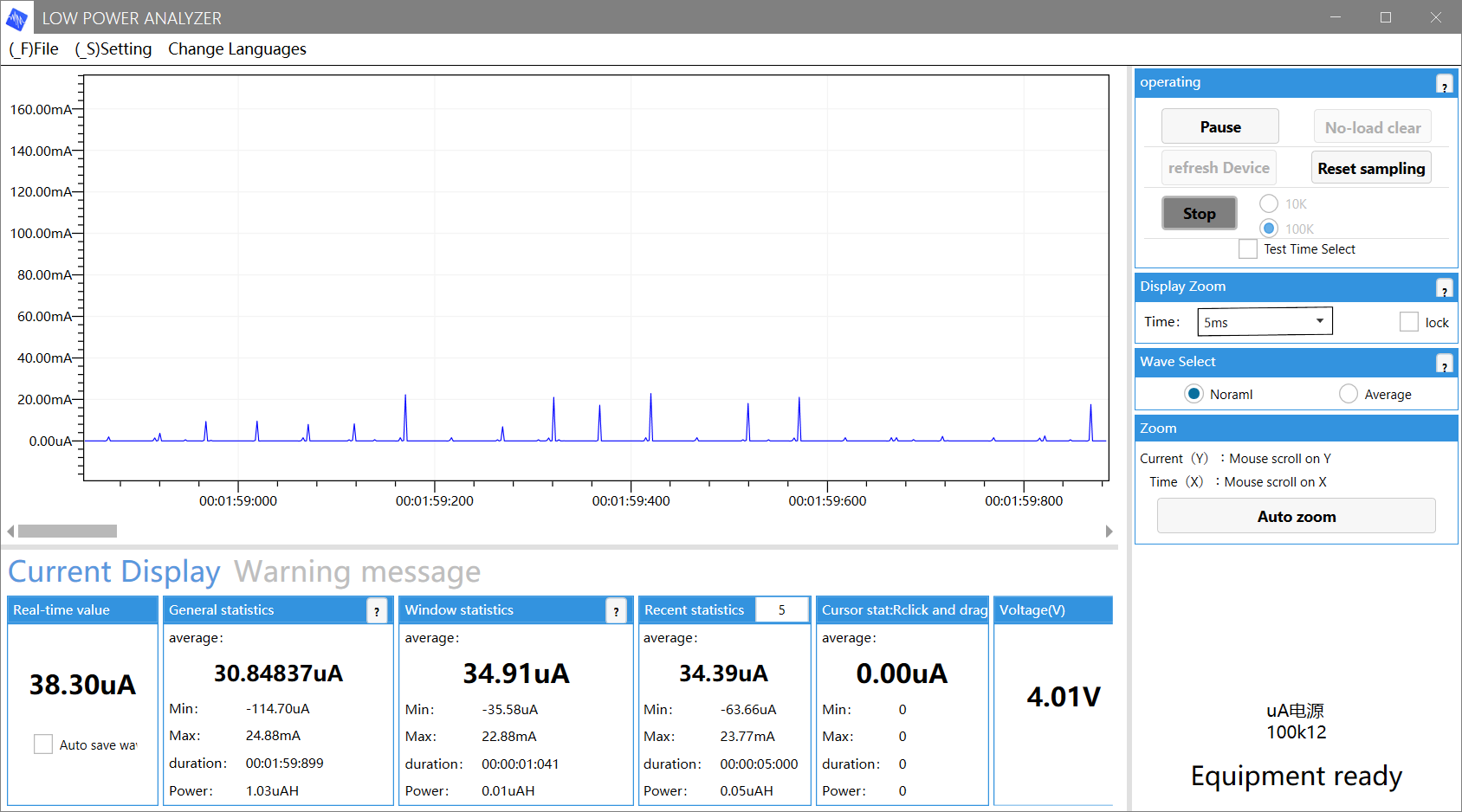
Consumo de Energia do Dispositivo durante o Anúncio BLE
Conforme mostrado no gráfico, o dispositivo exibe picos de corrente periódicos correspondentes a cada evento de anúncio, seguidos por períodos de menor consumo de corrente. O consumo médio de energia durante o anúncio é maior do que no modo System Off, refletindo as operações de rádio ativas necessárias para a transmissão.
Exemplo de Código de Anúncio BLE
Abaixo está o código usado para testar o consumo de energia durante o anúncio BLE:
#include <stdio.h>

#include <zephyr/bluetooth/bluetooth.h>
#include <zephyr/bluetooth/hci.h>
#include <zephyr/bluetooth/conn.h>
#include <zephyr/bluetooth/uuid.h>
#include <zephyr/bluetooth/gatt.h>

// Custom 128-bit UUID for the ONOFF Service
#define BT_UUID_ONOFF_VAL BT_UUID_128_ENCODE(0x8e7f1a23, 0x4b2c, 0x11ee, 0xbe56, 0x0242ac120002)
#define BT_UUID_ONOFF     BT_UUID_DECLARE_128(BT_UUID_ONOFF_VAL)

// Custom 128-bit UUID for the ONOFF Action Characteristic (Write)
#define BT_UUID_ONOFF_ACTION_VAL \
    BT_UUID_128_ENCODE(0x8e7f1a24, 0x4b2c, 0x11ee, 0xbe56, 0x0242ac120002)
#define BT_UUID_ONOFF_ACTION BT_UUID_DECLARE_128(BT_UUID_ONOFF_ACTION_VAL)

// Custom 128-bit UUID for the ONOFF Read Characteristic (Read)
#define BT_UUID_ONOFF_READ_VAL \
    BT_UUID_128_ENCODE(0x8e7f1a25, 0x4b2c, 0x11ee, 0xbe56, 0x0242ac120003)
#define BT_UUID_ONOFF_READ BT_UUID_DECLARE_128(BT_UUID_ONOFF_READ_VAL)

// Static flag to hold the on/off state, initialized to 0 (off)
static uint8_t onoff_flag = 0;

// Advertising data: flags and complete device name
static const struct bt_data ad[] = {
 BT_DATA_BYTES(BT_DATA_FLAGS, (BT_LE_AD_GENERAL | BT_LE_AD_NO_BREDR)), // General Discoverable, No BR/EDR
 BT_DATA(BT_DATA_NAME_COMPLETE, CONFIG_BT_DEVICE_NAME, sizeof(CONFIG_BT_DEVICE_NAME) - 1), // Device Name
};

// Scan response data: include the 128-bit UUID of our custom service
static const struct bt_data sd[] = {
 BT_DATA_BYTES(BT_DATA_UUID128_ALL, BT_UUID_ONOFF_VAL), // Service UUID
};

/**
 * @brief GATT read callback for the ONOFF Read characteristic.
 *
 * This function is called when a connected central device attempts to read
 * the ONOFF Read characteristic. It returns the current value of onoff_flag.
 *
 * @param conn Pointer to the connection object.
 * @param attr Pointer to the GATT attribute being read.
 * @param buf Buffer to store the read value.
 * @param len Maximum length of the buffer.
 * @param offset Offset from which to read the attribute value.
 * @return Number of bytes read, or a negative error code.
 */
static ssize_t read_onoff_val(struct bt_conn *conn, const struct bt_gatt_attr *attr,
                  void *buf, uint16_t len, uint16_t offset)
{
    // The user_data field of the attribute points to onoff_flag
    const uint8_t *value = attr->user_data;
    // Perform the GATT attribute read operation
    return bt_gatt_attr_read(conn, attr, buf, len, offset, value, sizeof(*value));
}

/**
 * @brief GATT write callback for the ONOFF Action characteristic.
 *
 * This function is called when a connected central device attempts to write
 * to the ONOFF Action characteristic. It updates the onoff_flag based on
 * the received value.
 *
 * @param conn Pointer to the connection object.
 * @param attr Pointer to the GATT attribute being written.
 * @param buf Buffer containing the value to be written.
 * @param len Length of the value in the buffer.
 * @param offset Offset at which to write the attribute value.
 * @param flags Flags for the write operation.
 * @return Number of bytes written, or a negative error code.
 */
static ssize_t write_onoff_val(struct bt_conn *conn, const struct bt_gatt_attr *attr,
          const void *buf, uint16_t len, uint16_t offset, uint8_t flags)
{
 uint8_t val;

 // Ensure the length of the written data is 1 byte
 if (len != 1U) {
  return BT_GATT_ERR(BT_ATT_ERR_INVALID_ATTRIBUTE_LEN);
 }

 // Ensure the write operation starts from offset 0
 if (offset != 0) {
  return BT_GATT_ERR(BT_ATT_ERR_INVALID_OFFSET);
 }

 // Get the value from the buffer
 val = *((uint8_t *)buf);

 // Update onoff_flag based on the received value
 if (val == 0x00U) {
  printf("Write: 0\n");
  onoff_flag = 0; // Set to off
 } else if (val == 0x01U) {
  printf("Write: 1\n");
  onoff_flag = 1; // Set to on
 } else {
  // Return error if value is not 0 or 1
  return BT_GATT_ERR(BT_ATT_ERR_VALUE_NOT_ALLOWED);
 }

 return len; // Return number of bytes successfully written
}

// Define the custom GATT service and its characteristics
BT_GATT_SERVICE_DEFINE(lbs_svc,
    BT_GATT_PRIMARY_SERVICE(BT_UUID_ONOFF), // Primary Service: ONOFF Service
    BT_GATT_CHARACTERISTIC(BT_UUID_ONOFF_ACTION, BT_GATT_CHRC_WRITE, // Characteristic: ONOFF Action (Write)
        BT_GATT_PERM_WRITE, NULL, write_onoff_val, NULL), // Permissions, callbacks
    BT_GATT_CHARACTERISTIC(BT_UUID_ONOFF_READ, BT_GATT_CHRC_READ, // Characteristic: ONOFF Read (Read)
        BT_GATT_PERM_READ, read_onoff_val, NULL, &onoff_flag), // Permissions, callbacks, user_data (onoff_flag)
);

/**
 * @brief Callback function for successful Bluetooth connection.
 *
 * @param conn Pointer to the connection object.
 * @param err Error code (0 if successful).
 */
static void connected(struct bt_conn *conn, uint8_t err)
{
 if (err != 0U) {
  printf("Connection failed (%02x, %s)\n", err, bt_hci_err_to_str(err));
  return;
 }

 printf("Connected\n");
}

/**
 * @brief Callback function for Bluetooth disconnection.
 *
 * @param conn Pointer to the connection object.
 * @param reason Reason for disconnection.
 */
static void disconnected(struct bt_conn *conn, uint8_t reason)
{
 printf("Disconnected (%02x, %s)\n", reason, bt_hci_err_to_str(reason));
}

// Define connection callbacks
BT_CONN_CB_DEFINE(conn_callbacks) = {
 .connected = connected,
 .disconnected = disconnected,
};

/**
 * @brief Main function of the application.
 *
 * Initializes the Bluetooth stack, starts advertising, and enters the main loop.
 * @return 0 on success, negative error code on failure.
 */
int main(void)
{
 int err;

 // Enable the Bluetooth stack
 err = bt_enable(NULL);
 if (err < 0) {
  printf("Bluetooth enable failed (err %d)", err);
  return err;
 }

 // Start BLE advertising
 err = bt_le_adv_start(BT_LE_ADV_CONN_FAST_1, ad, ARRAY_SIZE(ad), sd, ARRAY_SIZE(sd));
 if (err < 0) {
  printf("Advertising failed to start (err %d)", err);
  return err;
 }

 printf("Bluetooth enabled");
 return 0;
}
Estado de Ultrabaixo Consumo de Energia
Para atingir um consumo de energia extremamente baixo no dispositivo, realizamos testes de consumo de energia no modo System Off. O modo System Off é um modo de sono profundo fornecido pelo Zephyr OS, onde a maioria dos periféricos e a CPU são desligados, retendo apenas fontes de ativação essenciais (como interrupções GPIO) para minimizar o consumo de energia.
O gráfico a seguir ilustra a curva típica de consumo de energia após o dispositivo entrar no modo System Off:
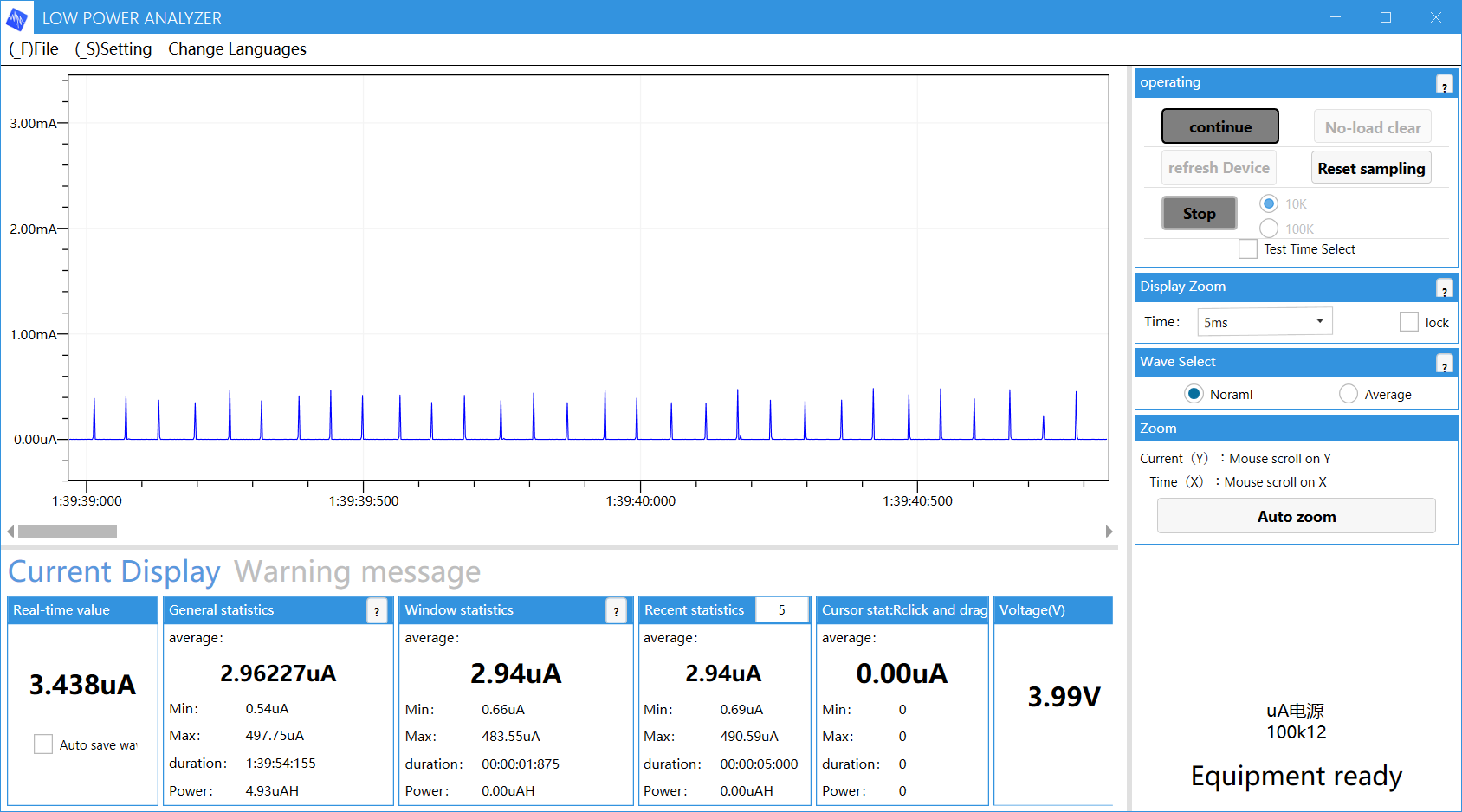
Consumo de Energia do Dispositivo no Modo System Off
Conforme mostrado no gráfico, após entrar no modo System Off, o consumo de energia é significativamente reduzido, mantendo apenas níveis de microamperes, o que estende consideravelmente a vida útil da bateria. Quando o botão sw0 é pressionado, o dispositivo acorda do modo System Off e reinicia.
Exemplo de Código de Consumo de Energia
Abaixo está o código usado para testar o consumo de energia no modo System Off descrito acima:
/*
 * Copyright (c) 2019 Nordic Semiconductor ASA
 *
 * SPDX-License-Identifier: Apache-2.0
 */
#include <inttypes.h>
#include <stdio.h>

#include <zephyr/device.h>
#include <zephyr/drivers/gpio.h>
#include <zephyr/drivers/hwinfo.h>
#include <zephyr/drivers/comparator.h>
#include <zephyr/kernel.h>
#include <zephyr/pm/device.h>
#include <zephyr/sys/poweroff.h>
#include <zephyr/sys/util.h>

static const struct gpio_dt_spec sw0 = GPIO_DT_SPEC_GET(DT_ALIAS(sw0), gpios);

void print_reset_cause(void)
{
 uint32_t reset_cause;

 hwinfo_get_reset_cause(&reset_cause);
 if (reset_cause & RESET_DEBUG) {
  printf("Reset by debugger.\n");
 } else if (reset_cause & RESET_CLOCK) {
  printf("Wakeup from System OFF by GRTC.\n");
 } else  {
  printf("Other wake up cause 0x%08X.\n", reset_cause);
 }
}

int main(void)
{
 int rc;
 const struct device *const cons = DEVICE_DT_GET(DT_CHOSEN(zephyr_console));

 if (!device_is_ready(cons)) {
  printf("%s: device not ready.\n", cons->name);
  return 0;
 }

 printf("\n%s system off demo\n", CONFIG_BOARD);
 print_reset_cause();


 /* configure sw0 as input, interrupt as level active to allow wake-up */
 rc = gpio_pin_configure_dt(&sw0, GPIO_INPUT);
 if (rc < 0) {
  printf("Could not configure sw0 GPIO (%d)\n", rc);
  return 0;
 }

 rc = gpio_pin_interrupt_configure_dt(&sw0, GPIO_INT_LEVEL_LOW);
 if (rc < 0) {
  printf("Could not configure sw0 GPIO interrupt (%d)\n", rc);
  return 0;
 }

 printf("Entering system off; press sw0 to restart\n");


 rc = pm_device_action_run(cons, PM_DEVICE_ACTION_SUSPEND);
 if (rc < 0) {
  printf("Could not suspend console (%d)\n", rc);
  return 0;
 }

 hwinfo_clear_reset_cause();
 sys_poweroff();

 return 0;
}
Suporte Técnico e Discussão sobre Produtos
Obrigado por escolher nossos produtos! Estamos aqui para fornecer diferentes tipos de suporte para garantir que sua experiência com nossos produtos seja a mais tranquila possível. Oferecemos vários canais de comunicação para atender a diferentes preferências e necessidades.