reBot Arm B601-DM ROS2 Integration
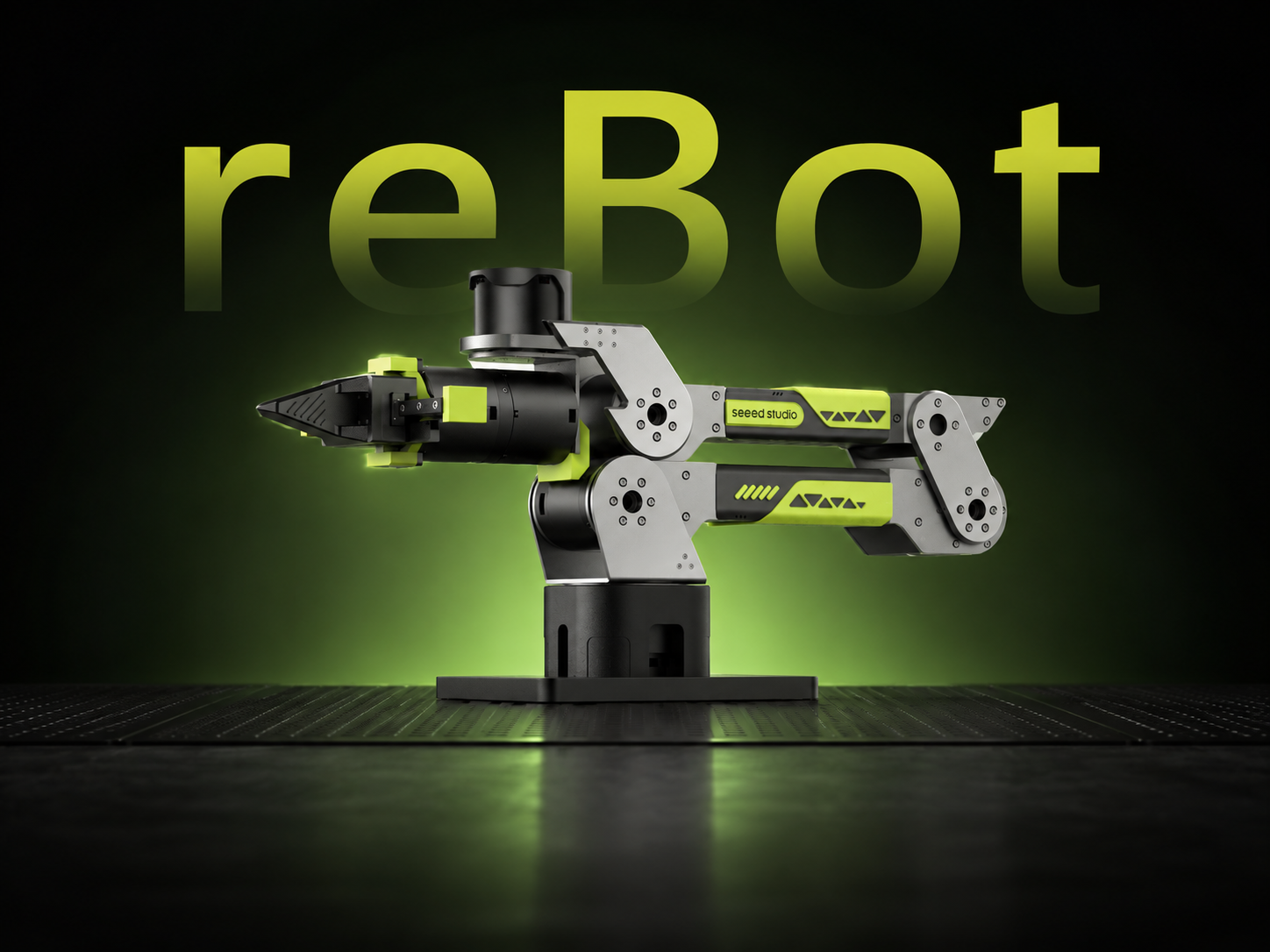





ROS2 Control · RViz Visualization · MoveIt2 Support
This tutorial shows how to run the ROS2 control workspace rebotarm_ros2 for the reBot Arm B601-DM. The workspace wraps the low-level reBotArm_control_py Python SDK into ROS2 topics, services, and actions, making it easier to integrate upper-level planning, visual grasping, RViz visualization, and custom application development.
This tutorial uses Ubuntu 24.04 + ROS2 Jazzy + Python 3.12 as the main reference environment. ROS2 Humble / Ubuntu 22.04 can follow the same workflow with the corresponding ROS2 distribution.
Project Features
-
Standard ROS2 Interfaces
Provides common ROS2 interfaces such as/joint_states,FollowJointTrajectory,GripperCommand, andMoveToPose, making it easier to integrate with MoveIt2, visual grasping pipelines, or task-level systems. -
Ready-to-use Kinematics, Trajectory, and Gravity Compensation Nodes
Provides out-of-the-box forward/inverse kinematics, trajectory execution, gravity compensation, and RViz visualization support. -
MoveIt 2 Integration
Includes complete MoveIt 2 configuration and application demos, supporting the RViz MotionPlanning plugin for simulated planning and real hardware execution.
Specifications
The hardware for this tutorial is provided by Seeed Studio.
| Parameter | Specification |
|---|---|
| Robot Arm Model | reBot Arm B601-DM |
| Degrees of Freedom | 6-DOF + Gripper |
| Motor Version | DAMIAO motor version |
| Communication | CAN Bus via USB2CAN serial bridge |
| Default Serial Port | /dev/ttyACM0 |
| Recommended System | Ubuntu 24.04 + ROS2 Jazzy + Python 3.12 |
| Reference System | Ubuntu 22.04 + ROS2 Humble + Python 3.10 |
Bill of Materials (BOM)
| Component | Quantity | Included |
|---|---|---|
| reBot Arm B601-DM Robotic Arm | 1 | ✅ |
| Gripper | 1 | ✅ |
| USB2CAN Serial Bridge | 1 | ✅ |
| Power Adapter (24V) | 1 | ✅ |
| USB-C / Communication Cable | 1 | ✅ |
| Ubuntu Host PC | 1 | Self-prepared |
Wiring
- Connect the USB2CAN serial bridge to the robot arm CAN bus.
- Connect the 24V power supply and plug the USB2CAN adapter into the host PC.
- Confirm that the host recognizes the serial device:
ls /dev/ttyACM*
If you need to temporarily grant serial port permission:
sudo chmod 666 /dev/ttyACM0
It is recommended to add the current user to the dialout group instead. Log out and log back in for the change to take effect:
sudo usermod -a -G dialout $USER
Environment Requirements
| Item | Recommended Requirement |
|---|---|
| Operating System | Ubuntu 24.04, Ubuntu 22.04 can be used as reference |
| ROS2 | Jazzy, Humble can be used as reference |
| Python | System Python. Jazzy usually uses 3.12, while Humble usually uses 3.10 |
Installation Steps
Step 0. Complete Basic Robot Arm Setup
Before starting the ROS2 integration, please complete the reBot Arm B601-DM Getting Started Guide, including assembly, motor ID configuration, zero-position initialization, and basic connectivity verification.
Step 1. Install the ROS2 Version for Your Ubuntu System
Please refer to the official ROS2 documentation:
If you are using Ubuntu 24.04, you should install ROS 2 Jazzy.
If you are using Ubuntu 22.04, you should install ROS 2 Humble.
Step 2. Install Build Tools and ROS Dependencies
Install colcon, pip, Git, and the ROS packages required by this workspace:
sudo apt update
sudo apt install -y python3-colcon-common-extensions python3-pip git
sudo apt install -y \
  ros-jazzy-control-msgs \
  ros-jazzy-trajectory-msgs \
  ros-jazzy-tf-transformations \
  ros-jazzy-robot-state-publisher \
  ros-jazzy-rviz2 \
  ros-jazzy-pinocchio
Verify the installation:
source /opt/ros/jazzy/setup.bash
python3 -c "import pinocchio; print('pinocchio', pinocchio.__version__)"
If you use ROS2 Humble, replace the ros-jazzy-* package names with ros-humble-* and
source /opt/ros/humble/setup.bash.
Step 3. Clone the Code Repository
Use the Seeed-Projects official repository by default:
git clone https://github.com/Seeed-Projects/reBotArmController_ROS2.git rebotarm_ros2
cd rebotarm_ros2
Step 4. Install motorbridge
Install motorbridge from the official PyPI source:
python3 -m pip install --user --break-system-packages --index-url https://pypi.org/simple motorbridge
Step 5. Get the Low-level SDK
mkdir -p third_party
git clone https://github.com/Seeed-Projects/reBotArm_control_py.git third_party/reBotArm_control_py
Step 6. Build the Workspace
source /opt/ros/jazzy/setup.bash
colcon build --symlink-install
source install/setup.bash
Verify the executable entries:
ros2 pkg executables rebotarmcontroller
Expected entries include:
rebotarmcontroller reBotArmController
rebotarmcontroller GravityCompensation
rebotarmcontroller GripperControl
rebotarmcontroller MoveTo
rebotarmcontroller MoveToPose
Quick Start
Before using the robot, note the following: The arm controller has a high degree of freedom. Before enabling the controller or powering the arm, make sure the workspace is clear of people and obstacles. Review every motion command carefully to avoid accidents. Dangerous operation is strictly prohibited; you are responsible for any consequences.
Start the Full System
The full bringup launches:
reBotArmControllercontrol noderobot_state_publisher- Optional RViz
cd your/path/to/rebotarm_ros2
source install/setup.bash
ros2 launch rebotarm_bringup bringup.launch.py channel:=/dev/ttyACM0  #Do not open the RViz visualization interface when starting communication
Every time you open a new terminal, you need to run the following two commands first
cd your/path/to/rebotarm_ros2
source install/setup.bash
If your serial port is not /dev/ttyACM0, replace it with the actual device name:
ros2 launch rebotarm_bringup bringup.launch.py channel:=/dev/ttyACM1
Start RViz Visualization
ros2 launch rebotarm_bringup bringup.launch.py channel:=/dev/ttyACM0 use_rviz:=true #Open the RViz visualization interface when starting communication
If the model appears too small in RViz, adjust the view from the Views panel on the left:
- Set
Target Frametobase_link - Adjust
Distance, for example to1.0or1.5 - Use the mouse wheel to zoom
- Confirm that
Fixed Frameis set tobase_link
Start Only the Control Node
If URDF and RViz are not needed:
ros2 launch rebotarm_bringup driver.launch.py channel:=/dev/ttyACM0
You can also run the node directly:
ros2 run rebotarmcontroller reBotArmController
Unlike driver.launch.py, which passes configuration files from rebotarm_bringup/config, running the controller directly falls back to the default SDK arm configuration. For normal use, launching through ROS is recommended.
ROS2 Namespace
The default namespace is:
/rebotarm
Therefore, all topics, services, and actions are prefixed with /rebotarm, for example:
/rebotarm/joint_states
/rebotarm/enable
/rebotarm/move_to_pose
If you need multiple robot arms or want to run alongside other ROS2 systems, you can change the namespace at launch time:
ros2 launch rebotarm_bringup bringup.launch.py arm_namespace:=left_arm
In this case, /rebotarm/joint_states becomes /left_arm/joint_states.
Common APIs
Status Topics
| API | Type | Description |
|---|---|---|
/rebotarm/joint_states | sensor_msgs/msg/JointState | 6-axis joint positions, velocities, and efforts |
/rebotarm/arm_status | rebotarm_msgs/msg/ArmStatus | Control mode, enabled state, state machine, and error codes |
/rebotarm/joints/<joint>/state | rebotarm_msgs/msg/JointMotorState | Single-joint motor state |
/rebotarm/gripper/state | rebotarm_msgs/msg/JointMotorState | Gripper motor state |
Examples:
ros2 topic echo /rebotarm/joint_states --once
ros2 topic echo /rebotarm/arm_status --once
Services
| API | Type | Description |
|---|---|---|
/rebotarm/enable | std_srvs/srv/Trigger | Enable the robot arm |
/rebotarm/disable | std_srvs/srv/Trigger | Disable the robot arm |
/rebotarm/safe_home | std_srvs/srv/Trigger | Move back to the safe home position |
/rebotarm/set_mode | rebotarm_msgs/srv/SetMode | Switch between mit, pos_vel, and vel |
/rebotarm/set_zero | rebotarm_msgs/srv/SetZero | Set zero position for all joints or a single joint |
/rebotarm/move_to_pose_ik | rebotarm_msgs/srv/MoveToPoseIK | IK pre-check and target joint solution |
/rebotarm/gripper/set | rebotarm_msgs/srv/SetGripper | Set gripper motor position in rad |
/rebotarm/gravity_compensation/start | std_srvs/srv/Trigger | Start gravity compensation |
/rebotarm/gravity_compensation/stop | std_srvs/srv/Trigger | Stop gravity compensation |
Actions
| API | Type | Description |
|---|---|---|
/rebotarm/move_to_pose | rebotarm_msgs/action/MoveToPose | End-effector pose motion |
/rebotarm/follow_joint_trajectory | control_msgs/action/FollowJointTrajectory | Standard joint trajectory compatible entry point |
/rebotarm/gripper/command | control_msgs/action/GripperCommand | Standard gripper action |
Basic Control Examples
1. Enable the Robot Arm
ros2 service call /rebotarm/enable std_srvs/srv/Trigger
2. Move to an End-effector Pose
ros2 action send_goal /rebotarm/move_to_pose rebotarm_msgs/action/MoveToPose \
  "{target_pose: {position: {x: 0.30, y: 0.0, z: 0.30}, orientation: {x: 0.0, y: 0.0, z: 0.0, w: 1.0}}, duration: 2.0}"
3. Send a Joint Target
ros2 action send_goal /rebotarm/follow_joint_trajectory \
  control_msgs/action/FollowJointTrajectory \
  "{trajectory: {joint_names: ['joint1','joint2','joint3','joint4','joint5','joint6'],
    points: [{positions: [0.1,0,0,0,0,0], time_from_start: {sec: 5}}]}}"
4. Safe Home and Disable
ros2 service call /rebotarm/safe_home std_srvs/srv/Trigger
ros2 service call /rebotarm/disable std_srvs/srv/Trigger
Demo Examples
All examples assume that reBotArmController is already running:
cd your/path/to/rebotarm_ros2
source install/setup.bash
ros2 launch rebotarm_bringup bringup.launch.py channel:=/dev/ttyACM0
Joint Motion Example
Control all 6 joints at once. The unit is rad:
ros2 run rebotarmcontroller MoveTo -- \
  0.20 -0.20 -0.20 -0.20 0.10 -0.10 \
  --duration 8.0
Control only one joint:
ros2 run rebotarmcontroller MoveTo -- --joint joint3 --position -0.20 --duration 5.0
End-effector Pose Example
ros2 run rebotarmcontroller MoveToPose -- --x 0.30 --y 0.0 --z 0.30 --qw 1.0 --duration 2.0
Gravity Compensation Example
ros2 run rebotarmcontroller GravityCompensation
The script first calls /rebotarm/enable, then starts gravity compensation. When you press Ctrl+C, the script calls the following services in order:
/rebotarm/gravity_compensation/stop/rebotarm/safe_home/rebotarm/disable
This stops gravity compensation first, then moves the arm back to the safe home position and disables it.
You can also call the services manually:
ros2 service call /rebotarm/enable std_srvs/srv/Trigger
ros2 service call /rebotarm/gravity_compensation/start std_srvs/srv/Trigger
ros2 service call /rebotarm/gravity_compensation/stop std_srvs/srv/Trigger
ros2 service call /rebotarm/safe_home std_srvs/srv/Trigger
ros2 service call /rebotarm/disable std_srvs/srv/Trigger
Interactive Gripper Example
ros2 run rebotarmcontroller GripperControl
After launch, enter:
o / open    Open the gripper
c / close   Close the gripper
q / quit    Quit
Configuration
Default configuration files are located at:
src/rebotarm_bringup/config/
| File | Description |
|---|---|
arm.yaml | Motor, feedback ID, and control parameters for the 6 arm joints |
gripper.yaml | Gripper motor ID, feedback ID, vendor, and control parameters |
driver_params.yaml | ROS parameter examples |
Common launch parameters:
| Parameter | Default | Description |
|---|---|---|
arm_config | Built-in arm.yaml from bringup | Arm configuration path |
gripper_config | Built-in gripper.yaml from bringup | Gripper configuration path |
channel | Empty string | Use YAML by default. Override the serial port when non-empty |
joint_state_rate | 100.0 | Publish rate of /rebotarm/joint_states |
cmd_arbitration | reject | Low-level command arbitration during arm trajectory execution. reject or preempt; gripper low-level commands do not preempt arm trajectories |
arm_namespace | rebotarm | ROS namespace prefix |
frame_id | base_link | Robot arm base frame |
ee_frame_id | end_link | End-effector frame |
use_rviz | false | Whether to start RViz |
Low-level Command Topics
The ROS2 workspace also provides low-level motor debugging topics:
| API | Type | Description |
|---|---|---|
/rebotarm/joints/<joint>/cmd/mit | rebotarm_msgs/msg/JointMitCmd | Single-joint MIT raw command |
/rebotarm/joints/<joint>/cmd/pos_vel | rebotarm_msgs/msg/JointPosVelCmd | Single-joint position-velocity raw command |
/rebotarm/joints/<joint>/cmd/vel | rebotarm_msgs/msg/JointVelCmd | Single-joint velocity raw command |
/rebotarm/gripper/cmd/mit | rebotarm_msgs/msg/JointMitCmd | Gripper MIT raw command |
/rebotarm/gripper/cmd/pos_vel | rebotarm_msgs/msg/JointPosVelCmd | Gripper position-velocity raw command |
/rebotarm/gripper/cmd/vel | rebotarm_msgs/msg/JointVelCmd | Gripper velocity raw command |
Low-level command topics are intended for debugging and experiments. They do not perform IK, trajectory planning, or URDF limit checks. For application-level motion, prefer services and actions such as /move_to_pose, /follow_joint_trajectory, and /gripper/set.
MoveIt 2
MoveIt 2 is the motion planning framework used here for inverse kinematics, collision checking, trajectory planning and execution. The demos are separated into their own package so application flows stay isolated from the base driver. For more details, see the official MoveIt 2 Documentation.
MoveIt-related content is split into two packages:
| Package | Purpose |
|---|---|
rebotarm_moveit_config | Robot model, SRDF, kinematics, joint limits, controller and RViz config |
rebotarm_moveit_demos | Application demos based on MoveIt 2 |
The MoveIt environment uses simulated hardware through ros2_control and move_group for planning and execution. It is intended for validating the model, IK, trajectory planning and demo flow in RViz.
This repository also supports real hardware. Before connecting real hardware, make sure the arm zero configuration, joint directions, joint limits, velocity limits and gripper range are all correct, or keep the default repository configuration.
MoveIt Environment Setup
Make sure the ROS2 environment is available first. You can install packages for the currently sourced ROS distribution through ROS_DISTRO:
sudo apt update
sudo apt install -y \
  ros-${ROS_DISTRO}-moveit \
  ros-${ROS_DISTRO}-moveit-configs-utils \
  ros-${ROS_DISTRO}-moveit-kinematics \
  ros-${ROS_DISTRO}-moveit-planners-ompl \
  ros-${ROS_DISTRO}-moveit-simple-controller-manager \
  ros-${ROS_DISTRO}-ros2-control \
  ros-${ROS_DISTRO}-ros2-controllers \
  ros-${ROS_DISTRO}-xacro
The MoveIt config and demos are included in this workspace. After installing dependencies, rebuild the workspace:
cd your/path/to/rebotarm_ros2
colcon build --symlink-install
source install/setup.bash
Verify the MoveIt packages and demo entry points:
ros2 pkg list | grep rebotarm_moveit
ros2 pkg executables rebotarm_moveit_demos
Expected entries include:
rebotarm_moveit_demos draw_square
rebotarm_moveit_demos pick_place
Use MoveIt
MoveIt planning can be used through the RViz GUI or through ROS nodes, in both simulation and real scenes.
Use MoveIt in simulation
MoveIt uses the ros2_control virtual hardware interface for RViz simulation:
cd your/path/to/rebotarm_ros2
source install/setup.bash
ros2 launch rebotarm_moveit_config demo.launch.py
By default this starts:
move_grouprobot_state_publisherros2_control_nodejoint_state_broadcasterrebotarm_controllergripper_controller- RViz with the MoveIt MotionPlanning plugin
RViz opens automatically and loads the robot URDF model. You can control motion through the panel on the left side of the GUI.
To run the MoveIt environment without RViz:
ros2 launch rebotarm_moveit_config demo.launch.py use_rviz:=false
Use MoveIt with reBotArm hardware
For the real robot, first start the controller with the hardware interface instead of the virtual controller, then start the hardware MoveIt environment:
ros2 launch rebotarm_bringup driver.launch.py channel:=/dev/ttyACM0
In another terminal:
cd your/path/to/rebotarm_ros2
source install/setup.bash
ros2 launch rebotarm_moveit_config hardware.launch.py
To repeat: before running any demo on real hardware, make sure the workspace is clear of people and obstacles, verify the planned path in RViz, and be ready to stop the controller at any time.
Run the draw-square demo
Start the MoveIt environment first, then run in another terminal:
cd your/path/to/rebotarm_ros2
source install/setup.bash
ros2 launch rebotarm_moveit_demos draw_square.launch.py
draw_square moves gripper_tcp through the four corners of a coplanar rectangle.
Default parameters:
src/rebotarm_moveit_demos/config/draw_square.yaml
Common parameters:
| Parameter | Description |
|---|---|
start_point | Joint reset position before the demo starts |
rectangle_center | Rectangle center in base_link |
rectangle_width / rectangle_height | Rectangle dimensions in meters |
tcp_rpy | TCP orientation, defaulting to a downward-facing gripper |
tcp_yaw_offsets | Alternative IK yaw values used to avoid large joint6 wraps |
Run the pick-place demo
Start the MoveIt environment first, then run in another terminal:
cd your/path/to/rebotarm_ros2
source install/setup.bash
ros2 launch rebotarm_moveit_demos pick_place.launch.py
Default parameters:
src/rebotarm_moveit_demos/config/pick_place.yaml
Common parameters:
| Parameter | Description |
|---|---|
ready_point | Ready joint position used before and after pick/place |
pick_position | Object bottom-center position in base_link |
pick_tcp_rpy / place_tcp_rpy | TCP orientation for pick and place |
object_dimensions | Planning-scene object dimensions in meters |
max_gripper_width | Maximum total gripper opening, default 0.09m |
open_gripper_position / closed_gripper_position | Simulated single-side gripper joint open/close positions |
hardware_open_gripper_position / hardware_closed_gripper_position | Hardware gripper motor open/close positions |
grasp_gripper_to_object_width | Compute the grasp position from object width |
MoveIt configuration files
| File | Description |
|---|---|
rebotarm_moveit_config/config/rebotarm.urdf.xacro | Robot model used by MoveIt |
rebotarm_moveit_config/config/rebotarm.srdf | MoveIt groups, end effector and default states |
rebotarm_moveit_config/config/kinematics.yaml | IK solver configuration |
rebotarm_moveit_config/config/joint_limits.yaml | Joint limits used by MoveIt planning |
rebotarm_moveit_config/config/moveit_controllers.yaml | MoveIt trajectory execution controller config |
rebotarm_moveit_config/config/ros2_controllers.yaml | ros2_control controller config |
rebotarm_moveit_config/config/initial_positions.yaml | Initial joint positions for simulated hardware |
rebotarm_moveit_demos/config/draw_square.yaml | Draw-square demo parameters |
rebotarm_moveit_demos/config/pick_place.yaml | Pick-place demo parameters |
FAQ
1. open serial port /dev/ttyACM0 failed appears at startup
This means the default serial port does not exist or the device name has changed. First check the actual serial device:
ls /dev/ttyACM*
Then specify it with channel:
ros2 launch rebotarm_bringup bringup.launch.py channel:=/dev/ttyACM1
2. Device or resource busy appears at startup
This means the serial port is already occupied by another process. Common causes include a previously launched ROS2 node, an SDK example, or a debugging script that has not exited. Check the processes first:
ps aux | grep -E "reBotArmController|ros2|python"
Stop the process occupying the serial port and restart. The arm and gripper should share the same low-level Controller. Do not open the same serial port separately for the arm and gripper.
3. Permission denied
If the serial device exists but permission is denied:
sudo usermod -a -G dialout $USER
Log out and log back in for the change to take effect. For temporary debugging, you can also run:
sudo chmod 666 /dev/ttyACM0
4. Robot model is not displayed in RViz
Check the following:
- Whether the workspace has been sourced:
source install/setup.bash - Whether
Fixed Frameis set tobase_link - Whether
robot_state_publisherstarted correctly - Whether the URDF mesh path is
package://rebotarm_bringup/description/meshes/...
5. FastDDS SHM port warning appears
If the terminal shows something like:
[RTPS_TRANSPORT_SHM Error] Failed init_port fastrtps_port7002: open_and_lock_file failed
This is usually caused by leftover FastDDS shared-memory lock files after a previous ROS2 process exited abnormally. If services and actions still respond normally, this warning usually does not affect control.
To clean it up, stop the related ROS2 processes first, then run:
pkill -f ros2
pkill -f reBotArmController
rm -f /dev/shm/fastrtps_port*
If you want to temporarily bypass shared memory transport, set the following before launching ROS2:
export FASTDDS_BUILTIN_TRANSPORTS=UDPv4
6. What if I use Humble?
Humble users can follow the same workflow, replace jazzy with humble in the commands, and install the corresponding dependencies according to the Humble official documentation. After switching ROS2 distributions, run colcon build again.
7. pinocchio cannot be found
If a node or verification command reports:
ModuleNotFoundError: No module named 'pinocchio'
First make sure the Pinocchio package for your ROS2 distribution is installed:
sudo apt install -y ros-jazzy-pinocchio
Then make sure the current terminal has sourced the ROS2 environment:
source /opt/ros/jazzy/setup.bash
python3 -c "import pinocchio; print(pinocchio.__version__)"
If it still cannot be found, check whether the current Python search path contains the ROS2 Python package path:
python3 -c "import sys; print('\n'.join(sys.path))"
After sourcing Jazzy, you should see a path similar to
/opt/ros/jazzy/lib/python3.12/site-packages. If you use Humble, replace jazzy with
humble in the commands.
Contact
- Technical Support: Submit an Issue
- Project Repository: Github
- Forum: Seeed Studio Forum