1. Getting to Know Robots and Embodied Intelligence
Chapter 1 of the Seeed Embodied Intelligence Beginner's Course — understand what robots and robotic arms are, degrees of freedom, and the difference between traditional control, imitation learning, and VLA.
1.1 Learning Objectives
1.1 Learning Objectives
After completing this chapter, you should be able to:
- Explain the basic concepts of robots and robotic arms.
- Identify joints, links, degrees of freedom, and end effectors in a robotic arm.
- Understand perception, decision-making, and control in a robot system.
- Distinguish between industrial robotic arms and embodied intelligence robotic arms.
- Distinguish between traditional program control, imitation learning, and VLA.
- Describe the composition of a complete embodied intelligence robotic arm system.
- Understand the role of reBot Arm in the entire embodied intelligence system.
1.2 What Is a Robot?
1.2 What Is a Robot?
A robot is not merely a machine that looks like a human. From a functional perspective, a robot is a system that can:
- Acquire information about itself or its environment;
- Perform computation or decision-making based on goals;
- Change its own state or the surrounding environment through actuators.
A robot system can typically be abstracted as:
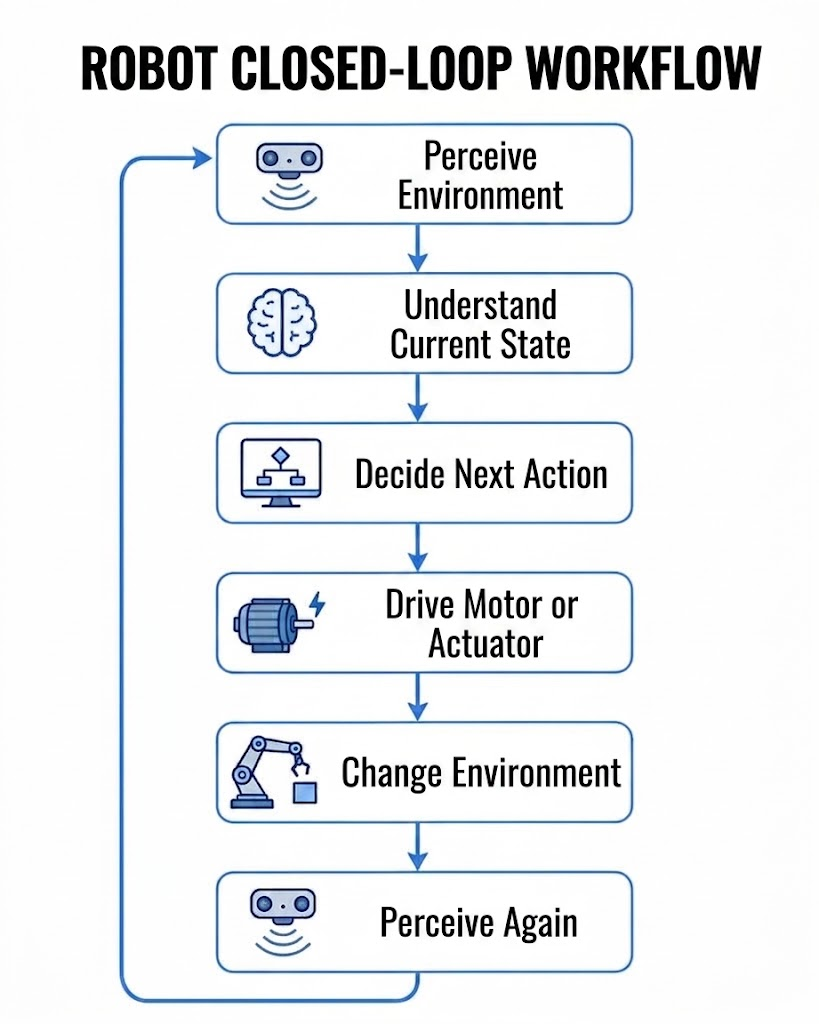
For example, a desktop grasping robot needs to complete the following process:
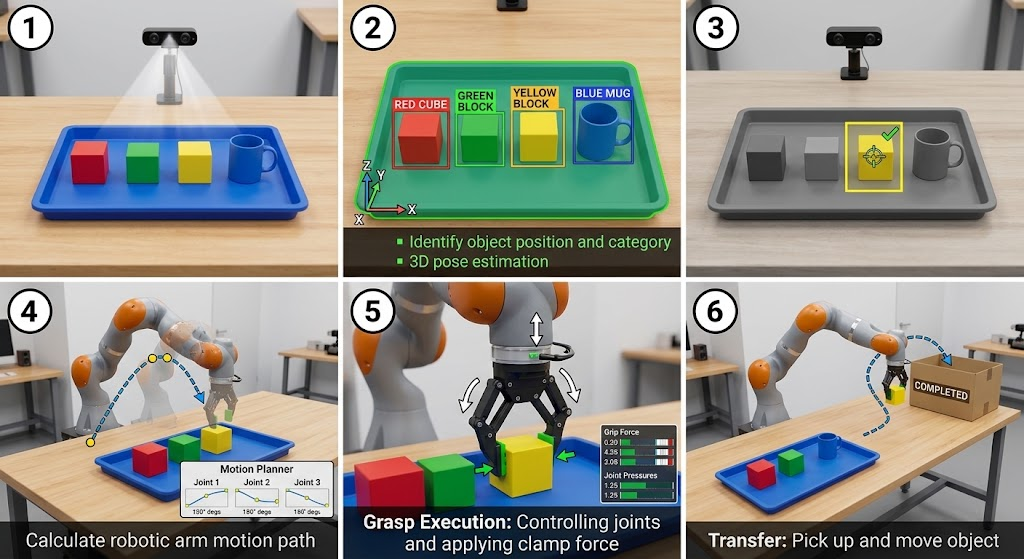
Therefore, a robot not only needs to "be able to move" but also must be able to form a continuously running closed loop.
The Difference Between Robots and Ordinary Machines
Ordinary machines often work in a fixed manner. For example:
- An electric fan keeps rotating after being powered on;
- A conveyor belt runs at a fixed speed;
- An ordinary motor rotates after receiving voltage.
Robots, on the other hand, typically have stronger state perception, program control, and task execution capabilities. For example, a robotic arm can control multiple joints to move to different postures based on different target positions.
1.3 What Is a Robotic Arm?
1.3 What Is a Robotic Arm?
A robotic arm is a robot mechanism composed of multiple joints and links. Through the coordinated motion of multiple joints, it brings the end effector to a specified position and posture, and completes tasks such as grasping, handling, assembly, polishing, and welding.
A robotic arm can be simply understood as:
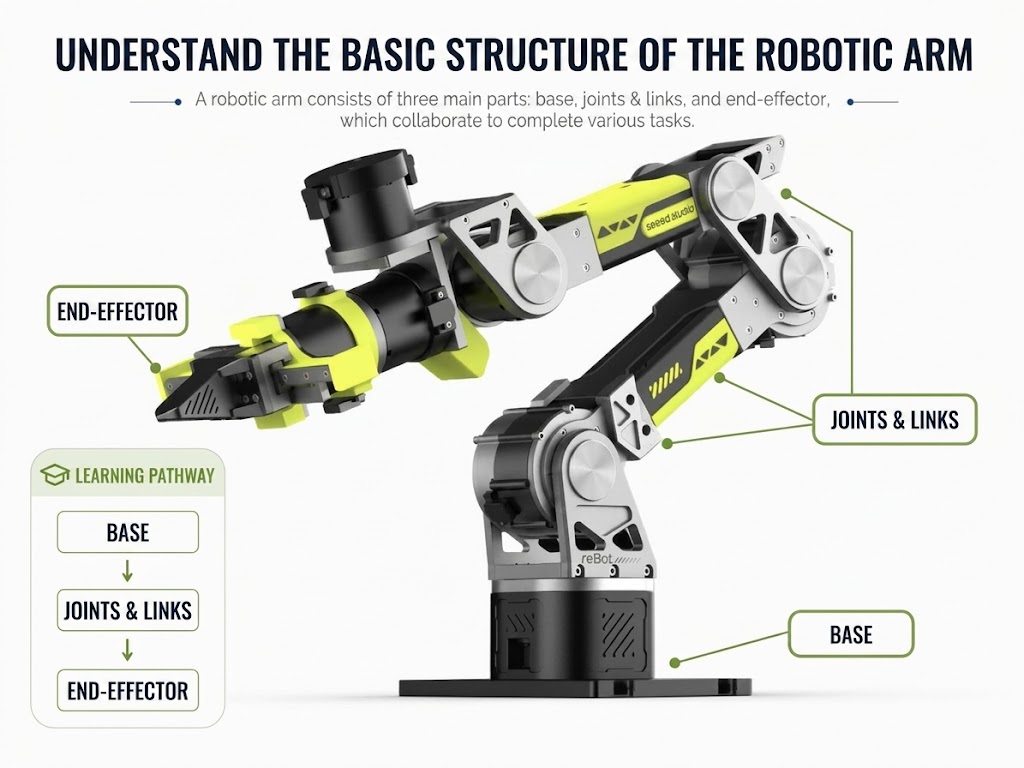
Robotic arms share some similarities with human arms. However, a robotic arm does not necessarily mimic human anatomy. Its number of joints, arrangement, and workspace are designed according to task requirements.
What Are Degrees of Freedom
Degrees of freedom are commonly denoted as DOF (Degree of Freedom). DOF describes the number of independent directions in which a mechanical system can move.
In three-dimensional space, the complete pose of a rigid body includes:
- Translation along the X, Y, and Z axes;
- Rotation about the X, Y, and Z axes.
Therefore, an object in 3D space has at most 6 degrees of freedom.
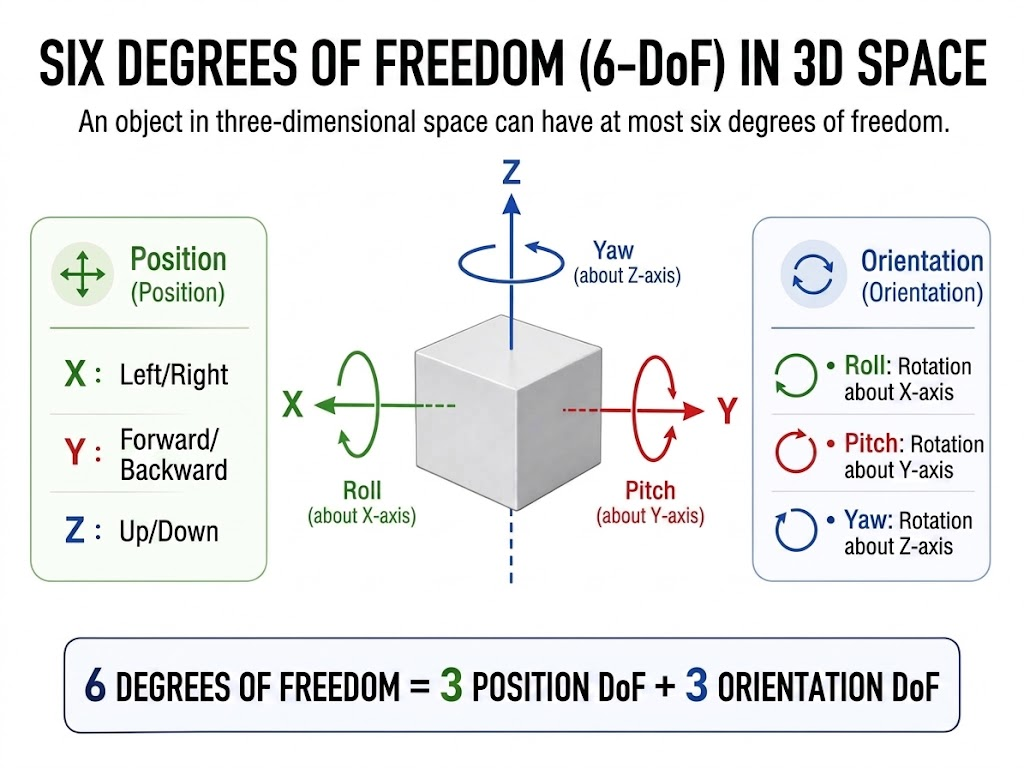
A six-degree-of-freedom robotic arm can typically control the position and posture of the end effector in 3D space.
It should be noted that:
Six degrees of freedom does not mean the robotic arm has only six motors, nor does it mean that all positions and postures can necessarily be reached.
A robotic arm is also affected by factors such as link lengths, joint limits, singularities, and collisions.
1.4 Traditional Control, Imitation Learning, and VLA
1.4 Traditional Control, Imitation Learning, and VLA
A robotic arm can obtain actions through different methods.
Traditional Program Control
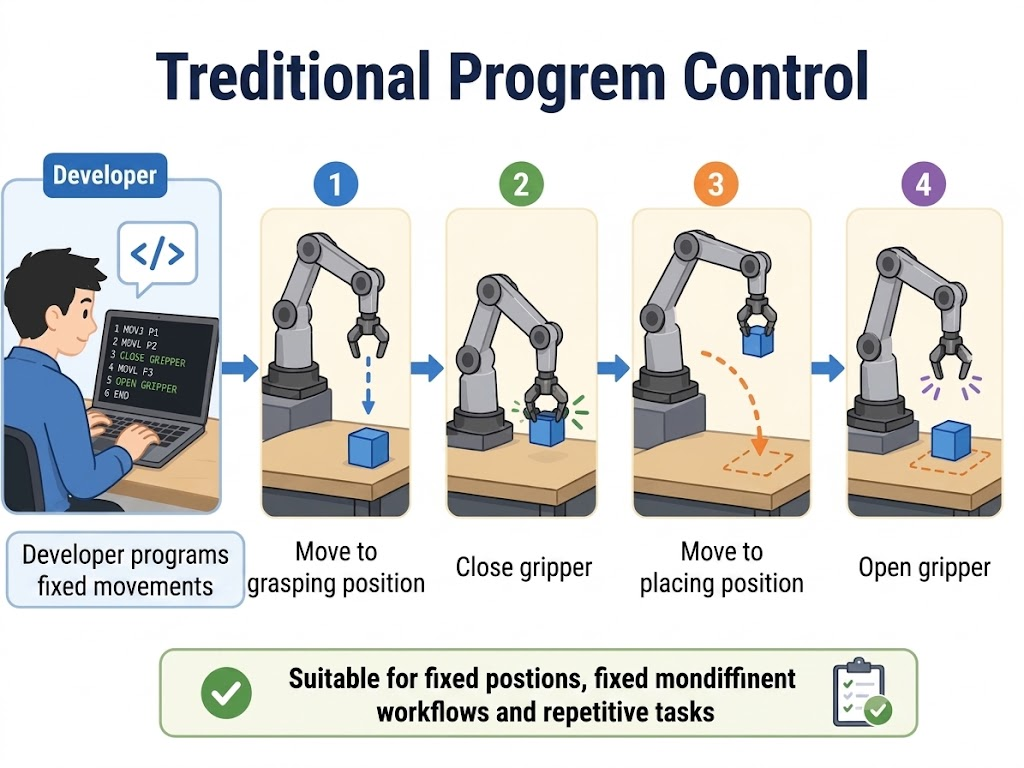
Suitable for fixed positions, fixed workflows, and repetitive tasks.
Imitation Learning
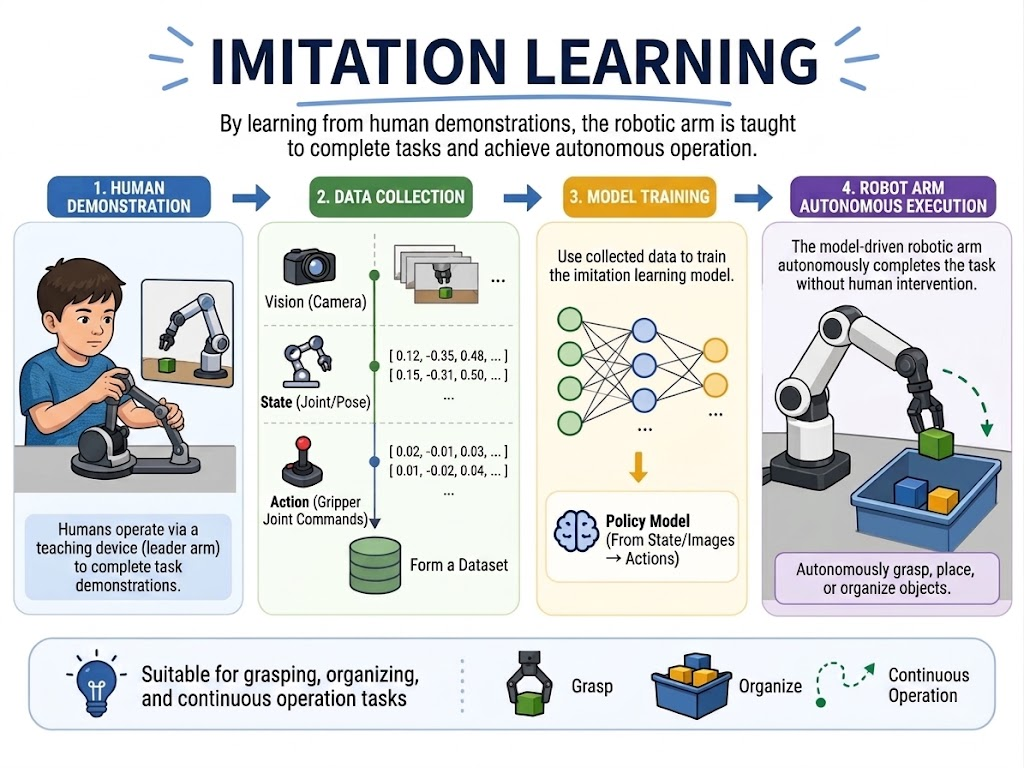
A human first teleoperates the robotic arm to complete a task, and then a model learns from the demonstration data. Suitable for grasping, organizing, and continuous operation tasks.
VLA
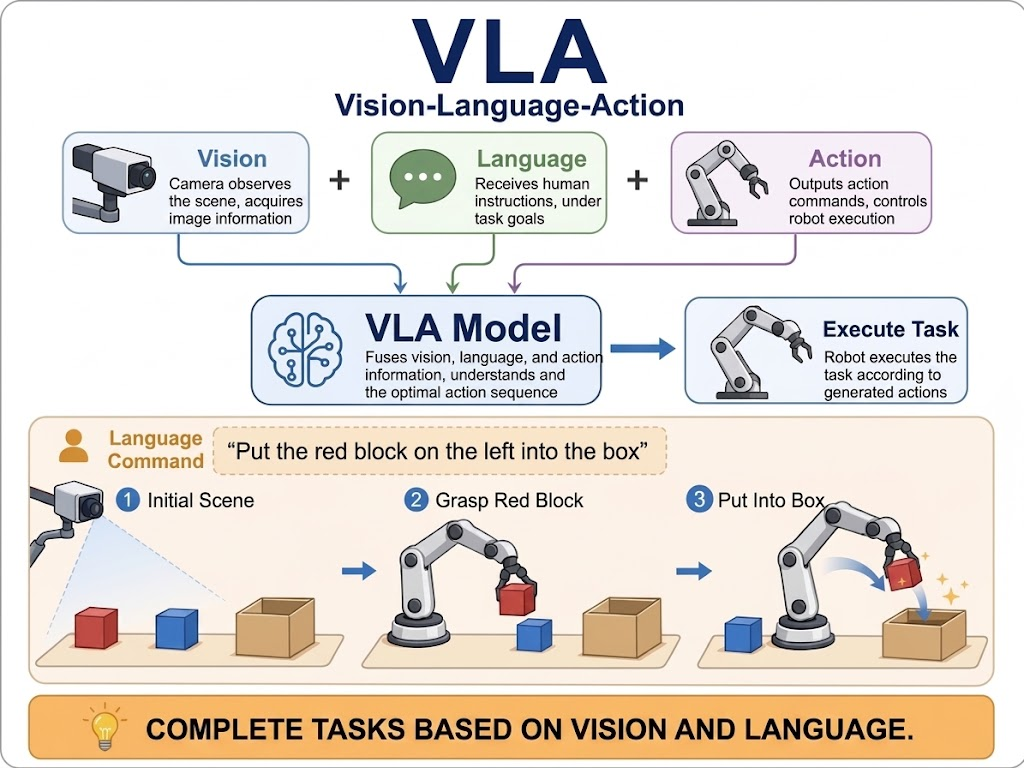
VLA uses visual, language, and action information to enable the robotic arm to complete tasks based on natural language.
For example:
Put the red block on the left into the box.
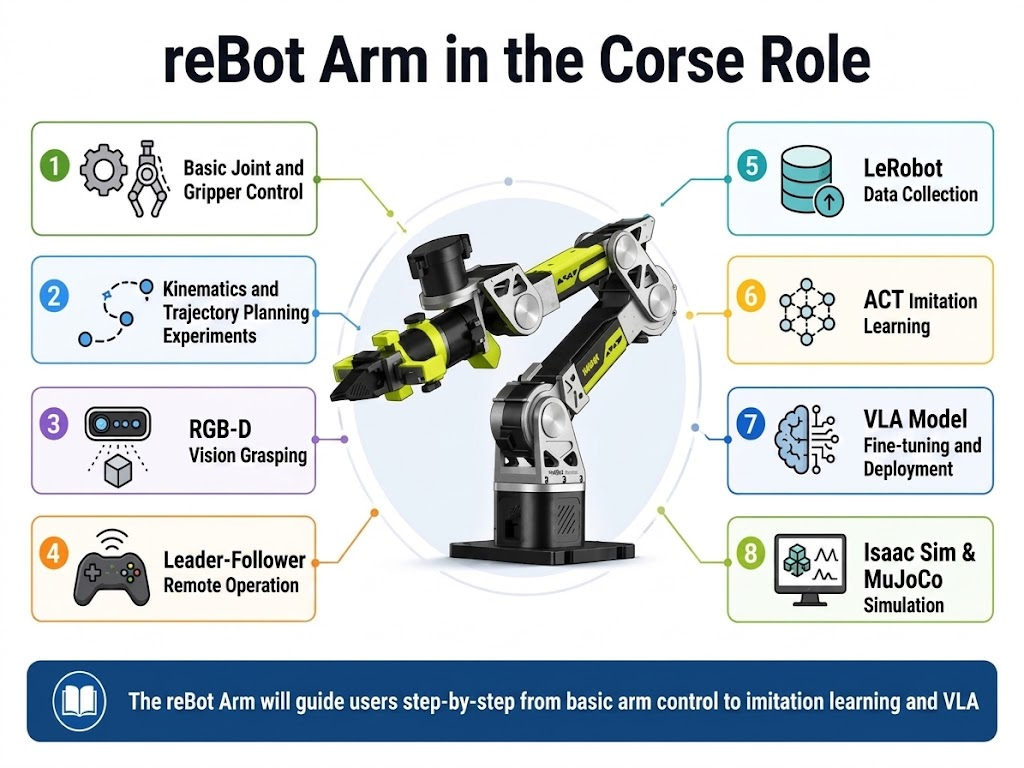
1.5 The Role of reBot Arm in the Course
1.5 The Role of reBot Arm in the Course
reBot Arm is the unified practical platform for the entire course. Later, we will use it to complete: