18. Multimodal Learning and VLA Basics
Chapter 18 of the Seeed Physical AI Beginner's Course — vision/language/action, VLM vs VLA, ACT vs VLA, language-conditioned tasks, single-task vs multi-task vs generalization, continuous actions vs action tokens, and VLA capabilities and limitations.
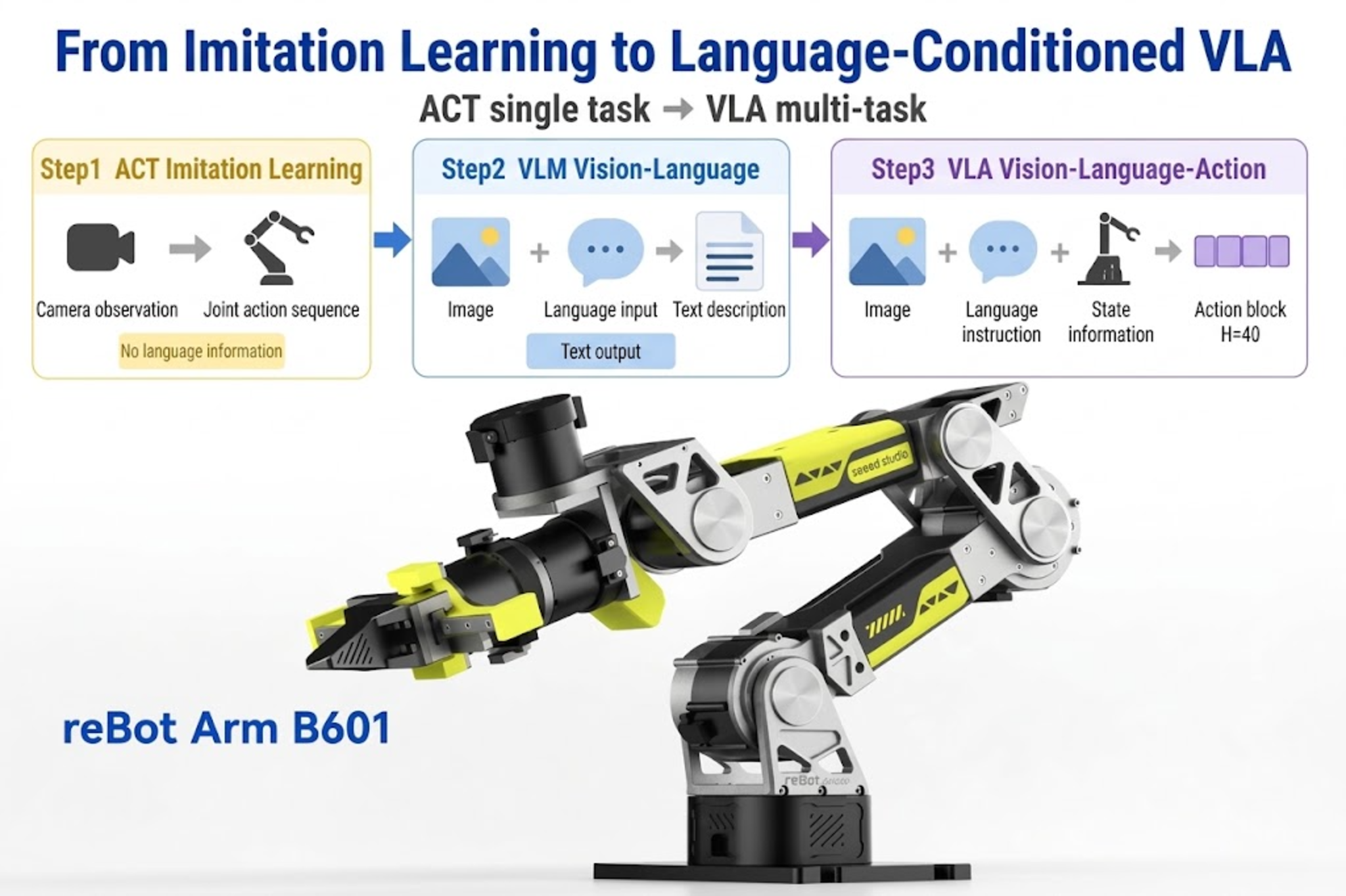
In the previous chapters, you have used policies such as ACT (Action Chunking with Transformers) on the reBot Arm to complete imitation learning that "looks at an image and outputs joint actions." Such methods are usually trained for a single task: the model only learns the single behavior of "putting the red cube into the box," and switching tasks requires recollecting data and retraining.
This chapter introduces the core idea of VLA (Vision-Language-Action): enabling the robot not only to "see" but also to "understand" natural language instructions, and to share one single policy network across multiple tasks.
18.1 Multimodal Models
18.1 What Is a Multimodal Model?
A multimodal model fuses more than one kind of information — images, text, and robot state — into a single unified decision. In the VLA context, the three modalities below are combined and decoded into robot actions.
18.2 Vision, Language, and Action
18.2 Vision, Language, and Action
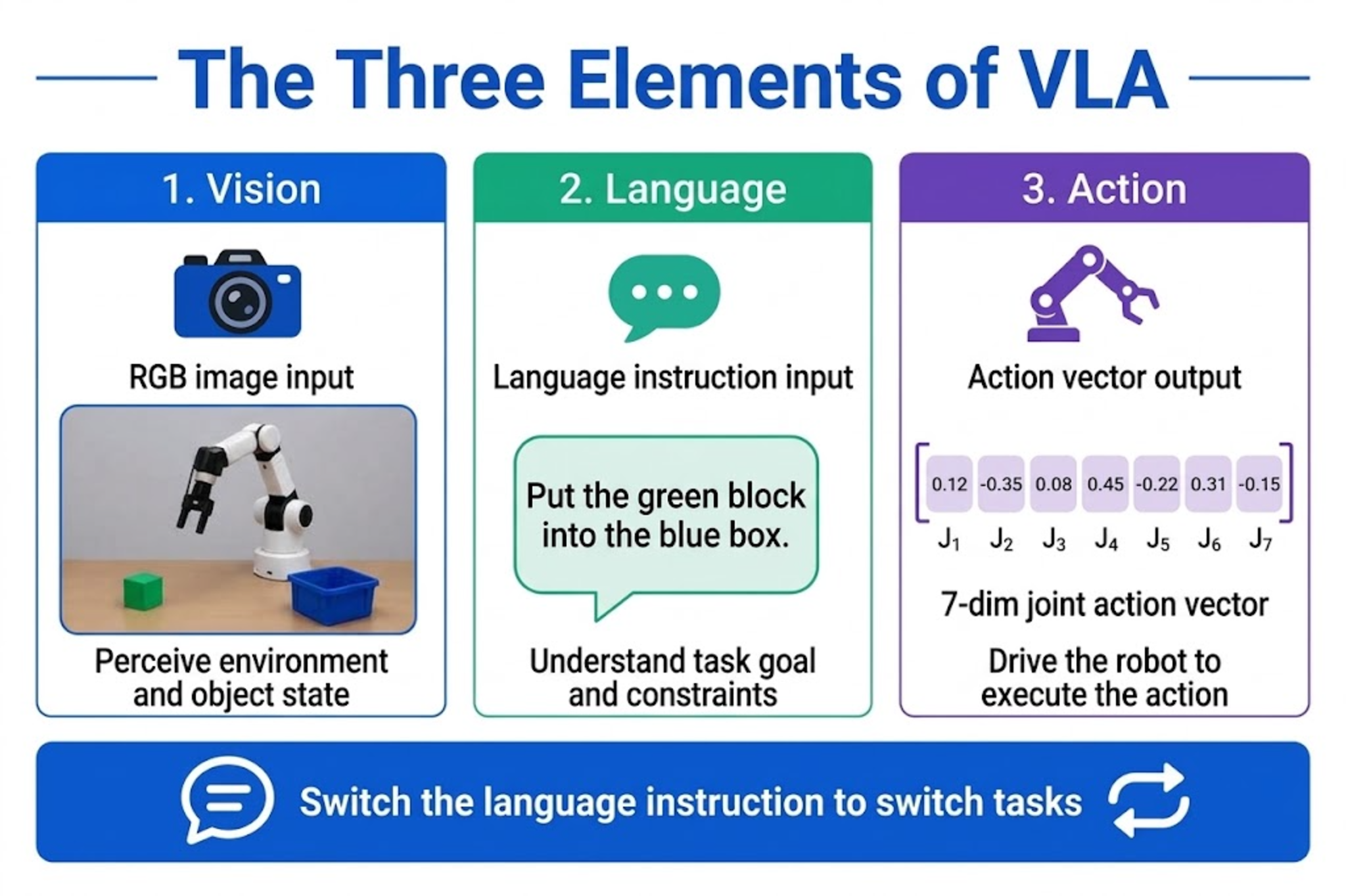
In the VLA framework, the three modalities each have a clear division of labor:
| Modality | Meaning | Typical source in reBot Arm |
|---|---|---|
| Vision | RGB images captured by external cameras and wrist cameras | Front-facing camera, wrist RealSense / USB camera |
| Language | Natural language description of the task | "Put the screwdriver into the toolbox" |
| Action | The control commands the robot must execute | Target angles of each joint, gripper open/close width |
State usually appears in pairs with Action: State describes "where the robot is now," and Action describes "where to go next." In LeRobot datasets, they are stored in the observation.state and action fields; in GR00T they are further split via meta/modality.json into sub-keys such as single_arm and gripper.
The key difference between VLA and pure-vision policies: language becomes a conditioning variable. During training, every demonstration trajectory is bound to a task description; at inference time, the user only needs to change the instruction text, without changing the model weights (within data coverage).
18.3 Difference Between VLM and VLA
18.3 Difference Between VLM and VLA
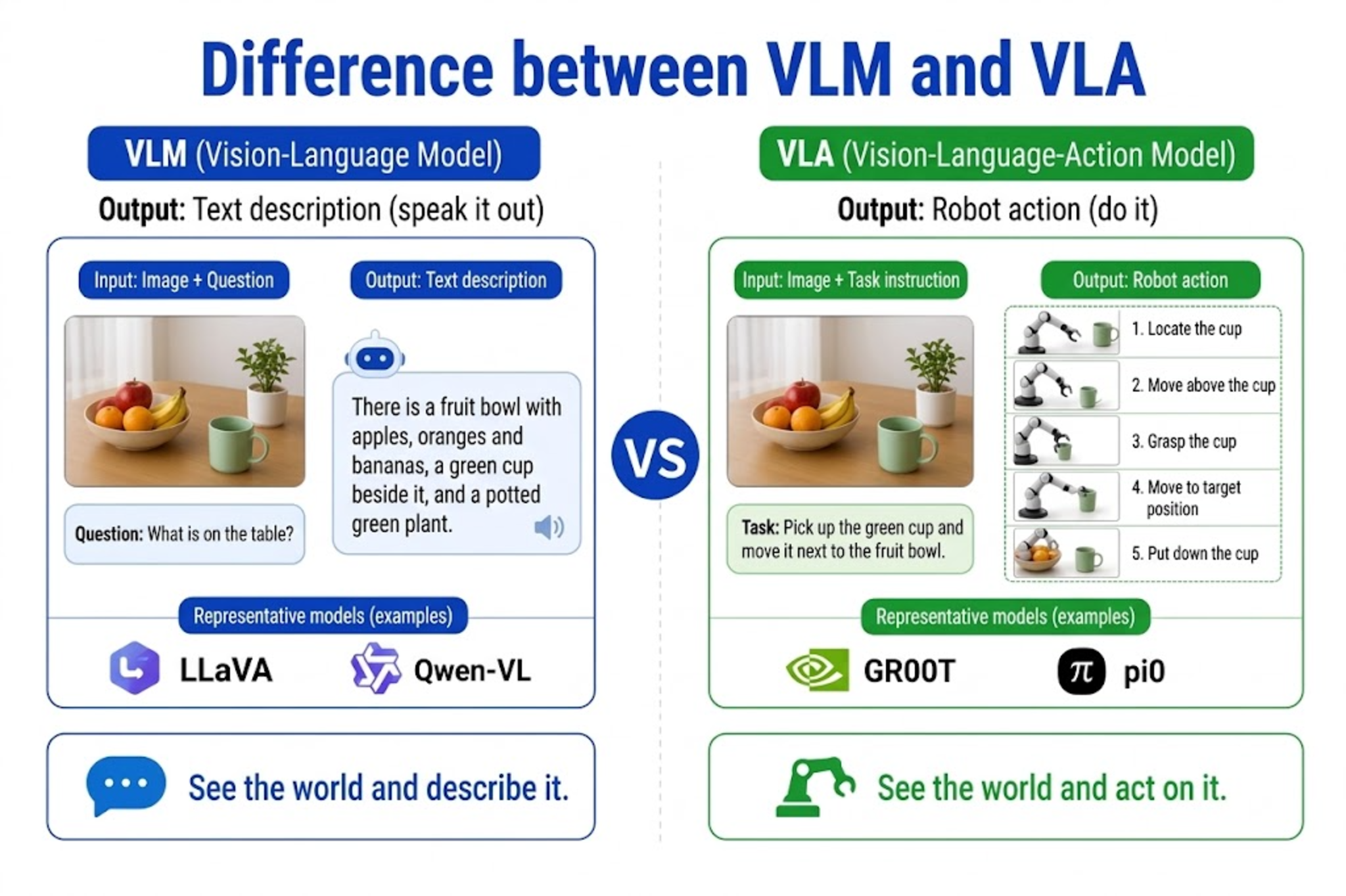
| Aspect | VLM (Vision-Language Model) | VLA (Vision-Language-Action) |
|---|---|---|
| Output | Text, descriptions, reasoning results | Robot action sequence |
| Typical use | Image QA, scene understanding, captioning | Grasping, placing, opening/closing doors, and other manipulation |
| Representative models | LLaVA, Qwen-VL, Cosmos-Reason2 | GR00T, pi0, OpenVLA |
| Relationship to robot | Can assist planning, does not directly drive motors | Outputs control commands end-to-end |
It can be understood simply as: VLM is responsible for "understanding the world and talking about it," while VLA is responsible for "understanding the world and taking action."
Isaac GR00T N1.7 reuses VLM capabilities architecturally: its backbone is Cosmos-Reason2-2B (based on the Qwen3-VL architecture, replacing the N1.6 Eagle backbone), responsible for encoding images and language, followed by a Diffusion Transformer (DiT) action head that decodes semantic representations into continuous action chunks. Therefore GR00T is both a VLA and embeds strong VLM representation capabilities.
18.4 Difference Between ACT and VLA
18.4 Difference Between ACT and VLA
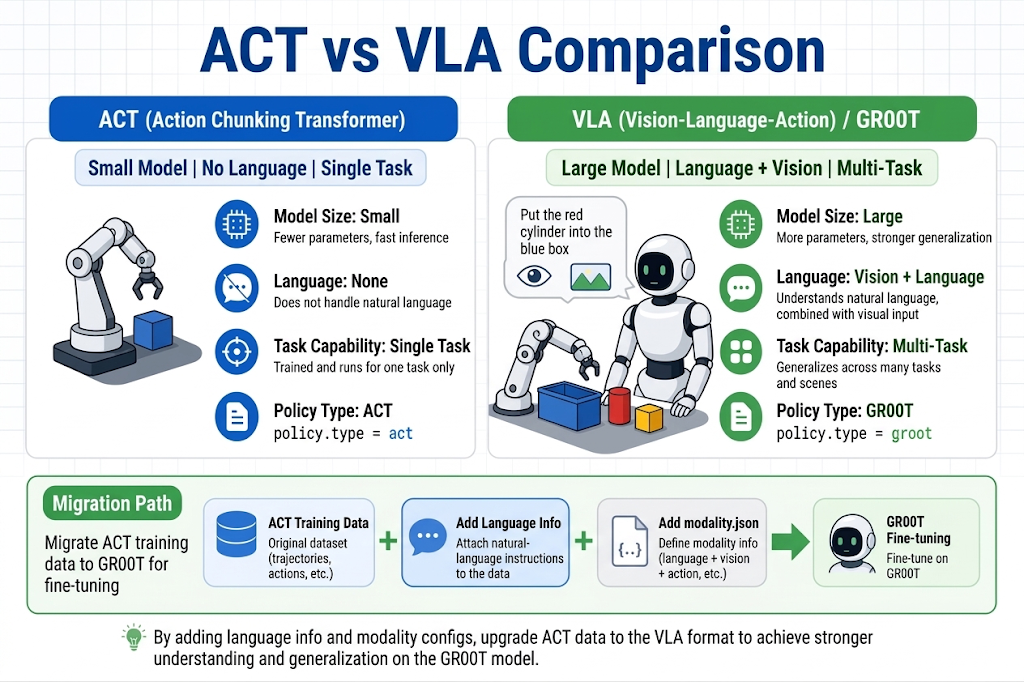
The ACT you encountered in previous chapters and the VLA in this chapter both belong to the imitation learning (Behavior Cloning) family, but their design goals differ:
| Aspect | ACT | VLA (GR00T as example) |
|---|---|---|
| Task condition | Usually no language, implicit single task | Language + vision, explicit multi-task |
| Model size | Smaller (tens of millions of parameters) | Larger (billions of parameter foundation model) |
| Training method | Train from scratch or light fine-tuning | Foundation model pretraining + downstream fine-tuning |
| Action representation | Action chunk | Action chunk + Flow Matching denoising |
| Generalization | Good within-distribution performance; retrain when switching tasks | Language conditioning supports zero/few-shot transfer |
| LeRobot policy type | act | groot |
The core technique of ACT is Action Chunking: predicting multiple future action steps at once to reduce accumulated error from step-by-step inference. GR00T also predicts action chunks, but the window length varies by version:
- N1.5 / N1.6:
action_horizon = 16 - N1.7:
action_horizonexpands from 16 to 40, and the maximum dimension of the pretrained general state/action space expands accordingly (reBot actually uses only 7 dimensions; the remaining dimensions are automatically zero-padded) - LeRobot
grootpolicy: source defaults tochunk_size=50,n_action_steps=50
This tutorial follows the official N1.7 fine-tuning example, using chunk_size=40 during training to align with the pretrained action window. Do not stick with 16 — a mismatched window degrades fine-tuning results. action_horizon is written into the diffusion head at training time and cannot be arbitrarily enlarged at inference.
Migration path: if you already have an ACT dataset for the reBot Arm (LeRobot v2 format), Chapter 20 only requires adding language annotations and Modality configuration before it can be used for GR00T fine-tuning, without recollecting all demonstrations.
18.5 Language-Conditioned Robot Tasks
18.5 Language-Conditioned Robot Tasks
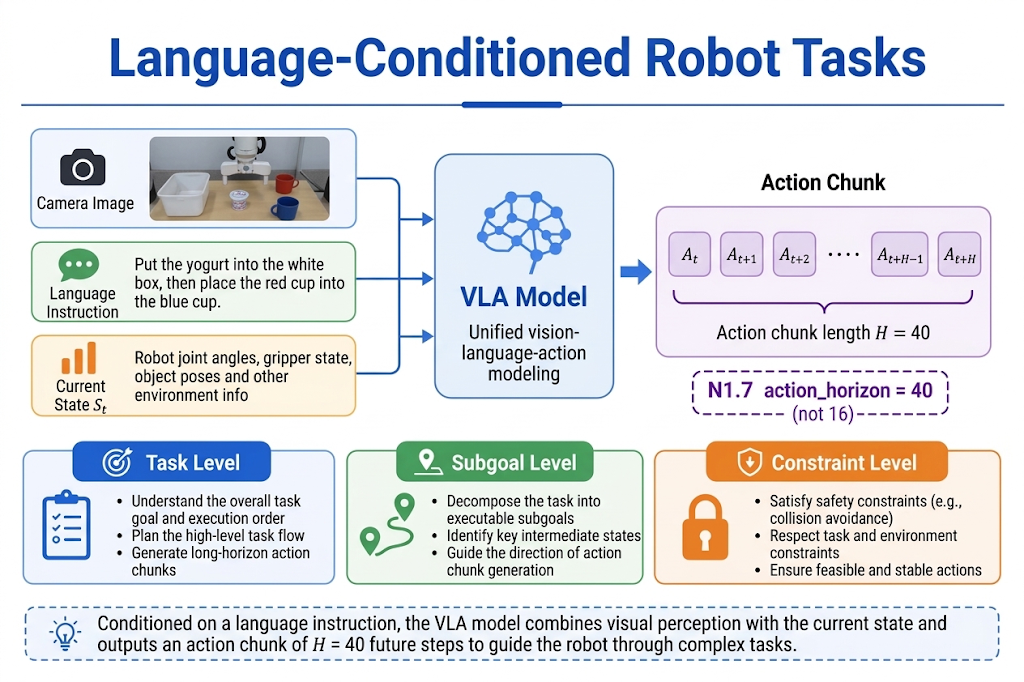
The standard form of a language-conditioned task is:
Input: image I_t + language instruction L + current state S_t
Output: actions A_{t:t+H} (action chunk for the next H steps)
Instruction granularity can vary:
- Task-level: "put the red cube into the blue box" (one sentence shared by the whole trajectory)
- Subgoal-level: "first approach the object" -> "then close the gripper" (segmented annotation, advanced scenarios)
- Constraint-level: "place gently," "avoid obstacles" (modifies how the action is executed)
In LeRobot datasets, language is usually written in the meta/tasks.jsonl or annotation field. GR00T reads it through the annotation key in modality.json; two common forms are:
| Key name | Typical datasets | reBot recommendation |
|---|---|---|
human.task_description | SO-100, cube_to_bowl, and other simple desktop tasks | Recommended: consistent with the Chapter 20 example |
human.action.task_description | LIBERO, SimplerEnv, and other simulation benchmarks | Use only if your data comes from these benchmarks |
Both keys are valid, but they must match the actual fields in the dataset; do not mix them between training and inference.
Practical advice (reBot Arm):
- When recording each demonstration, describe the task in one short, verb-first sentence in Chinese or English.
- Keep the phrasing consistent for similar tasks, e.g. uniformly use "put X on Y."
- Avoid having one data point correspond to multiple phrasings; the more consistent the better during early fine-tuning.
18.6 Single-Task, Multi-Task, and Generalization
18.6 Single-Task, Multi-Task, and Generalization
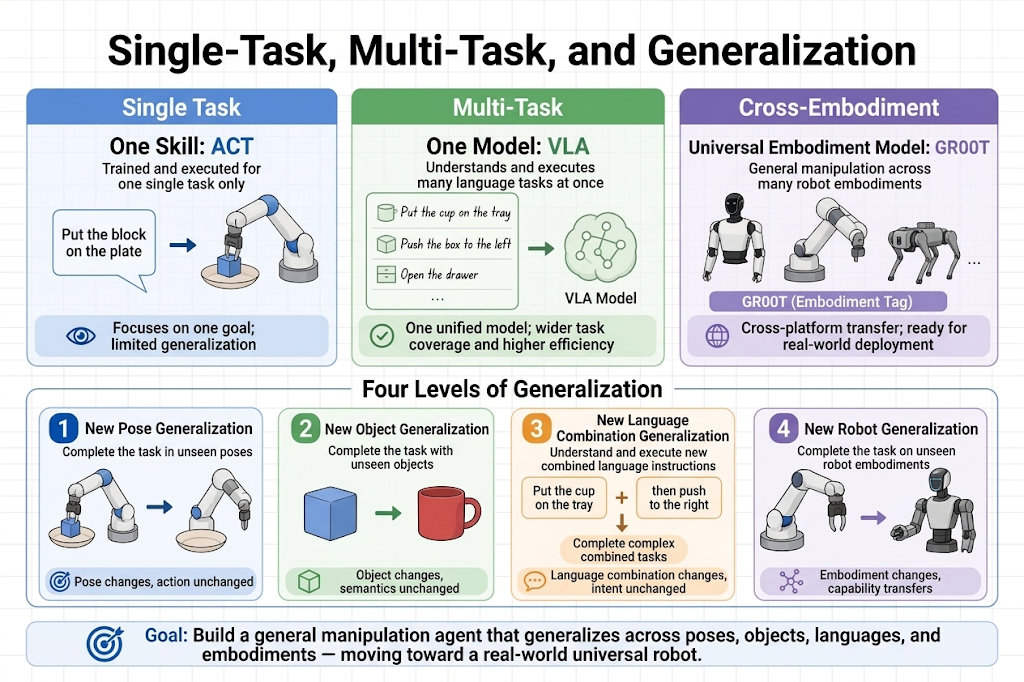
| Training paradigm | Description | Suitable scenarios |
|---|---|---|
| Single-task | Learns only one skill | ACT default; little data, clear objective |
| Multi-task | The same model learns multiple skills, distinguished by language | VLA fine-tuning; desktop tidying, sorting, etc. |
| Cross-embodiment generalization | Different robots share a foundation model | GR00T pretraining; adapted via embodiment_tag |
"Generalization" in VLAs has several levels — do not confuse them:
- Same task, new initial pose: can still grasp when the cube position changes — ACT can usually do this too.
- New objects, new containers: relies on visual generalization — requires sufficient diversity in training data.
- New language instruction combinations: "put A on B" never seen before but the sentence pattern is familiar — the language-conditioning advantage of VLA.
- New robot embodiment: still usable when switching arms — requires GR00T's embodiment projection layer plus a small amount of fine-tuning data.
For reBot Arm users, the realistic expectation is: after fine-tuning, you can switch among the multiple language tasks already collected; for entirely new objects or entirely new sentence patterns, additional demonstration data is still needed.
18.7 Continuous Actions and Action Tokens
18.7 Continuous Actions and Action Tokens
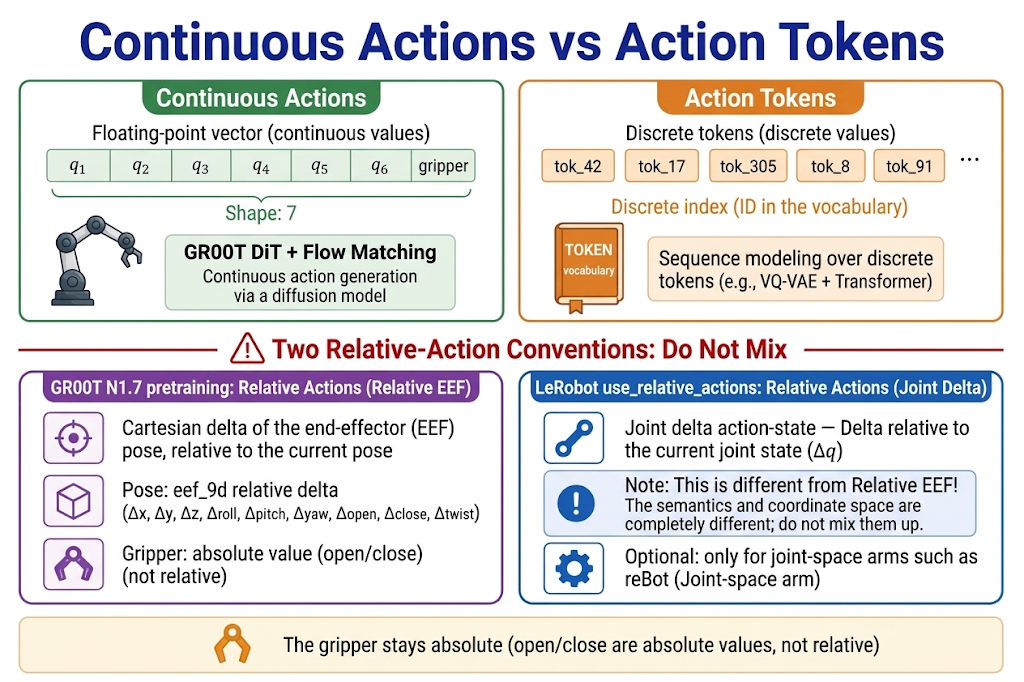
There are two mainstream representations for robot control commands:
Continuous Actions
Directly outputs a floating-point vector, e.g. 6 joint angles + 1 gripper open/close value:
action = [q1, q2, q3, q4, q5, q6, gripper] # shape: (7,)
- Advantage: high precision, consistent with the real motor interface.
- Disadvantage: high-dimensional space regression is difficult.
- GR00T uses: DiT + Flow Matching to denoise in continuous space, outputting action chunks.
Action Tokens (Discretized Actions)
Quantizes continuous values into discrete symbols, like a language model predicting the next token:
action_tokens = [tok_42, tok_17, tok_89, ...]
- Advantage: can reuse autoregressive LLM architectures; adopted by some VLAs such as pi0-FAST.
- Disadvantage: quantization loss, complex vocabulary design.
Relative vs. absolute actions:
- The core of GR00T N1.7 pretraining is the Relative EEF (relative end-effector) action space: actions are represented as Cartesian increments relative to the current end-effector pose, rather than joint-angle increments. End-effector increments have more consistent semantics across different robots (even human video), which is key to N1.7's cross-embodiment generalization. Official code configures this by action group:
eef_9duses relative end-effector,joint_positionuses relative joint, andgripper_positionstays absolute. - LeRobot's
--policy.use_relative_actions=trueis a framework-level switch: it applies a relative transform ofaction - stateto the joint dimensions. This is not the same as the Relative EEF in the paper, nor is it "the default recommendation of N1.7." When the reBot Arm runs in joint space (NON_EEF), this switch is only an optional LeRobot preprocessing step; do not describe it as "consistent with the GR00T pretraining design." - Non-joint quantities such as the gripper commonly use
relative_exclude_jointsto maintain absolute control. Relative joint trajectories are smoother, but long-term execution may drift.
18.8 Capabilities and Limitations of VLA
18.8 Capabilities and Limitations of VLA
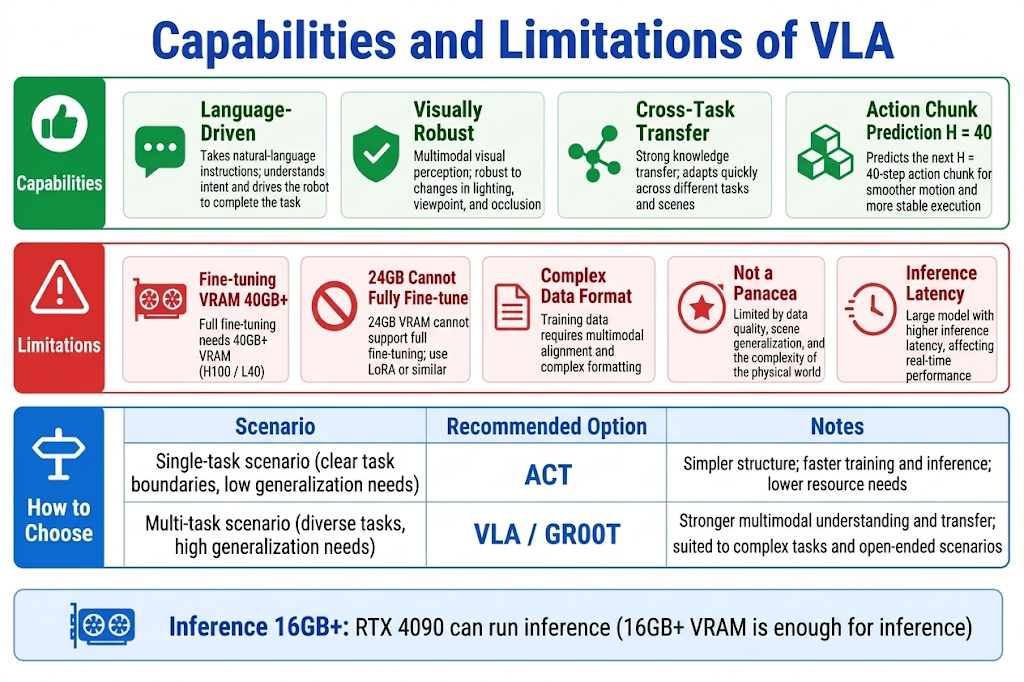
Capabilities
- Language-driven: one model, many tasks; switch behavior by changing the instruction.
- Visual robustness: large-scale pretraining brings better scene understanding than small ACT.
- Cross-task transfer: representations can be shared among similar sentence patterns and similar objects.
- Action-chunk prediction: one inference outputs multiple steps, suitable for real-time control (with RTC inference policy).
Limitations
- High compute demand: N1.7-3B recommends 40 GB+ VRAM for fine-tuning (H100 / L40; training only the projector + DiT head peaks around 35 GB; the official simulation fine-tuning tutorial requires ≥ 48 GB). Inference needs only 16 GB+ (RTX 4090 can run inference). Full fine-tuning on a 24 GB card is basically infeasible unless using efficient fine-tuning such as LoRA / PEFT.
- More complex data format: beyond standard LeRobot fields, a
modality.jsonand embodiment tag are required. - Not a panacea: objects, instructions, and workstation layouts not covered by the training set may still fail.
- Latency: large-model inference is slower than ACT; set
n_action_stepsand RTC parameters appropriately. - Sim-to-real gap: pretraining data is dominated by humanoid/specific platforms; desktop arms require sufficient fine-tuning.
When to Choose ACT, When to Choose VLA?
| Scenario | Recommendation |
|---|---|
| Single repetitive task, edge device, low latency | ACT |
| Multi-task, language interaction, willing to invest in GPU and annotation | VLA / GR00T |
| Already have ACT data, want to expand to multi-task | Add language to existing LeRobot data -> GR00T fine-tuning |
18.9 Chapter Summary
18.9 Chapter Summary
- Multimodal models fuse vision, language, and state into unified decisions.
- VLA adds action output on top of VLM, supporting language-conditioned manipulation.
- ACT is a lightweight single-task solution; GR00T is a large-scale pretraining + fine-tuning VLA solution.
- N1.7 pretraining uses Relative EEF and
action_horizon=40; joint relative actions in LeRobot are a separate optional preprocessing step — do not conflate the two. - The next chapter introduces how to land the general VLA onto this specific embodiment, the reBot Arm.