UDP Streaming reSpeaker XVF3800 44mm with XIAO ESP32-S3 Plus
Overview
This project streams real-time audio from the reSpeaker XVF3800 44mm array over Wi-Fi. The XIAO ESP32-S3 Plus captures the processed stereo output over I2S, splits it into numbered UDP packets, and sends them to a Python receiver on your PC, which reassembles the stream and saves it as a WAV file.
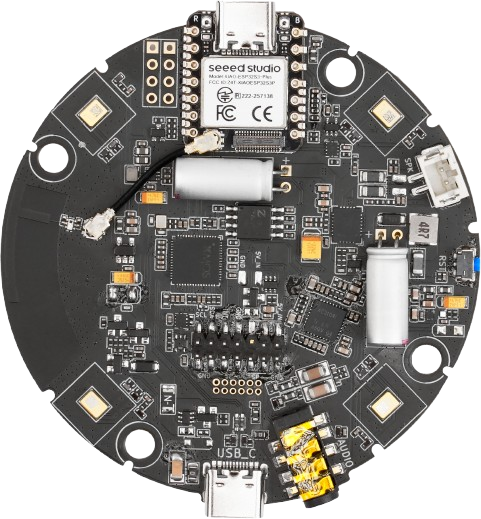
Functionality Overview
- Connects the XIAO to a Wi-Fi network in station mode.
- Captures 48 kHz, stereo, 32-bit audio from the XVF3800 over I2S.
- Sends five seconds of audio to the PC as UDP packets, each with an 8-byte header (
AUD0magic + sequence number). - The Python receiver reassembles the stream, detects missing or duplicate packets, inserts silence for gaps, and writes
respeaker_recording.wav.
This example expects the I2S firmware on the XVF3800, at 48 kHz. If the board is still running the USB image it will not produce I2S clocks. See Update Firmware.
Before You Start
- Put the board on the same network as your PC.
- Set your Wi-Fi credentials and your PC's IPv4 address in the sketch.
- Find the PC address with
ipconfig(Windows) orip addr(Linux/macOS). - Allow inbound UDP port
12345through the firewall, or the packets will be dropped silently.
Arduino Code
Update these values before uploading:
// WiFi credentials
const char* ssid     = "Your-SSID";
const char* password = "Your-PASSWORD";

// Your PC's IP address and the UDP port the Python script listens on
IPAddress pcIP(192, 168, 1, 100);
const uint16_t udpPort = 12345;
Full Code (streams 5 seconds of audio)
#include <WiFi.h>
#include <WiFiUdp.h>
#include "AudioTools.h"

// =====================================================
// WIFI CONFIGURATION
// =====================================================

const char* ssid = "Your-SSID";
const char* password = "Your-PASSWORD";

// Your Windows PC IP address
IPAddress pcIP(192, 168, 1, 100);

const uint16_t udpPort = 12345;

WiFiUDP udp;


// =====================================================
// I2S CONFIGURATION
// =====================================================

#define SAMPLE_RATE       48000
#define CHANNELS          2
#define BITS_PER_SAMPLE   32

#define I2S_BCK_PIN       8
#define I2S_WS_PIN        7
#define I2S_TX_PIN        44
#define I2S_RX_PIN        43

AudioInfo info(
    SAMPLE_RATE,
    CHANNELS,
    BITS_PER_SAMPLE
);

I2SStream i2s;
I2SConfig i2sConfig;


// =====================================================
// RECORDING CONFIGURATION
// =====================================================

#define RECORD_SECONDS   5

#define BUFFER_SIZE      1024

#define FRAME_BYTES      8

#define BYTES_PER_SECOND \
    (SAMPLE_RATE * CHANNELS * (BITS_PER_SAMPLE / 8))

#define TOTAL_BYTES \
    (BYTES_PER_SECOND * RECORD_SECONDS)


// =====================================================
// UDP PACKET CONFIGURATION
// =====================================================

// Header: 4-byte magic + 4-byte sequence
#define HEADER_SIZE 8

#define PACKET_MAGIC "AUD0"

uint8_t audioBuffer[BUFFER_SIZE];

uint8_t packetBuffer[HEADER_SIZE + BUFFER_SIZE];

uint32_t sequenceNumber = 0;


// =====================================================
// WIFI CONNECTION
// =====================================================

bool connectWiFi() {

    Serial.printf(
        "Connecting to WiFi: %s\n",
        ssid
    );

    WiFi.mode(WIFI_STA);

    WiFi.begin(ssid, password);

    unsigned long start = millis();

    while (WiFi.status() != WL_CONNECTED) {

        delay(500);
        Serial.print(".");

        if (millis() - start > 30000) {

            Serial.println("\nWiFi connection timeout!");

            return false;
        }
    }

    Serial.println("\nWiFi connected!");

    Serial.print("ESP32 IP: ");
    Serial.println(WiFi.localIP());

    Serial.print("PC destination: ");
    Serial.println(pcIP);

    Serial.print("UDP port: ");
    Serial.println(udpPort);

    return true;
}


// =====================================================
// I2S INITIALIZATION
// =====================================================

bool setupI2SInput() {

    Serial.println("\nInitializing I2S...");

    i2sConfig = i2s.defaultConfig(RX_MODE);

    i2sConfig.copyFrom(info);

    i2sConfig.pin_bck = I2S_BCK_PIN;
    i2sConfig.pin_ws = I2S_WS_PIN;

    i2sConfig.pin_data = I2S_TX_PIN;
    i2sConfig.pin_data_rx = I2S_RX_PIN;

    // XVF3800 supplies BCLK and LRCLK
    i2sConfig.is_master = false;

    if (!i2s.begin(i2sConfig)) {

        Serial.println("I2S initialization failed!");

        return false;
    }

    Serial.println("I2S initialized successfully");

    Serial.println("Sample rate: 48000 Hz");
    Serial.println("Channels: 2");
    Serial.println("Bit depth: 32-bit");

    return true;
}


// =====================================================
// SEND ONE UDP AUDIO PACKET
// =====================================================

bool sendAudioPacket(
    const uint8_t* data,
    size_t length
) {

    if (length == 0 || length > BUFFER_SIZE) {
        return false;
    }

    // Header magic
    memcpy(
        packetBuffer,
        PACKET_MAGIC,
        4
    );

    // Sequence number, little-endian
    memcpy(
        packetBuffer + 4,
        &sequenceNumber,
        4
    );

    // Audio payload
    memcpy(
        packetBuffer + HEADER_SIZE,
        data,
        length
    );

    if (!udp.beginPacket(pcIP, udpPort)) {
        return false;
    }

    size_t headerWritten = udp.write(
        packetBuffer,
        HEADER_SIZE
    );

    size_t audioWritten = udp.write(
        packetBuffer + HEADER_SIZE,
        length
    );

    int result = udp.endPacket();

    if (headerWritten != HEADER_SIZE ||
        audioWritten != length ||
        result != 1) {

        Serial.printf(
            "UDP send failed at packet %lu\n",
            (unsigned long)sequenceNumber
        );

        return false;
    }

    sequenceNumber++;

    return true;
}


// =====================================================
// RECORD AND TRANSMIT AUDIO
// =====================================================

void recordAndSendAudio() {

    Serial.println("\n================================");
    Serial.println("STARTING AUDIO TRANSMISSION");
    Serial.println("================================");

    Serial.printf(
        "Recording duration: %d seconds\n",
        RECORD_SECONDS
    );

    Serial.printf(
        "Expected audio: %lu bytes\n",
        (unsigned long)TOTAL_BYTES
    );

    size_t totalSent = 0;

    uint32_t successfulPackets = 0;
    uint32_t failedPackets = 0;

    unsigned long startTime = millis();

    while (totalSent < TOTAL_BYTES) {

        size_t remaining = TOTAL_BYTES - totalSent;

        size_t requestSize =
            (remaining > BUFFER_SIZE)
            ? BUFFER_SIZE
            : remaining;

        // Read I2S audio
        size_t bytesRead = i2s.readBytes(
            audioBuffer,
            requestSize
        );

        if (bytesRead == 0) {
            delay(1);
            continue;
        }

        // Preserve complete stereo frames
        bytesRead -= bytesRead % FRAME_BYTES;

        if (bytesRead == 0) {
            continue;
        }

        // Send via UDP
        if (sendAudioPacket(audioBuffer, bytesRead)) {

            totalSent += bytesRead;

            successfulPackets++;

        } else {

            failedPackets++;

            // Do not advance totalSent.
            // The same audio data will be retried.
        }

        static size_t lastProgress = 0;

        if (totalSent - lastProgress >= BYTES_PER_SECOND) {

            lastProgress = totalSent;

            Serial.printf(
                "Sent: %lu / %lu bytes (%.2f sec)\n",
                (unsigned long)totalSent,
                (unsigned long)TOTAL_BYTES,
                (float)totalSent / BYTES_PER_SECOND
            );
        }
    }

    unsigned long elapsed = millis() - startTime;

    Serial.println("\n================================");
    Serial.println("TRANSMISSION COMPLETE");
    Serial.println("================================");

    Serial.printf(
        "Total audio bytes: %lu\n",
        (unsigned long)totalSent
    );

    Serial.printf(
        "Successful packets: %lu\n",
        (unsigned long)successfulPackets
    );

    Serial.printf(
        "Failed packets: %lu\n",
        (unsigned long)failedPackets
    );

    Serial.printf(
        "Elapsed time: %.2f seconds\n",
        elapsed / 1000.0
    );

    Serial.printf(
        "Average data rate: %.2f KB/s\n",
        elapsed > 0
            ? (float)totalSent / elapsed
            : 0.0f
    );

    Serial.println("UDP transmission finished.");
}


// =====================================================
// SETUP
// =====================================================

void setup() {

    Serial.begin(115200);

    while (!Serial) {
        delay(10);
    }

    AudioLogger::instance().begin(
        Serial,
        AudioLogger::Info
    );

    Serial.println("\nReSpeaker 44mm UDP Audio Test");

    // 1. Connect WiFi
    if (!connectWiFi()) {
        while (true) delay(1000);
    }

    // 2. Initialize UDP
    if (!udp.begin(0)) {
        Serial.println("UDP initialization failed!");
        while (true) delay(1000);
    }

    Serial.println("UDP initialized");

    // 3. Initialize I2S
    if (!setupI2SInput()) {
        while (true) delay(1000);
    }

    delay(500);

    // 4. Record and transmit
    recordAndSendAudio();
}


// =====================================================
// LOOP
// =====================================================

void loop() {

    // One-time recording test
    delay(1000);
}
Open the Serial Monitor at 115200 baud to confirm the Wi-Fi connection and the streaming progress.
Packet Format
| Bytes | Field | Value |
|---|---|---|
| 0–3 | Magic | AUD0 (ASCII) |
| 4–7 | Sequence number | Little-endian uint32, starts at 0 |
| 8–1031 | Audio payload | 1024 bytes of raw 32-bit stereo PCM |
With 48 kHz × 2 channels × 4 bytes, one second is 384,000 bytes; five seconds is 1,920,000 bytes, or 1,875 packets of 1024 bytes.
Python Script (receive and save the audio)
Save this as udp_receiver.py and run it on the PC before resetting the board.
import socket
import struct
import wave
import time

# ==========================================
# UDP CONFIGURATION
# ==========================================

UDP_IP = "0.0.0.0"
UDP_PORT = 12345

PC_IP = "192.168.1.100"

# ==========================================
# AUDIO CONFIGURATION
# ==========================================

SAMPLE_RATE = 48000
CHANNELS = 2
SAMPLE_WIDTH = 4

RECORD_SECONDS = 5

BYTES_PER_SECOND = (
    SAMPLE_RATE * CHANNELS * SAMPLE_WIDTH
)

EXPECTED_BYTES = BYTES_PER_SECOND * RECORD_SECONDS

# Arduino sends 1024-byte audio chunks
CHUNK_SIZE = 1024

EXPECTED_PACKETS = EXPECTED_BYTES // CHUNK_SIZE

# Packet header:
# 4 bytes magic + 4 bytes sequence number
HEADER_SIZE = 8

OUTPUT_FILE = "respeaker_recording.wav"

# ==========================================
# UDP SOCKET
# ==========================================

sock = socket.socket(
    socket.AF_INET,
    socket.SOCK_DGRAM
)

# Allow reuse of port
sock.setsockopt(
    socket.SOL_SOCKET,
    socket.SO_REUSEADDR,
    1
)

sock.bind((UDP_IP, UDP_PORT))

sock.settimeout(5.0)

print("======================================")
print("ReSpeaker 44mm UDP Audio Receiver")
print("======================================")

print(f"Listening on: {UDP_IP}:{UDP_PORT}")
print(f"PC IP: {PC_IP}")
print(f"Sample rate: {SAMPLE_RATE}")
print(f"Channels: {CHANNELS}")
print(f"Bit depth: {SAMPLE_WIDTH * 8}")
print(f"Expected duration: {RECORD_SECONDS} seconds")
print(f"Expected packets: {EXPECTED_PACKETS}")

print("\nWaiting for ESP32 audio transmission...")

# ==========================================
# AUDIO STORAGE
# ==========================================

audio_data = bytearray()

expected_sequence = 0

received_packets = 0
missing_packets = 0
duplicate_packets = 0
invalid_packets = 0

end_received = False

last_packet_time = time.time()

# ==========================================
# RECEIVE UDP PACKETS
# ==========================================

try:

    while True:

        try:

            data, addr = sock.recvfrom(2048)

            last_packet_time = time.time()

            # Check packet size
            if len(data) < HEADER_SIZE:
                invalid_packets += 1
                continue

            # Decode packet header
            magic, sequence = struct.unpack(
                "<4sI",
                data[:HEADER_SIZE]
            )

            # End-of-transmission marker
            if magic == b"END0":
                print("\nEnd-of-transmission received.")
                end_received = True
                break

            # Check packet identifier
            if magic != b"AUD0":
                invalid_packets += 1
                print("Invalid packet identifier")
                continue

            payload = data[HEADER_SIZE:]

            if len(payload) != CHUNK_SIZE:
                invalid_packets += 1
                print(
                    f"Unexpected payload size: {len(payload)}"
                )
                continue

            # Handle missing packets
            if sequence > expected_sequence:

                lost = sequence - expected_sequence

                missing_packets += lost

                print(
                    f"Missing {lost} packet(s) before "
                    f"sequence {sequence}"
                )

                # Insert silence for missing audio
                audio_data.extend(
                    bytes(lost * CHUNK_SIZE)
                )

            # Ignore duplicate or out-of-order packets
            elif sequence < expected_sequence:

                duplicate_packets += 1

                print(
                    f"Duplicate/late packet: {sequence}"
                )

                continue

            # Store audio payload
            audio_data.extend(payload)

            expected_sequence = sequence + 1

            received_packets += 1

            # Progress
            if received_packets % 375 == 0:

                duration = (
                    len(audio_data) / BYTES_PER_SECOND
                )

                print(
                    f"Received: {received_packets} packets | "
                    f"{duration:.2f} seconds"
                )

        except socket.timeout:

            if received_packets > 0:

                print("\nReceiver timeout.")

                break

            print("Still waiting for ESP32...")

except KeyboardInterrupt:

    print("\nRecording stopped by user.")

finally:

    sock.close()


# ==========================================
# SAVE WAV FILE
# ==========================================

print("\n======================================")
print("RECORDING STATISTICS")
print("======================================")

print(f"Received packets: {received_packets}")
print(f"Missing packets: {missing_packets}")
print(f"Duplicate packets: {duplicate_packets}")
print(f"Invalid packets: {invalid_packets}")
print(f"End marker received: {end_received}")

print(f"Total audio bytes: {len(audio_data)}")

print(
    f"Audio duration: "
    f"{len(audio_data) / BYTES_PER_SECOND:.2f} seconds"
)

if len(audio_data) > 0:

    # Ensure complete stereo frames
    audio_data = audio_data[
        :len(audio_data) - len(audio_data) % 8
    ]

    print(f"\nSaving WAV: {OUTPUT_FILE}")

    with wave.open(OUTPUT_FILE, "wb") as wav:

        wav.setnchannels(CHANNELS)
        wav.setsampwidth(SAMPLE_WIDTH)
        wav.setframerate(SAMPLE_RATE)

        wav.writeframes(audio_data)

    print("WAV saved successfully!")

else:

    print("No audio received!")

print("\nReceiver finished.")
The receiver ends on the 5-second socket timeout rather than an end marker, because the sketch does not send the optional END0 packet. End marker received: False in the statistics is therefore normal.
Expected Output
Arduino Serial Monitor:
ReSpeaker 44mm UDP Audio Test
Connecting to WiFi: Your-SSID
....
WiFi connected!
ESP32 IP: 192.168.1.42
PC destination: 192.168.1.100
UDP port: 12345
UDP initialized

Initializing I2S...
I2S initialized successfully
Sample rate: 48000 Hz
Channels: 2
Bit depth: 32-bit

================================
STARTING AUDIO TRANSMISSION
================================
Recording duration: 5 seconds
Expected audio: 1920000 bytes
Sent: 384000 / 1920000 bytes (1.00 sec)
Sent: 768000 / 1920000 bytes (2.00 sec)
Sent: 1152000 / 1920000 bytes (3.00 sec)
Sent: 1536000 / 1920000 bytes (4.00 sec)
Sent: 1920000 / 1920000 bytes (5.00 sec)

================================
TRANSMISSION COMPLETE
================================
Total audio bytes: 1920000
Successful packets: 1875
Failed packets: 0
Elapsed time: 5.02 seconds
Average data rate: 382.47 KB/s
UDP transmission finished.
Python receiver:
======================================
ReSpeaker 44mm UDP Audio Receiver
======================================
Listening on: 0.0.0.0:12345
PC IP: 192.168.1.100
Sample rate: 48000
Channels: 2
Bit depth: 32
Expected duration: 5 seconds
Expected packets: 1875

Waiting for ESP32 audio transmission...
Received: 375 packets | 1.00 seconds
Received: 750 packets | 2.00 seconds
Received: 1125 packets | 3.00 seconds
Received: 1500 packets | 4.00 seconds
Received: 1875 packets | 5.00 seconds

Receiver timeout.

======================================
RECORDING STATISTICS
======================================
Received packets: 1875
Missing packets: 0
Duplicate packets: 0
Invalid packets: 0
End marker received: False
Total audio bytes: 1920000
Audio duration: 5.00 seconds

Saving WAV: respeaker_recording.wav
WAV saved successfully!

Receiver finished.
Listening to the Audio
Open respeaker_recording.wav in any audio player — VLC, Windows Media Player, or Audacity for inspection. It is 48 kHz, stereo, 32-bit PCM.
Tech Support & Product Discussion
Thank you for choosing our products! We are here to provide you with different support to ensure that your experience with our products is as smooth as possible. We offer several communication channels to cater to different preferences and needs.