VLA-JEPA: Learning Latent Actions from Video
VLA-JEPA: Enhancing Vision-Language-Action Model with Latent World Model
- Human-video pretraining
- Latent world model
- Flow-matching action head
- Perturbation robustness
Human videos show how to place an apple in a bowl, but contain no control commands for a particular robot. VLA-JEPA first learns how objects change from video, then learns how to act from robot demonstrations. A world model connects the two learning signals.
Prerequisites
Three quantities matter. Consider placing an apple in a bowl:
- World-state features describe the scene and object state, as extracted by a video encoder.
- Latent actions are hidden features that help predict state changes, such as the apple moving from the table to above the bowl. They have no predefined physical units.
- Robot actions contain values sent to the controller, such as end-effector translation, rotation, and gripper commands.
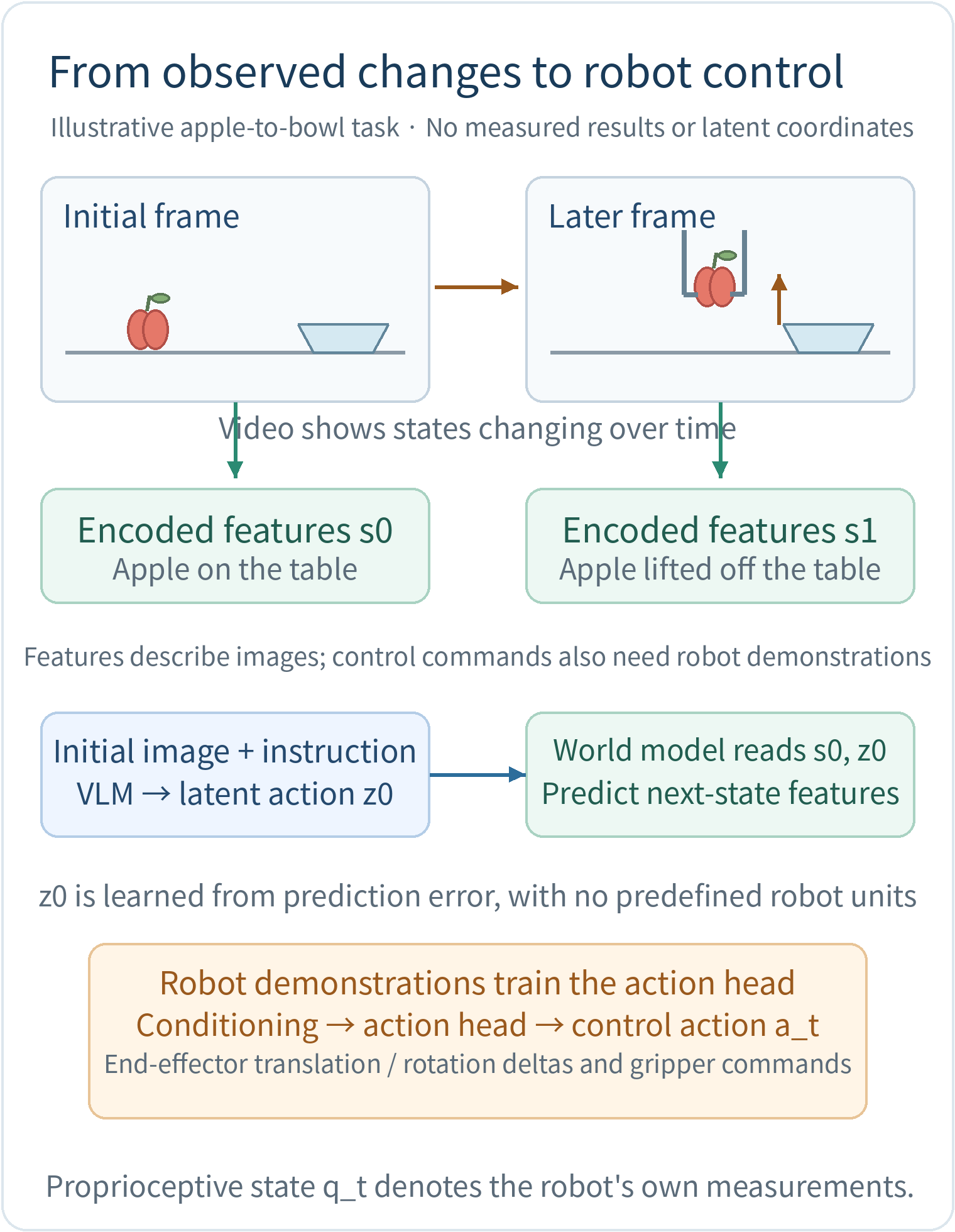
JEPA (Joint-Embedding Predictive Architecture) predicts future features. It compares predicted features with features encoded from actual future images, without reconstructing every pixel. VLA-JEPA uses this objective to teach a vision-language model (VLM) manipulation-related changes.
Abstract
Paraphrase: Internet video can help address the shortage of robot data for vision-language-action models (VLAs). Existing latent-action methods, however, can learn appearance changes, irrelevant motion, or shortcuts from future images. VLA-JEPA generates latent actions from current observations and language, then predicts future state features. Future images provide supervision without directly entering the VLM that generates latent actions. Joint pretraining on video and robot data, followed by downstream adaptation, yields competitive simulation and hardware results.
Reading note: The absence of action labels applies to human videos. Videos teach changes; robot demonstrations still teach control values. The ablations show clearer benefits for perturbation robustness than consistent improvement across all tasks.
Introduction and Related Work
Start with the data problem. Robot demonstrations are expensive, while human videos are abundant. The authors therefore seek to transfer video experience to robot learning (Section 1 of the paper). More video alone is insufficient: pixel prediction can focus on texture, lighting, and camera motion rather than changes useful for control.
Then examine supervision. If a latent-action extractor sees current and future images, it may encode the future answer. Extracting latent actions before separately aligning a policy also adds training stages. The authors change both the prediction target and the information source: predict future features, and generate latent actions only from initial observations.
Section 2 discusses two main groups: VLAs such as the RT series that rely on action-labeled demonstrations, and methods such as LAPA, UniVLA, and MotoGPT that extract latent actions from video before connecting them to robot control. VLA-JEPA instead lets state-prediction error directly train the VLM that generates latent actions, while robot-action supervision trains the same backbone. This forms a unified pretraining process, still followed by downstream fine-tuning.
How VLA-JEPA Learns Actions from Video
The Overall Network
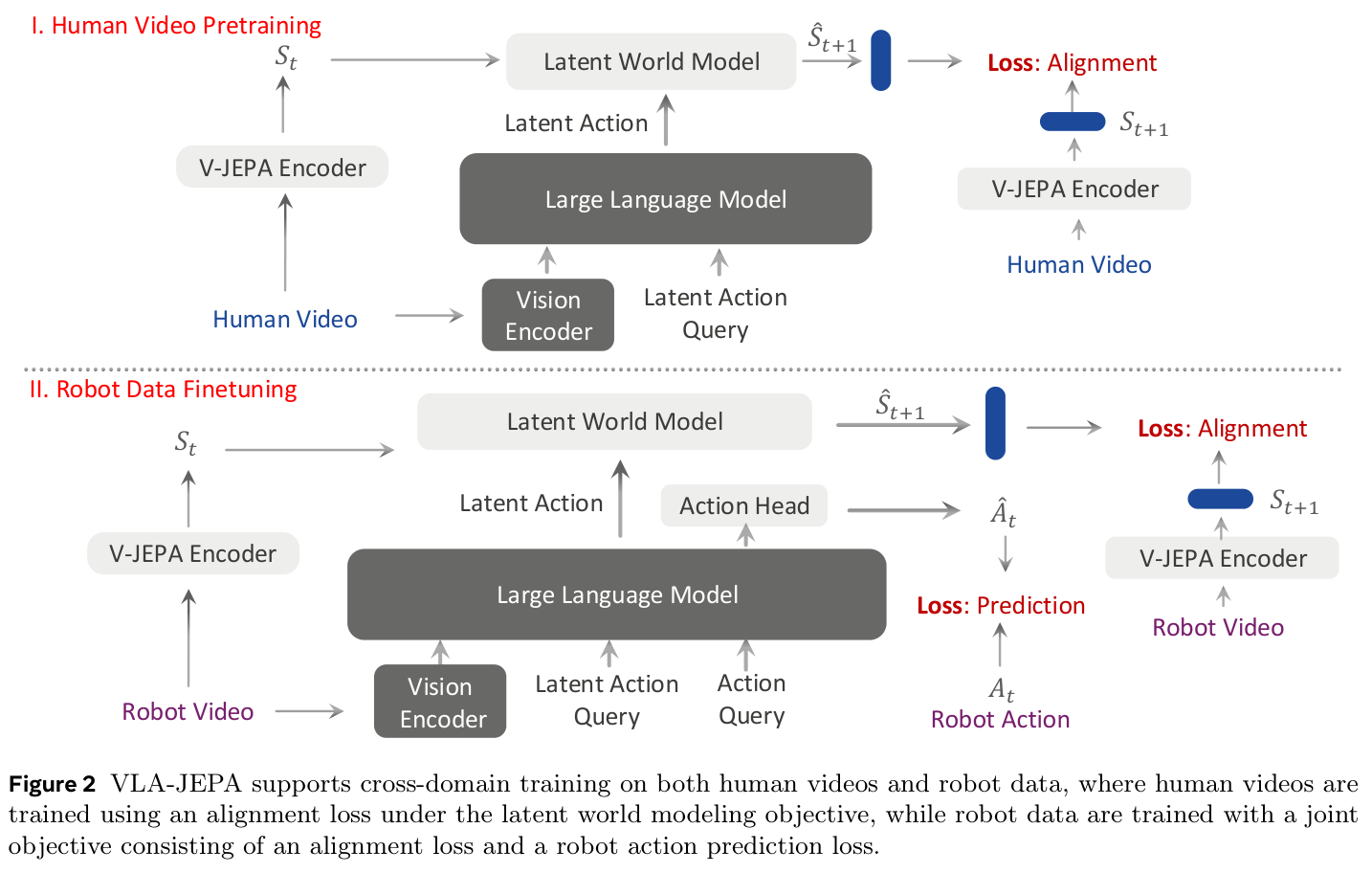
Each of the four modules has a role: Qwen3-VL-2B reads current images and instructions to produce latent actions and action conditioning; frozen V-JEPA2 encodes video into state features; the world model predicts subsequent states; and the action head generates robot-control sequences.
The upper path trains state prediction on human video. The lower path trains state prediction and action generation on robot data. Both share the VLM, allowing video experience to influence later control.
Training Latent Actions through State Prediction
A fixed encoder extracts features from each view and concatenates them along the feature dimension (Equation (1) in the paper):
is the image from view at temporal position . In the interface of Table 5, two feature arrays become : the visual-token count remains unchanged, and each token combines two views.
Learnable latent-action queries follow the initial images and language. Their VLM features become . The world model predicts the next state from historical states and latent actions. Equations (2)–(3) can be shortened to:
is the instruction, and is a learnable query token. All latent actions use the same initial observations rather than their corresponding future images. Training uses teacher forcing: predicting may use true history , but predicting cannot use as an input.
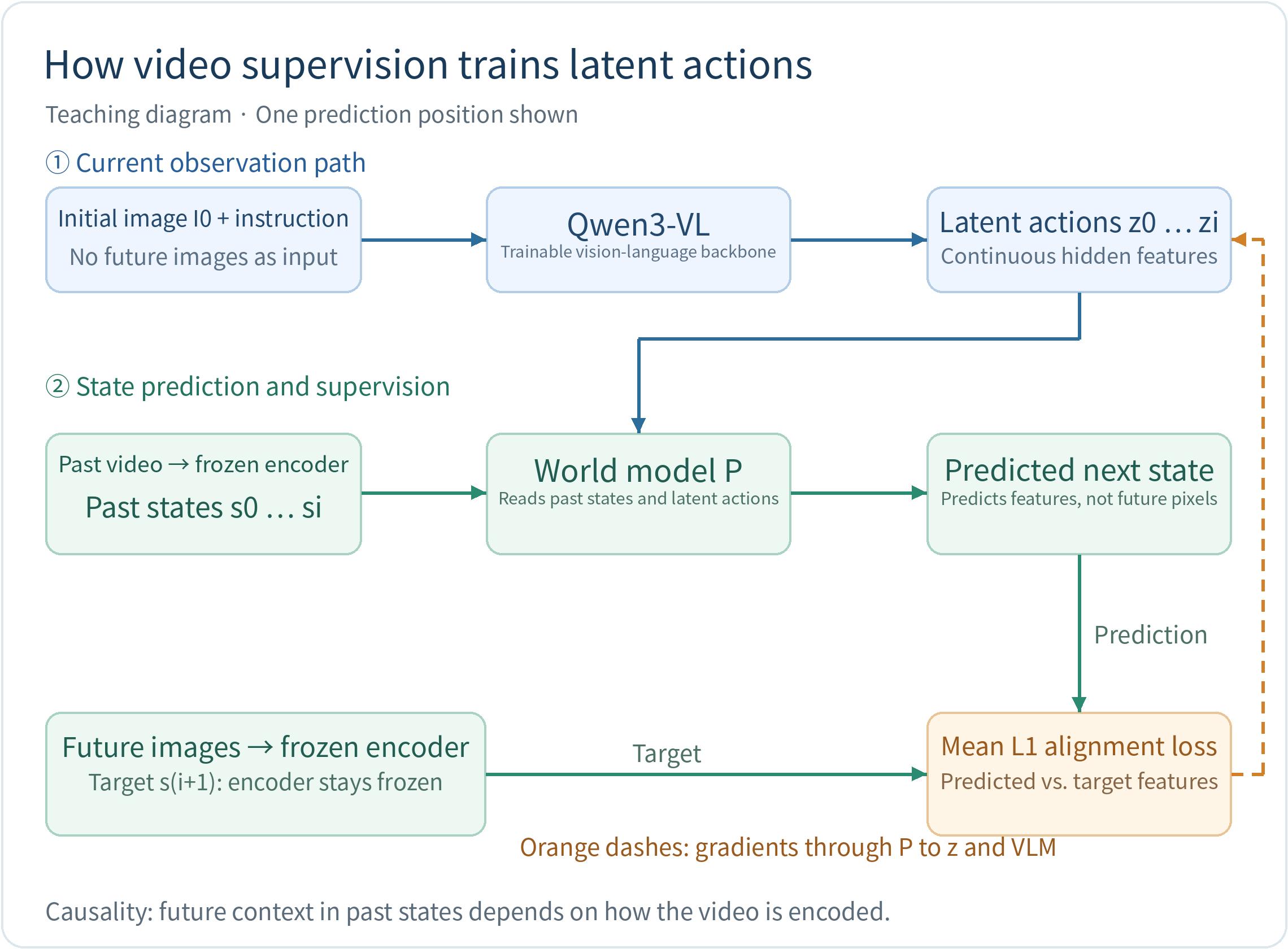
The crucial connection is the gradient path. Future images pass through the fixed encoder to form targets. Prediction error propagates through the world model into the VLM, encouraging latent actions to carry information useful for predicting changes. To predict an apple leaving the table, for example, the latent action must help explain that transition without a manual semantic label for every hidden feature.
The author implementation uses mean L1 error. The following expands that implemented loss; Equation (5) itself does not specify the error norm:
collects target features, counts elements, and denotes stop-gradient; the encoder stays fixed. In a teaching example, target and prediction give mean error .
This restricts future-image input to the VLM. The predictor’s temporal mask alone does not guarantee strict causality of the video encoder’s historical features.
From Latent Actions to Robot Actions
State features still need a connection to control. A second set of action queries follows the latent-action queries, reading preceding images, language, and latent actions to form conditioning (Equation (6)). A DiT (Diffusion Transformer) action head then generates a continuous action sequence.
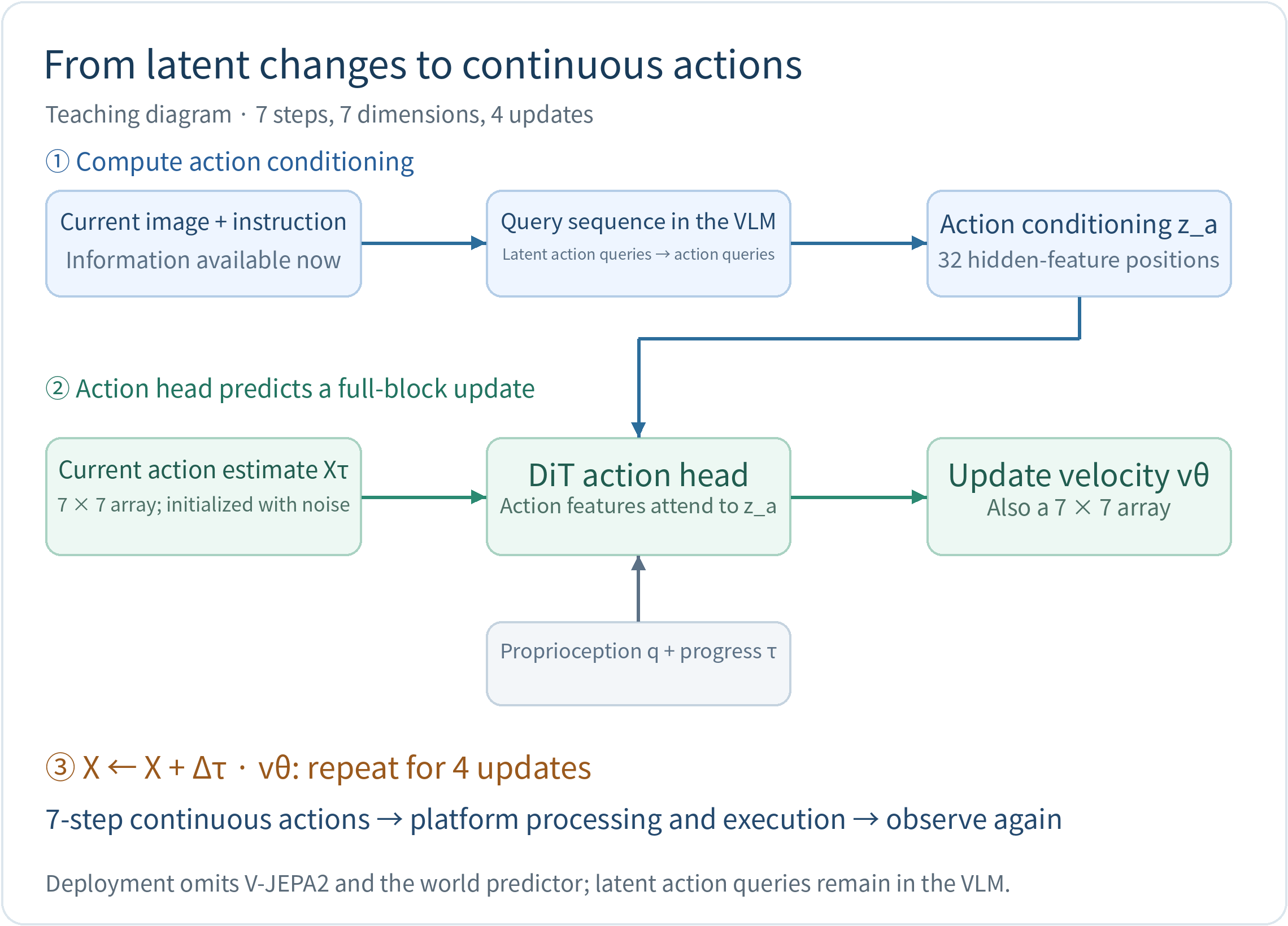
The head uses conditional flow matching. It mixes a demonstrated action chunk with same-shaped Gaussian noise , then learns the direction from noise toward actions. Equations (7)–(8) can be written as:
is generation progress, distinct from robot time. returns updates with the action chunk's shape. For one element, , , and give an intermediate value of 0.2 and target direction of 0.8. Predicting 0.5 gives squared error 0.09.
Inference starts from fresh noise and follows predicted directions. The pinned implementation uses Euler updates:
Four updates generate a action chunk: seven control steps with seven values each. The four updates occur inside the action head, rather than representing four robot steps. The implementation also supplies proprioceptive state and generation progress to the head, which reads through cross-attention. The paper uses uniform time sampling, while the pinned implementation uses Beta sampling, a training-configuration difference.
Training and Inference
Joint pretraining uses approximately 220,000 Something-Something-v2 human videos and 76,000 DROID robot trajectories. Human videos provide images and language for state prediction. Robot data additionally supplies action labels for joint optimization (Equation (9)):
weights the two losses. The author implementation and pinned LeRobot version both use 0.1. After 50,000 pretraining steps, separate branches continue from that checkpoint for simulation training (30,000 steps) and hardware fine-tuning (20,000 steps).
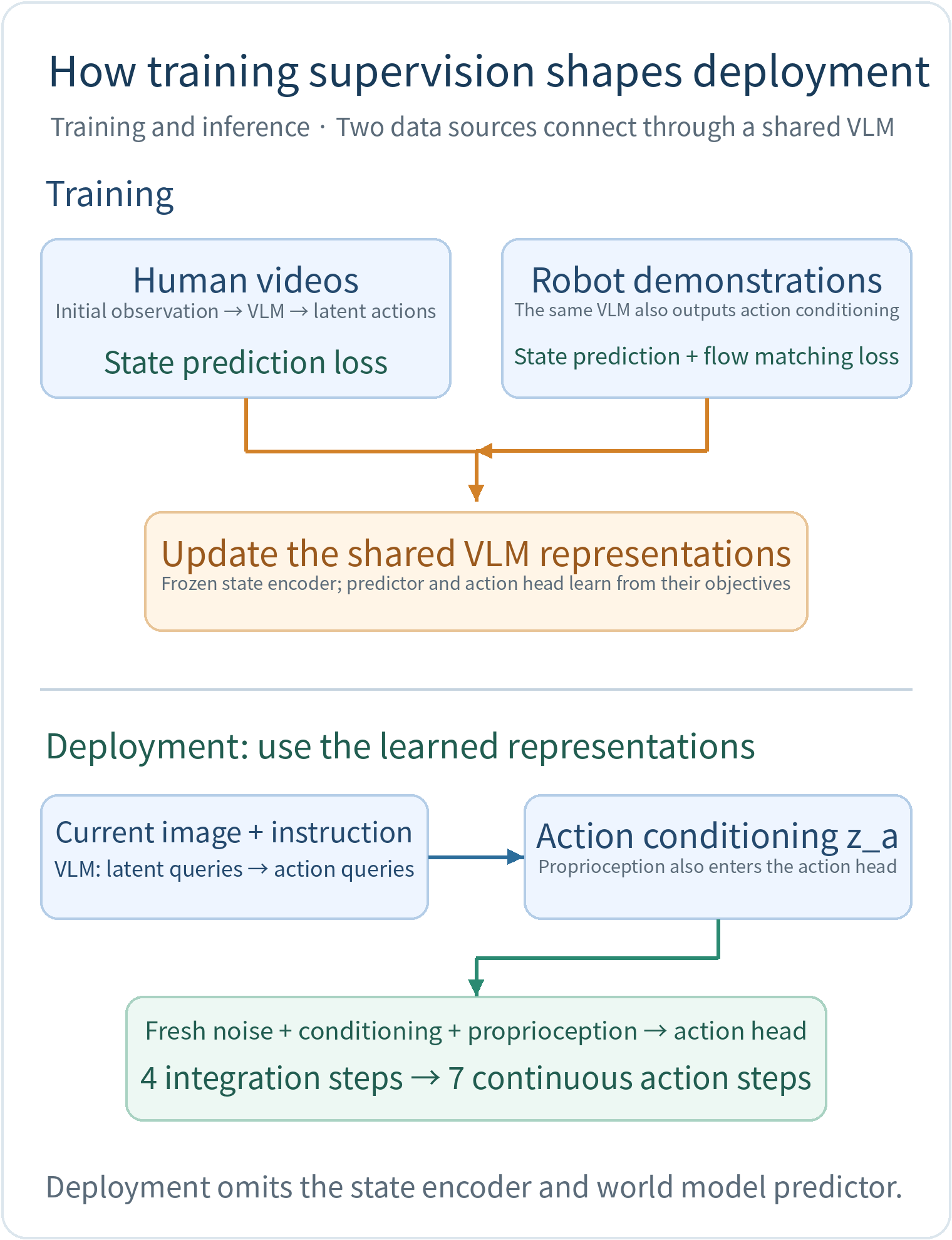
During training, the video encoder supplies history and targets; world-model error trains the VLM, and robot demonstrations add control supervision. During deployment, current images, instructions, and the action head's required state inputs suffice. Latent-action computation and the action head remain; the video encoder and world-model predictor are omitted. The controller executes actions, then new observations support another prediction.
The world model thus acts mainly as a training-time teacher. It encourages representations that explain changes, without searching future videos to choose actions during deployment.
Experimental Results
Standard Tasks and Perturbations
LIBERO fine-tuning uses expert demonstrations. Four suites each contain ten tasks, evaluated 50 times per task: 2,000 trials in total. Table 1 compares complete methods and includes the human-video ablation in its final two rows:
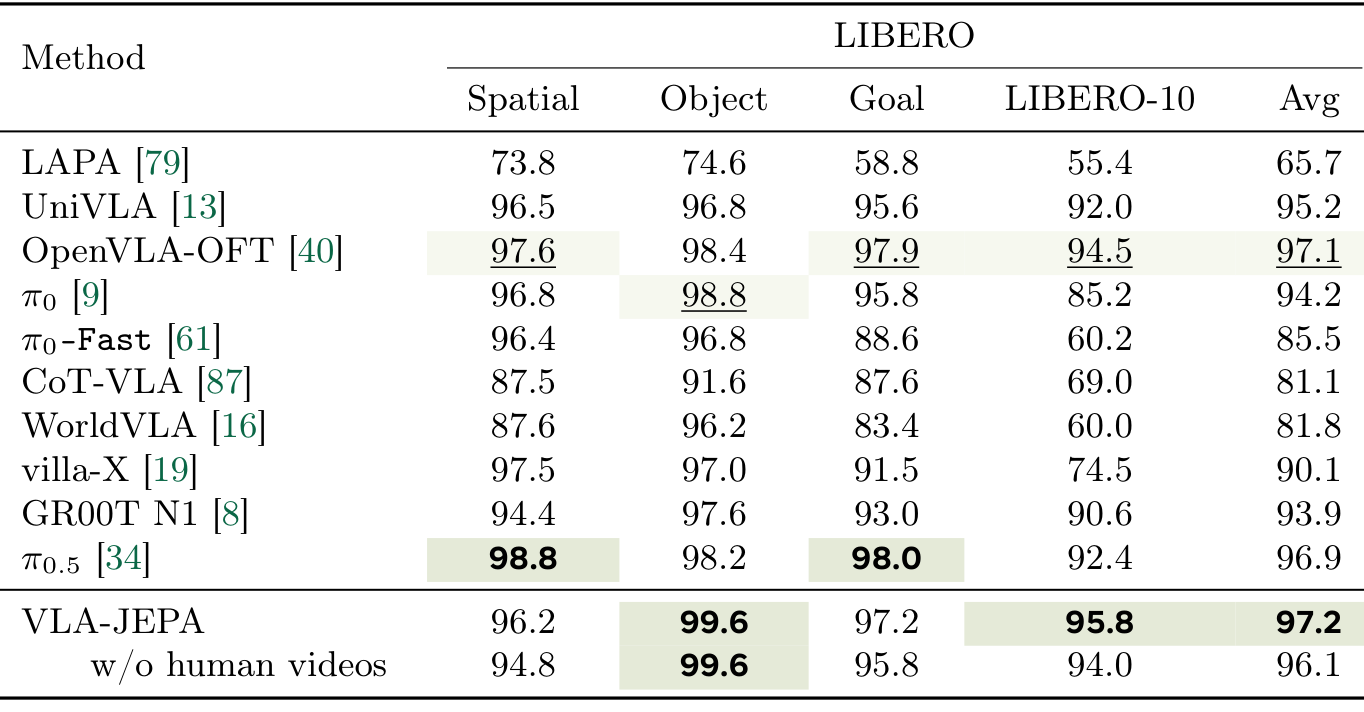
Mean success is 97.2%, versus 96.1% without human video. The complete model leads the listed methods, but is close to OpenVLA-OFT's 97.1%. The main table lacks error bars across independent training runs, so small differences should not be overstated.
LIBERO-Plus adds seven types of perturbation while retaining the original LIBERO training data:
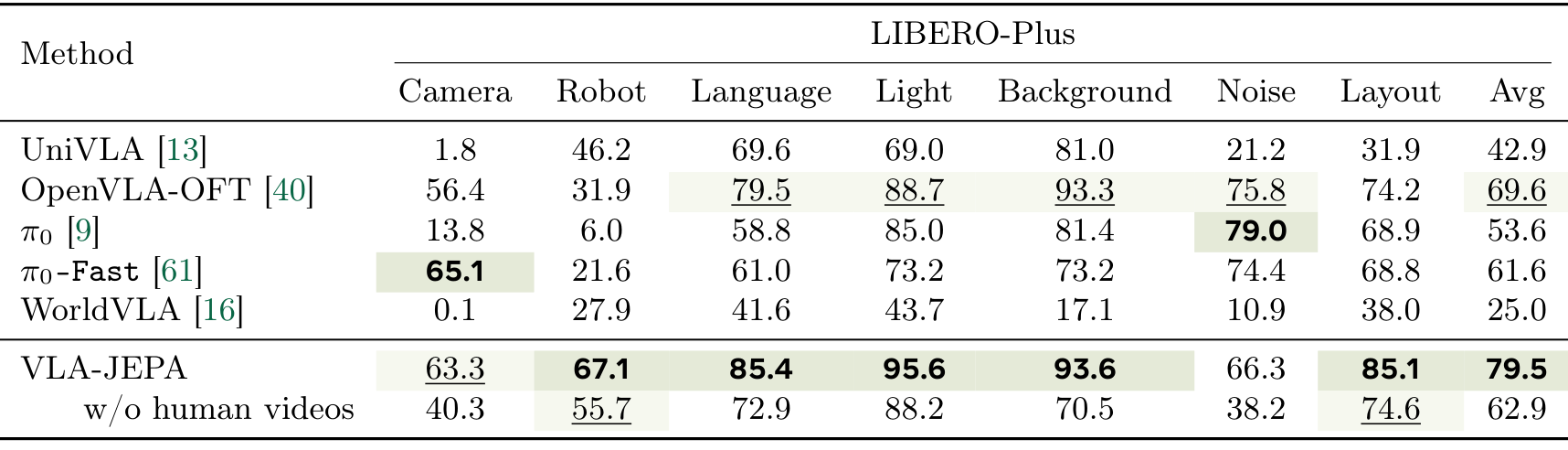
Human video raises mean success from 62.9% to 79.5%, improving all seven categories. This 16.6-percentage-point gain is larger than the 1.1-point gain on standard tasks, providing clearer evidence of benefits under perturbations.
Transfer and Hardware Performance
SimplerEnv evaluates transfer from real-robot training data to simulation:
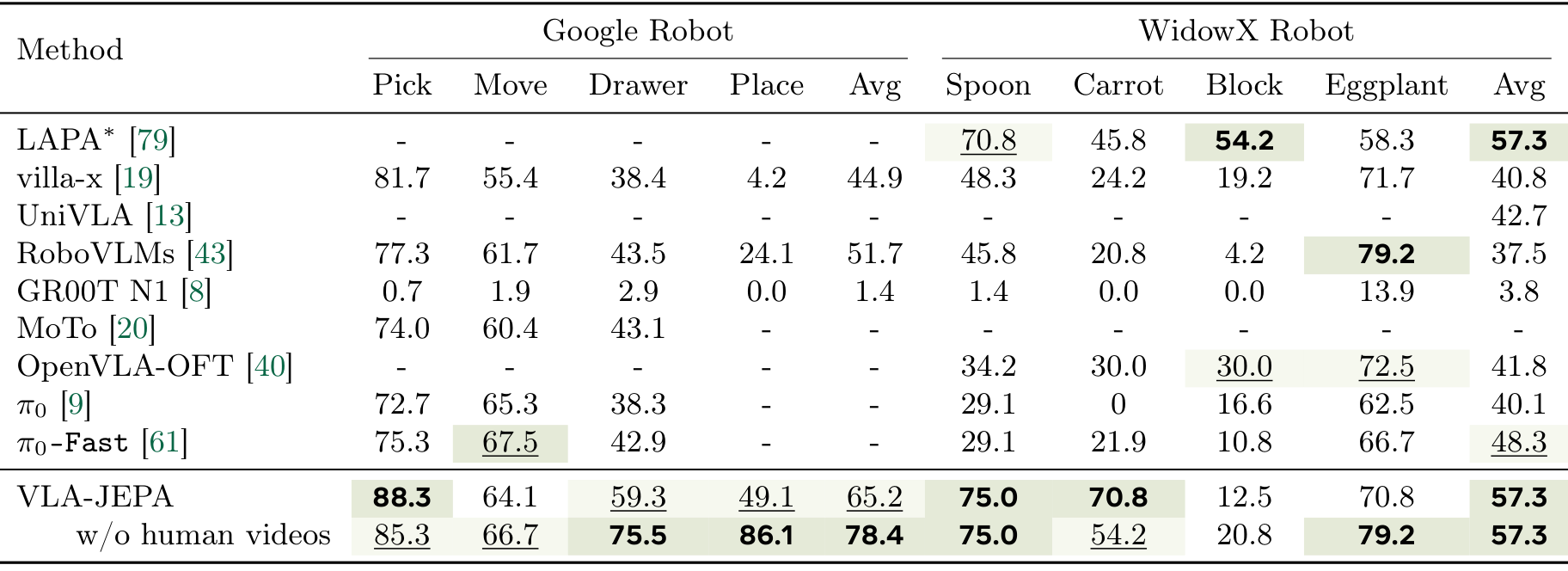
Benefits are not universal. Adding human video reduces Google Robot mean success from 78.4% to 65.2%; WidowX remains at 57.3%. Video experience does not replace robot demonstrations for specific control tasks. Some baseline means and textual rankings are inconsistent, so the conclusion here uses the model ablation.
Hardware tests use a Franka Research 3, Robotiq gripper, and three D435 cameras, with ten trials per task. Figure 4 reports the results:
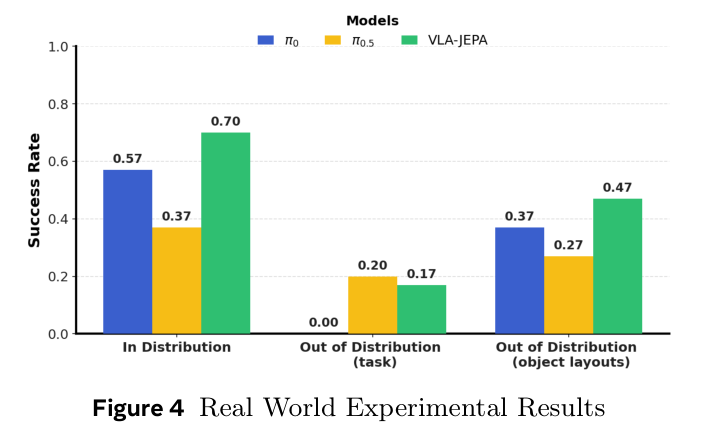
VLA-JEPA reaches 0.70 under in-distribution conditions and 0.47 after layout changes, leading the two baselines. Its unseen-task score is 0.17, below π0.5's 0.20. None of the three models completes placing grapes on the top level of an unseen shelf, and VLA-JEPA can still select the wrong object.
These experiments support the overall method's competitiveness and the contribution of human video to perturbation robustness. They do not separately isolate the effects of the JEPA objective, information access, and training stages.
Conclusion
VLA-JEPA turns state changes in video into supervision for robot representations. Latent actions explain changes, the action head produces control values, and robot demonstrations connect the two. This supervision design improves performance under the tested perturbations, while reliable execution and generalization to unseen tasks remain unresolved.