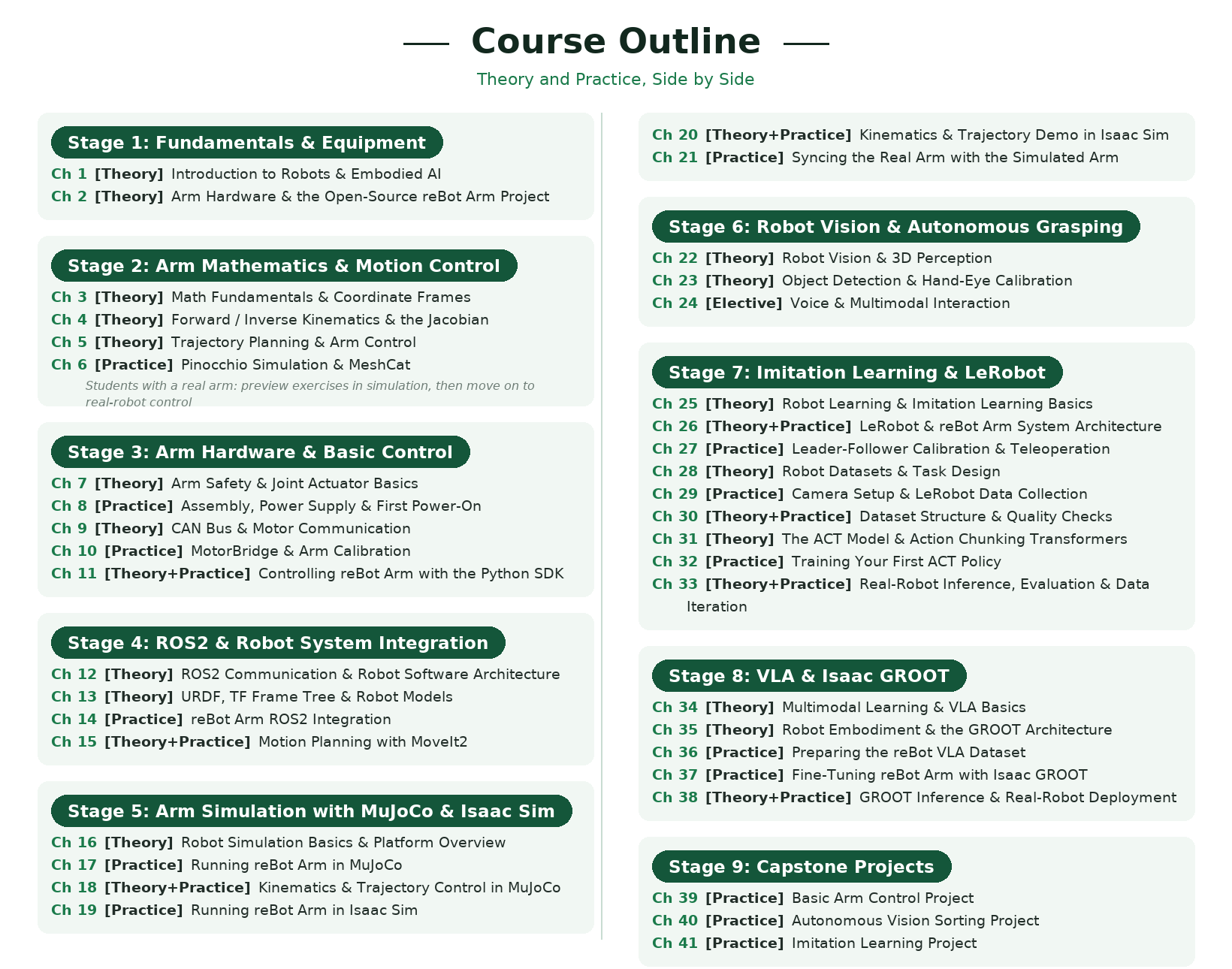
8 Stages, 39 Chapters — free and hands-on
A free, hands-on guide to building and learning with the 100% open-source reBot robotic arm. The published chapters take you from basic concepts, assembly and motor control, through imitation learning with LeRobot and VLA with Isaac GR00T, to the robot arm mathematics and motion control behind it all — and on to robot vision, autonomous grasping, ROS2 robot system integration and simulation.
This course was created and shared for free by the Seeed Studio AI Robotics team, to give robotics learners, students, job seekers, and makers a clear and systematic learning path. You are welcome to learn from it and share it with others, but unauthorized copying, commercial redistribution, or misuse of the content is prohibited — the copyright belongs to Seeed Studio (Shenzhen) Co., Ltd.
It is built around reBot, a 100% open-source, commercially usable and reproducible robotic arm, and combines theory with hands-on practice to cover robotic arm control, traditional robotics algorithms, and modern VLA-based embodied AI. The course is completely free — if you find it useful, please support the project by starring reBot-DevArm on GitHub ⭐, where the hardware drawings, BOM files, and other open-source resources are also available. Experienced users can go straight to our Robotics Wiki for tutorials and examples. The focus is practical understanding rather than deep mathematical derivation, so you can build a solid foundation quickly and prepare for more advanced study. Stage 5 does introduce the mathematical foundations — coordinate frames, kinematics, the Jacobian and trajectory planning — but it is written as reference material you can read once and then look up while working through the hands-on chapter. Stage 6 follows the same pattern: Chapters 27 and 28 are vision theory, and Chapter 29 is the hands-on visual grasping practice. Stage 7 does the same again — Chapters 31 and 32 are the ROS2 concepts, and Chapters 33 and 34 put the arm on a real ROS2 system. Stage 8 closes the course by putting the arm inside a computer: Chapter 35 is simulation theory, Chapters 36 and 37 run the arm in MuJoCo, Chapter 38 builds it in Isaac Sim, and Chapter 39 synchronizes the real arm into the simulation.
Community Groups


Discord
Course Design Principles
This course uses the reBot Arm B601-DM and B601-RS as practical platforms, combining robotic arm theory, robotics learning theory, and real hardware practice. The course outline is as follows: