Edge License Plate Recognition — Selection, Deployment and Measured Data
Supports mainland China single-row blue plates (7 characters) and green new-energy plates (8 characters); two-row, special-purpose and overseas plates are not supported. The licence of the detection and recognition weights is not yet confirmed; confirm it before commercial distribution.
What this solution does
Keep the network cameras already mounted at the gate and add one recognition host on site to read plates. When a whitelisted vehicle arrives, the gate controller sends the barrier one opening signal; every vehicle leaves a record with its plate number, confidence and a snapshot. It fits residential, campus and staff car-park gates, and can also run without a barrier as an entry/exit log.
- Deployment package (Docker Compose and configuration): github.com/suharvest/sensecraft-solutions
- Selection and deployment: reference design page
Plates and video stay on site
Recognition runs on the host on site. Snapshots stay there for 7 days by default and leave only when fetched by link.
30 fps at 1080p
reComputer J30 Series and RK3576 Series both process 1080p at 29–30 fps; see "Performance and measured data".
Keep your cameras
Existing 1080p network cameras connect over RTSP; the host pulls the stream across the LAN.
One record per vehicle
Each vehicle is reported once with plate number, plate type, confidence and a snapshot link; a parking system subscribes to one MQTT topic.
On a real device
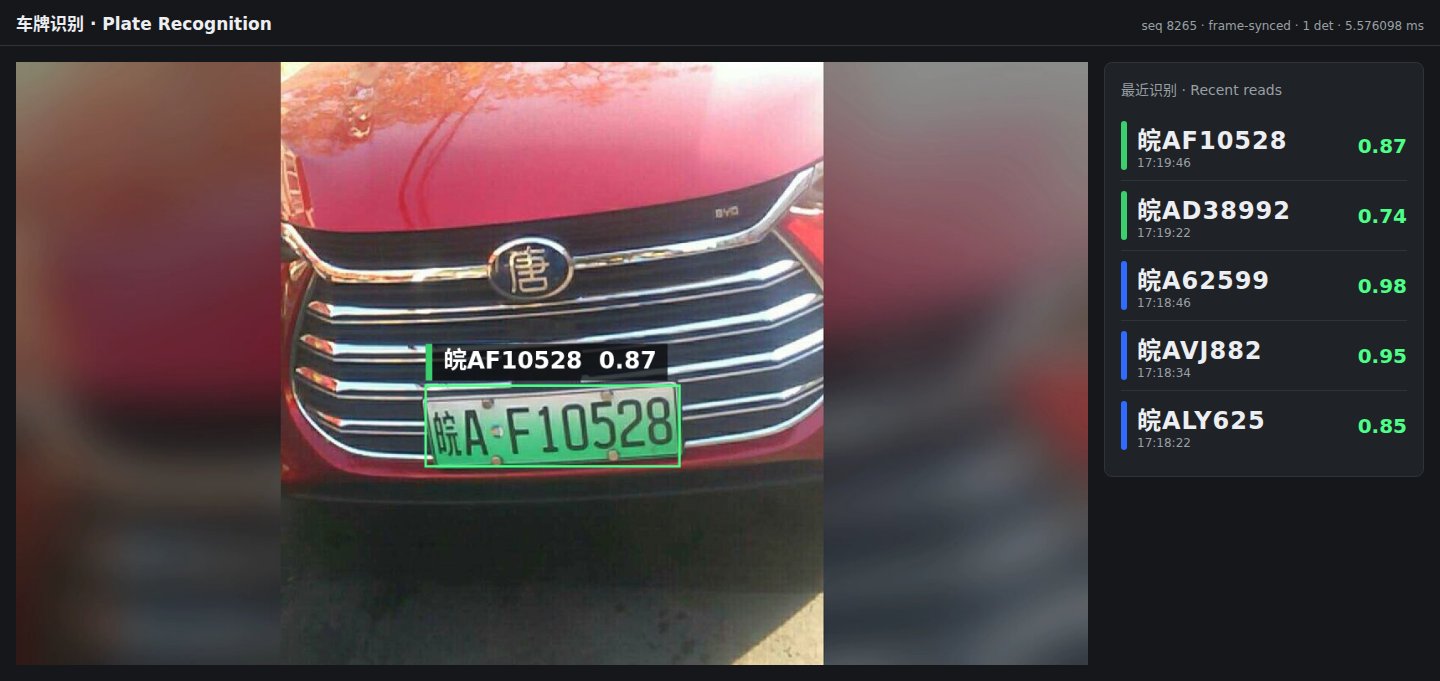
The recognition host's own browser preview page: the plate is boxed and labelled with its number and confidence, and the last five reads are listed on the right.
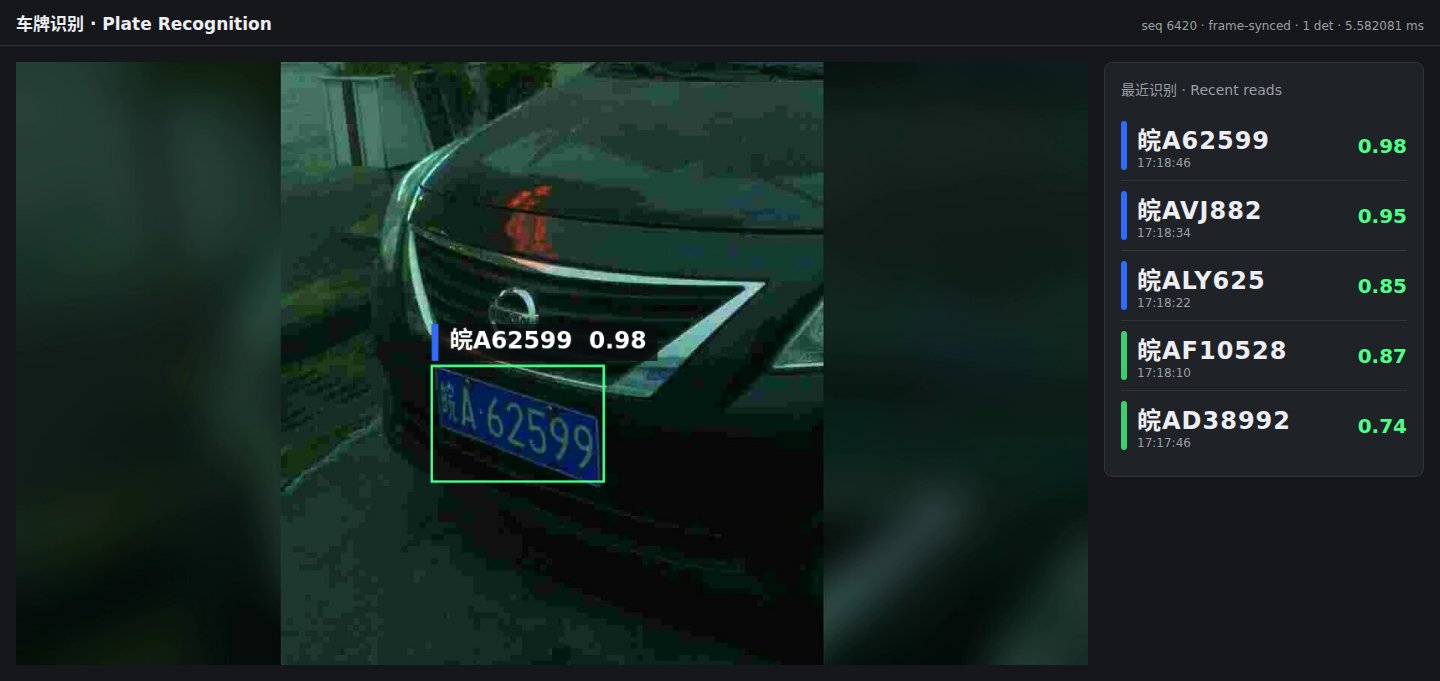
The input frames are stills from the CCPD public test set (MIT licence) looped over RTSP, not site footage.
Hardware you need
Three things on site: the gate camera, one recognition host, and, for automatic opening, a gate controller plus an interposing relay.
① Gate camera: your existing network camera, 1080p or better, with an RTSP stream.
② Recognition host: pick one; one host per gate camera.
| Recognition host | Measured (1080p input) | Choose it when | |
|---|---|---|---|
 | reComputer J30 Series (J3011) Jetson Orin Nano, JetPack 6.2 | 30 fps | Default choice |
 | reComputer J40 Series (J4012) Jetson Orin NX, JetPack 6.2 | Same package as J30 | The host also runs other models |
 | reComputer RK3588 Series On-board NPU | Deployment and output measured | The site standardises on Rockchip |
 | reComputer RK3576 Series On-board NPU | 29–30 fps | Cost comes first |
③ Gate controller (optional): reComputer R1100 Series (R1124-10). It runs the MQTT broker, holds the whitelist, and signals the barrier from a digital output through a DIN-rail interposing relay. Closing stays with the barrier's own loop or radar.
Camera, recognition host and gate controller sit on the same LAN; wired connections are recommended.
Deploying on site
1. Mount the camera
Mount the camera 3–8 m from the lane at a fixed position, aimed where plates pass. Recognition only runs inside a configured region of the picture (the lower middle by default); check that region again whenever the camera moves.
2. Install the software: three steps
Device-by-device steps are on the reference design page; this is the outline.
- Gate controller (optional): install the MQTT broker and the gate service on the R1124-10, upload the whitelist CSV, and confirm the barrier moves with the test-open endpoint.
- Recognition host: enter the camera's RTSP address and the MQTT broker address, then deploy. The first deployment downloads the runtime and models; after that it runs offline.
- Check: open the preview page on port 8080 of the host; passing vehicles show a boxed plate, and the plate topic carries one record per vehicle.
Before going live, check the reads against real plates using daytime and night footage from your own gate.
Interfaces
Results go over MQTT to the broker you entered at deployment (usually the R1124-10); snapshots and status use HTTP.
- Parking or billing system: subscribe to the plate topic, one record per vehicle; reconcile on
plate_normalized. - Barrier: the R1124-10 checks each plate record against the whitelist and publishes the result on the gate topic. The same plate arriving again within the cooldown is logged as
suppressedand does not reopen. - Your own system: fetch the snapshot by the link in the record, or monitor the service through the health endpoint.
| Topic / port | Content |
|---|---|
MQTT <site>/parking/<camera>/plate | Plate number, plate type (cn_blue / cn_green), confidence, voting frames, position in the picture, snapshot link |
MQTT <site>/parking/<camera>/gate | Gate record: open_pulse (opened) or suppressed, with the matching plate record and whitelist label |
MQTT <root>/status | Service status, published periodically; the last one stays on the broker if the host goes offline |
HTTP 8080 /snapshots/{seq}.jpg | Snapshot linked from the plate record, kept 7 days by default |
HTTP 8081 /whitelist (R1124-10) | GET returns the whitelist CSV, PUT replaces it (a 400 names the failing line); POST /gate/test fires one test opening |
HTTP 8099 /healthz | Service status including processing speed |
Snapshots are not embedded in records; a record carries only the link and the snapshot's sha256.
Performance and measured data
Processing speed
| Device | Processing speed | Plate detection per frame | Conditions |
|---|---|---|---|
| reComputer J30 Series (Orin Nano) | 29.9 fps (measured) | p50 5.6 ms (measured) | 1080p RTSP at 30 fps |
| reComputer RK3576 Series | 29–30 fps (measured) | p50 23.1 ms, recognition 1.8 ms (measured) | Same |
Reproduce: sensecraft-solutions/solutions/edge_plate_recognition (deployment package) with input clip plate-labeled40-1080p-120s.mp4
Plate reads
Input is CCPD test-set plate stills, each held for several seconds, streamed at 1080p over RTSP. Ground truth comes from the CCPD file names.
| Device | Input | Result |
|---|---|---|
| reComputer J30 Series | 40 stills | 56 plate records published, 50 match the ground truth (measured) |
| reComputer RK3576 Series | 40 stills | 57 plate records published, 51 match the ground truth (measured) |
| reComputer J30 Series | 8 stills | 5 read correctly, 3 produced no record, 0 wrong plates (measured) |
| reComputer RK3588 Series | 8 stills | 5 read correctly, 3 produced no record, 0 wrong plates (measured) |
One still can produce more than one record while it stays on screen, so record counts exceed still counts. When a plate cannot be read the host publishes nothing: neither device published a wrong plate on the 8 stills.
Reproduce: sensecraft-solutions/solutions/edge_plate_recognition/gallery/ATTRIBUTION.md (file names and ground truth of the 8 stills)
Models and runtimes
| Device | Detection | Recognition | Runtime |
|---|---|---|---|
| reComputer J30 / J40 Series | YOLOX-Tiny, 640×640, FP16 | PlateRecNet (in-house), 96×32, FP16 | TensorRT, hardware decode |
| reComputer RK3588 / RK3576 Series | YOLOX-Tiny, 640×640, INT8 | PlateRecNet, 96×32, INT8 (FP16 output layer) | RKNN runtime 2.3.2, MPP hardware decode |
Parameters that affect results (deployment package config/plate.json):
plate.roi: recognition region, lower middle of the picture by default. Redraw it after the camera moves.plate.vote: up to 7 frames vote per vehicle; a record is published when at least 3 agree with confidence 0.6 or higher.plate.dedup_s: the same plate is published at most once in 30 s.
Known degradation
- Unsupported plate types: Supports single-row blue (7-character) and new-energy green (8-character) plates only. Double-row yellow, trailers, police and overseas plates are not supported.
- Camera angle and speed: Vehicles must enter at an angle ≤ 30° with plate width > 96 pixels in the frame. Acute entry angles (> 45°) or speeds over 30 km/h degrade detection.
- Glare and headlight overexposure: Direct glare or high-beam headlights at night can wash out characters. Even supplemental lighting (~5000K) is recommended in unlit gates.
Data and asset sources
- CCPD (Xu, Z. et al., ECCV 2018): github.com/detectRecog/CCPD, MIT License, Copyright (c) 2017 CCPD. The screenshots on this page use its test-set images; the plates are real plates from the public dataset.
- Detection model code YOLOX: Apache-2.0. The recognition model structure is in-house code. The licence of both sets of trained weights is not yet confirmed; confirm it before commercial distribution.