Edge Product Recognition: Build, Deploy, and Measured Results
Recognition results are not a legal measurement and cannot be used as the basis for pricing or a legally binding count.
What this solution does
A camera watches a checkout belt or a shelf face. Every product in the frame is boxed, cropped, turned into a 512-dimensional vector and looked up in a gallery of registered SKUs. At the checkout the output is a basket (SKU-to-quantity, aggregated by track id so one item passing the camera is counted once); on the shelf it is a slot state (ok, empty, wrong_sku, unknown, aggregated per planogram position). One MQTT message per frame carries the results.
Adding a product in store needs no retraining: photograph the new SKU three to eight times, post the images to the console, and the gallery gains a new immutable version. The detector is single-class and only answers "there is a product here", so it never learns individual products; the embedder is not updated either.
- Selection and deployment: Reference design page
- Upstream repository: not published. The package carries no
intro.links.github; the code lives in an internal repository at packaging time.
Add a SKU with 3–8 photos, no retraining
Registration creates a new immutable gallery version. Going from one registration image to eight raises top-1 by 28 percentage points (see performance and measured data).
Detection runs on an NPU or GPU
RKNN fp16 on RK3588 agrees with the CPU reference on 99.85% of boxes at 56.7 ms p50; the Hailo-8 INT8 HEF runs at 9.04 ms p50 with 94.77% agreement; TensorRT fp16 on reComputer J40 series (J4012) runs at 5.18 ms p50 with 99.91% agreement.
Your own cameras and store systems
Any RTSP / USB camera. The POS reads SKU-to-quantity from MQTT, a replenishment system reads empty and wrong slots, and an HTTP API serves event queries and gallery management.
Data stays on site
Camera, recognition host and console host are all local, and the broker runs in the console stack. The bundled broker is anonymous plaintext; add accounts and TLS before going live.
The console
The upstream package ships four screenshots of the management UI: the event list, the per-box event detail, the product gallery and the checkout/shelf board. All four were produced by the upstream web_demo tool against synthetic fixtures; the SKUs, similarity scores and events in them are test data and show only the interface layout.
The three shelf states
The shelf decision was measured on the reComputer RK3588 series and on the reComputer R2000 series + Hailo-8. Each slot gets one of three states: correct, empty, or wrong SKU.
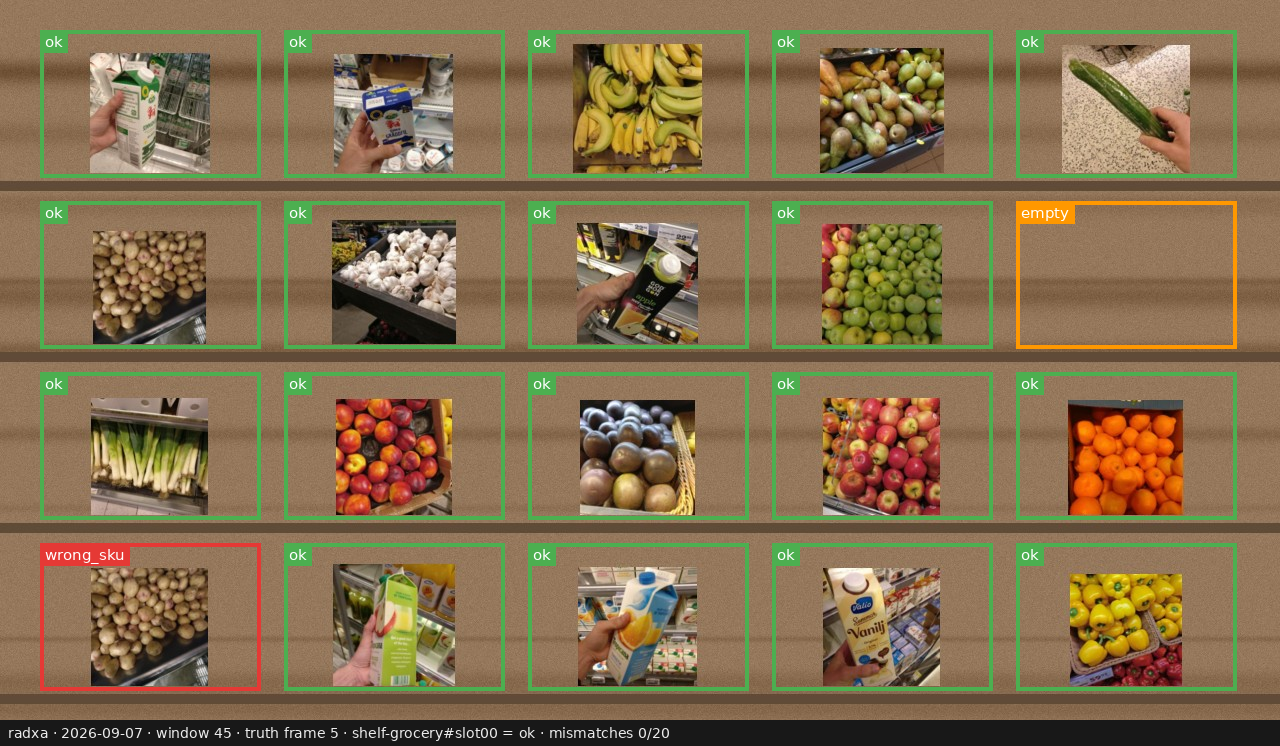
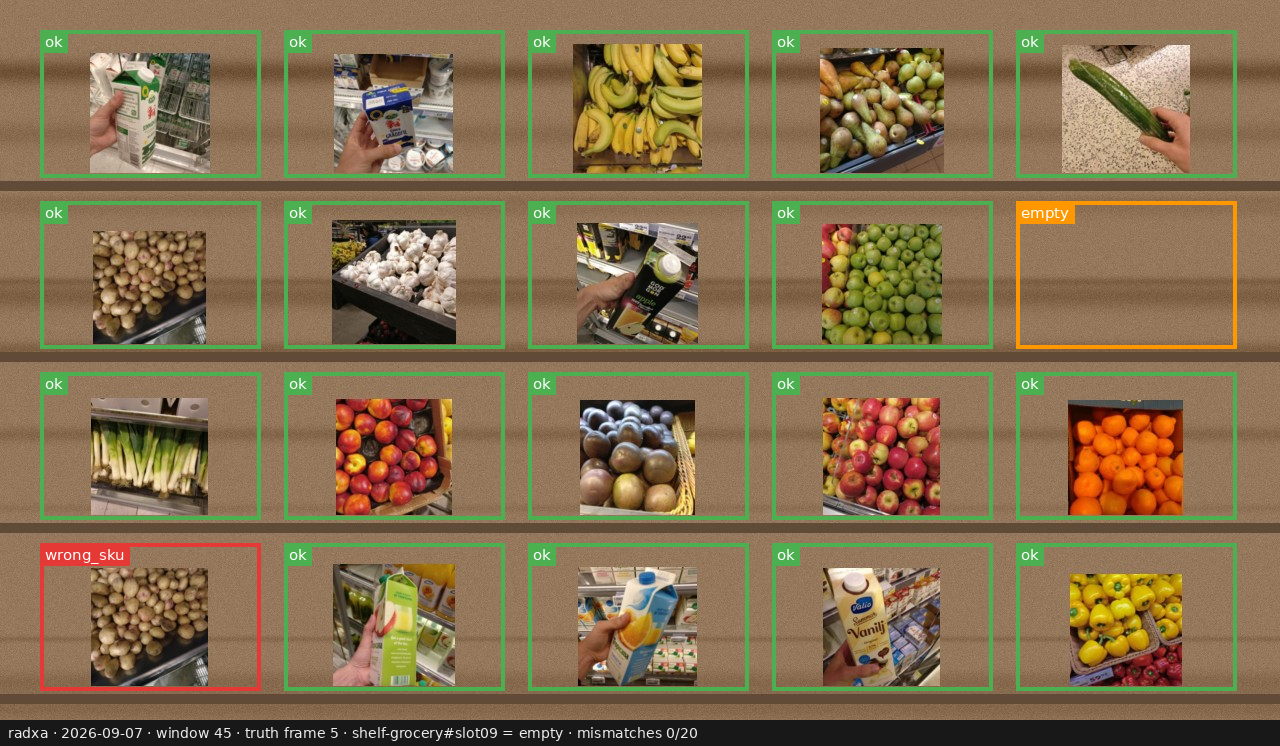
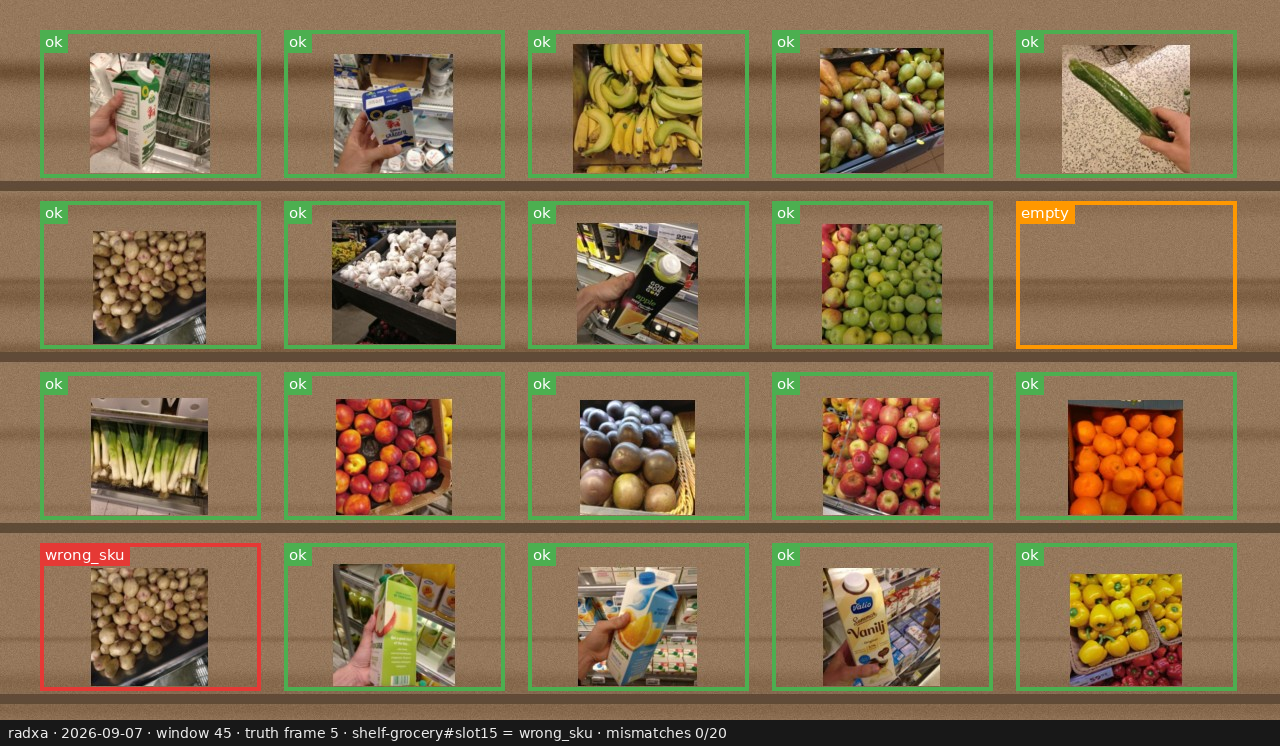
The three states in sequence:
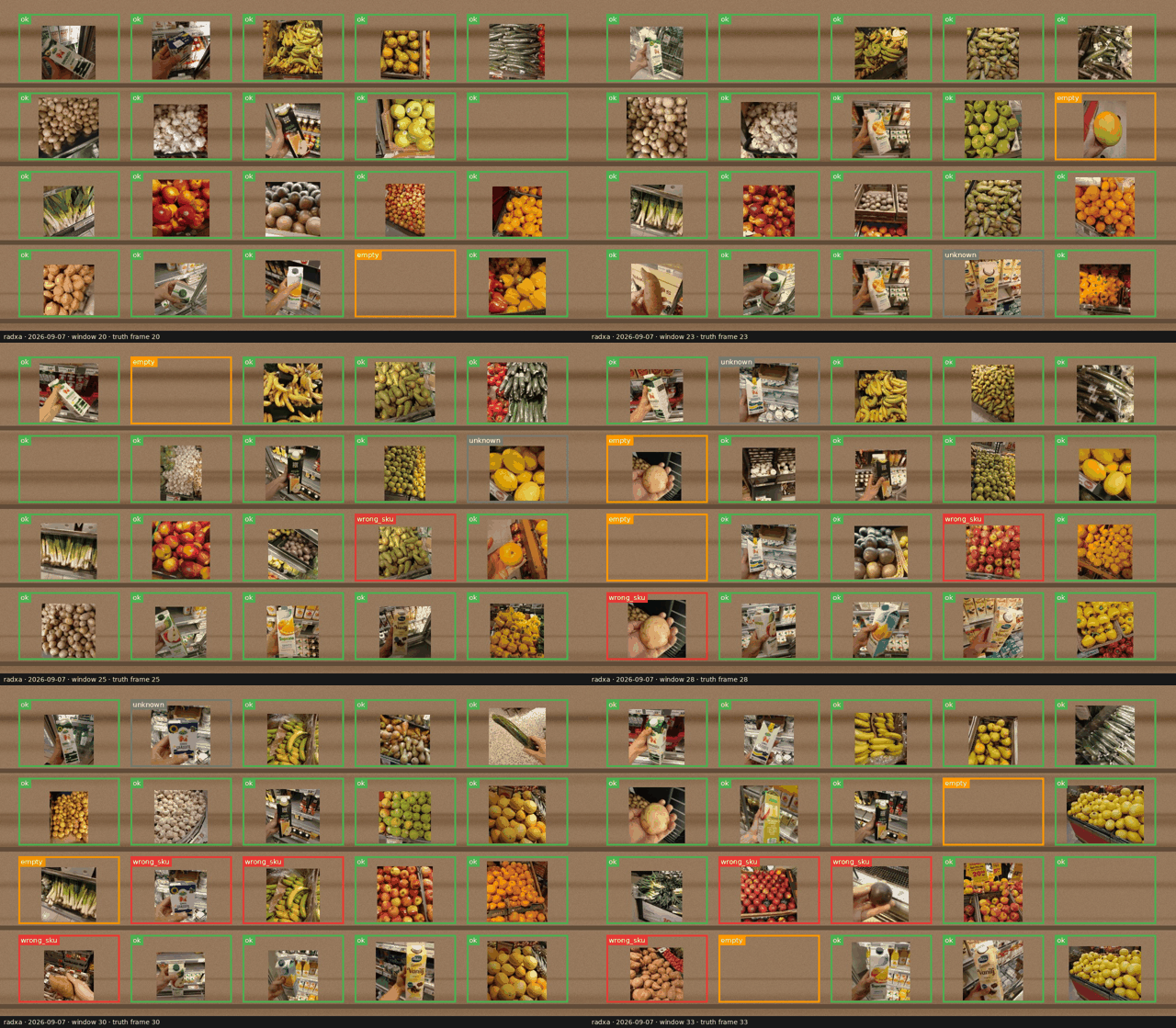
The checkout chain outputs per-item tracks:
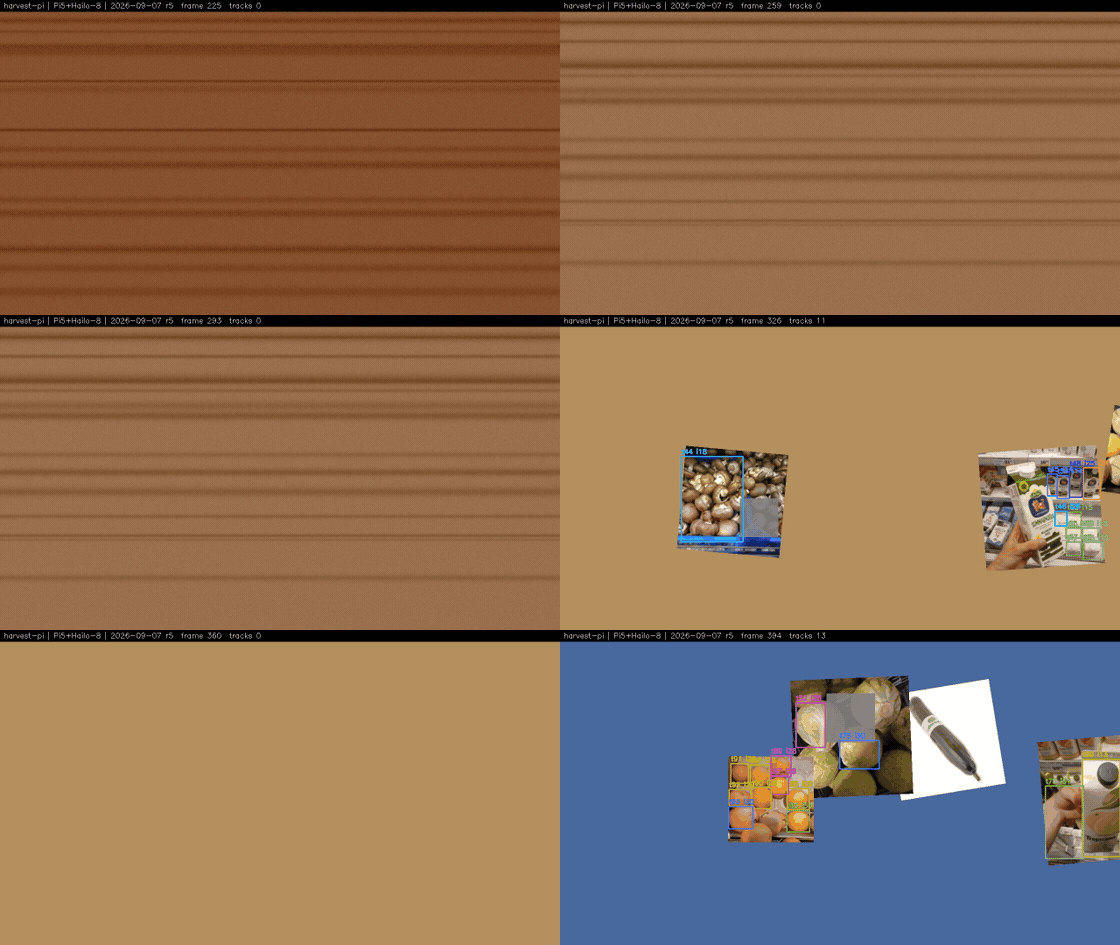
These frames come from two hardware runs, edge-retail-recognition/evaluation/runs/2026-09-07-runtime-*, using products the project bought; none come from a dataset.
What hardware you need
Four things per site: a camera, a recognition host, a console host, and an x86_64 conversion machine (used once per model).
① Camera — any RTSP / USB camera mounted above the checkout or facing the shelf; nothing runs on it. The input size is compiled into the artifact: 640² for checkout, 1280² for shelf.
② Recognition host — this is where the three presets differ:
| Host | Measured on this hardware | When to pick it | |
|---|---|---|---|
 | reComputer Industrial R2035-12 (Hailo-8, 26 TOPS) Detector on the NPU, embedder on the four A76 cores | Both stages: 9.04 ms detection, 91.95 ms per crop embedding | You need measured data for both detection and embedding |
 | reComputer RK3588-30 Detector on the Rockchip NPU, embedder on the CPU or the NPU | Detector at 99.85% box agreement and 56.7 ms; with the embedder on the NPU, a 20-SKU shelf replay published results at 924 ms p50 from detection | You already run Rockchip boards, or the camera faces a shelf. RK3576 uses the same toolchain |
 | reComputer J4012 (Orin NX 16GB) or reComputer J3011 (Orin Nano 8GB) TensorRT path, detector and embedder on the GPU | J4012: 5.18 ms detection, 4.23 ms per crop embedding; 2956-frame checkout replay with 0 dropped frames | You already run Jetson, or want the whole chain on one machine |
All figures are measured on the hardware in that row.
③ Console host — your own amd64 or arm64 Linux machine with Docker, no GPU needed, reachable by every recognition device. It runs three containers: the registration/query service, the management UI and the MQTT broker. Both container images are built on this host from the upstream repository, not pulled from a registry.
④ An x86_64 conversion machine — neither rknn-toolkit2 nor the Hailo Dataflow Compiler runs on the target board. Each model is converted once; deployments do not repeat it.
Negative Selection Boundaries
- Catalog Size and Search Latency: If the local product catalog exceeds 200 SKUs, linear vector search latency increases. For larger catalogs (>500 SKUs), deploy ANN indexing or offload search.
- CPU-Only Embedding: Never run embedding extraction on CPU alone (exceeds 900 ms per crop); always verify NPU or TensorRT hardware acceleration.
How to deploy on site
Settle the artifact and camera position first, then install the software in four steps per preset.
1. Mounting: choose the artifact, then the camera position
The input size is compiled into the artifact and cannot change at runtime. A 640² artifact looking at a shelf misses distant products; moving to 1280² raises small-object mAP50-95 on SKU-110K test from 17.49 to 26.88. Decide checkout or shelf first, then mount the camera so products take up a suitable share of the frame.
On the Hailo-8 preset, embedding is one CPU inference per box. At the 91.95 ms per crop measured on the reComputer R2000 series, a five-item basket takes about half a second; a shelf frame at the measured density of 157.6 boxes takes about 14 seconds. Shelf deployments on this preset must subsample frames or sample per slot. On reComputer J40 series (J4012) embedding runs on the GPU at 4.23 ms per crop.
2. Software, four steps
Per-device steps are on the reference design page; this section lists the flow. All three presets follow the same four steps:
- Bring up the console — the registration service, UI and broker run on the console host, with a role token table written at deploy time. There is no default token and no anonymous read; with an empty table the service refuses to start.
- Put the embedding model in place — place the DINOv2 ONNX where the console mounts it and switch
RETAIL_EMBEDDERaway from the placeholder. The upstream default isfake, which hashes image bytes into a vector;GET /api/healthdoes not report this, and the only symptom is that registration works but every lookup returns the wrong SKU. - Register SKUs — 3 to 8 photos each, at least front, back and side, under two lighting conditions. Fewer than three is rejected; a repeated sku_id returns 409 unless
replace=trueis set. - Convert and check the detector on the board — convert on the x86_64 host, copy the artifact to the board, and run a consistency check against the CPU reference.
Allow about 90 minutes per preset for the four steps, plus container build time on the console host.
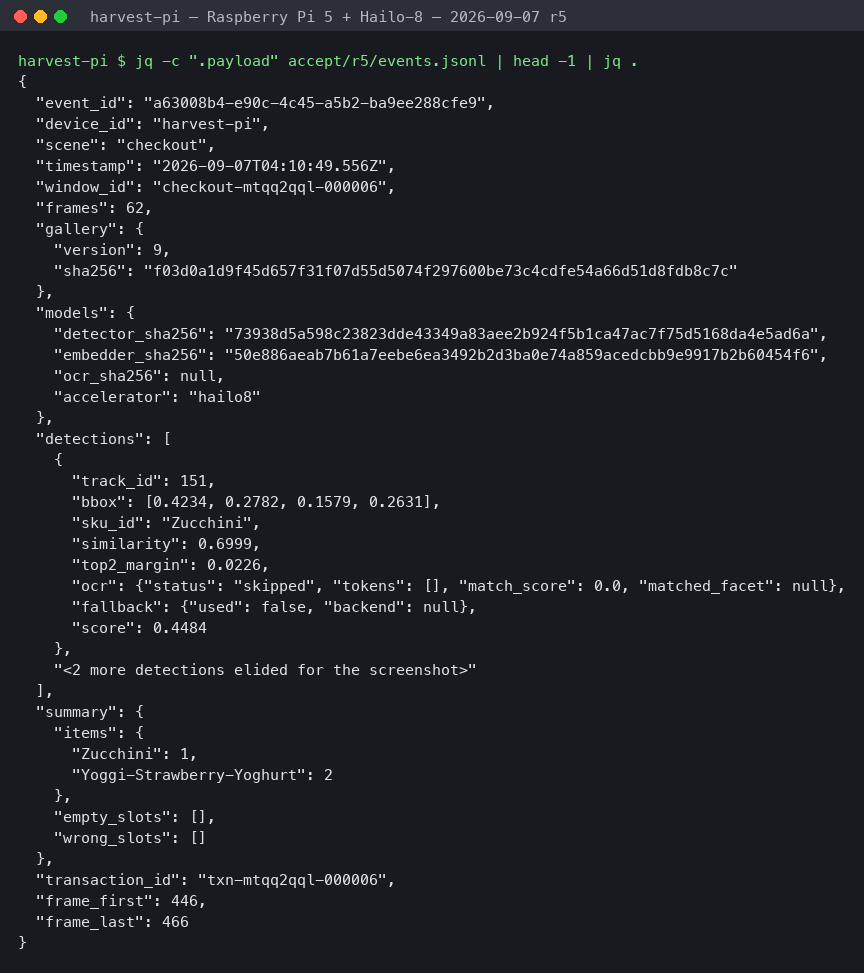
Confirm the embedding model is wired in. One recognition leaves a full record in the event stream: slot, matched SKU, similarity and per-box coordinates. With the fake implementation the similarity distribution is visibly abnormal.
What interfaces are available
Every output is on the console host: MQTT on 1883 and two HTTP interfaces on 8089 and 8080, all on the local network, and all except the broker behind the same token check.
- Checkout / POS subscribes to
retail/v1/eventsand readssummary.items, the frame's SKU-to-quantity map, without parsing the per-box array. - Replenishment or shelf audit reads
summary.empty_slotsandsummary.wrong_slotsfrom the same message. - A system that needs to trace a decision reads
detections[]: each box carriestrack_id, a normalisedbbox,sku_id,similarity,top2_margin, anocrblock and afallbackflag.
The full topic and payload
| Interface / port | Content | Notes |
|---|---|---|
MQTT retail/v1/events, 1883 | event_id, scene, timestamp, gallery.{version,sha256}, detections[], summary.{items,empty_slots,wrong_slots}, models.{detector_sha256,embedder_sha256} | One per frame, not one per box |
HTTP /v1/gallery/skus, 8089 | POST a sku_id, display name, aliases, licence fields and 3–8 images → a new immutable version | Same sku_id returns 409 unless replace=true |
HTTP /v1/gallery, /v1/gallery/{version}, /v1/gallery/current/download, /v1/gallery/rollback/{version}, 8089 | Version list, per-version manifest, tar.gz with SHA256SUMS, and rollback that re-verifies the target's SHAs before switching | Rollback does not create a new version |
HTTP /api/events, /api/events/{id}, /api/summary, 8080 | Event list filtered by scene / SKU / device / time, per-box detail, board summary | Read-only API, same token check |
Read similarity together with gallery.version, gallery.sha256 and the model hashes in the same message. Vectors from two different embedders are not comparable, and mixing them shows up as nothing being recognised; every message carries all four for this reason.
Authentication is Bearer <token> with roles viewer < operator < admin. The broker ships anonymous and plaintext, so anyone who can reach port 1883 can publish forged recognition events.
Performance and measured data
Detection, measured on device
| Device | Artifact | p50 / p95 | Box agreement with CPU reference |
|---|---|---|---|
| reComputer R2000 series + Hailo-8 | INT8 HEF, 640² | 9.04 / 9.10 ms | 94.77% (200 images), 94.68% (300 images) |
| reComputer RK3588 series | RKNN fp16, 640² | 56.7 / 89.5 ms | 99.85% |
| reComputer RK3588 series | RKNN INT8, 640² | 26.0 / 33.2 ms | 98.35% |
| reComputer RK3576 series | RKNN fp16, 640², two cores | 51.05 / 54.18 ms | 99.91% |
| reComputer J40 series (J4012) | TensorRT fp16, 640² | 5.18 / 5.28 ms | 99.91% |
| reComputer J30 series (J3011) | TensorRT fp16, 640² | 5.88 / 8.89 ms | 99.27% (checkout frames) |
Conditions: agreement is matched against the CPU reference at IoU ≥ 0.5; RK3588, RK3576 and J4012 use the same 50 SKU-110K images, J3011 uses 50 checkout frames. Hailo single-stream throughput 110.4 fps (hailortcli benchmark 110.64 fps, pure hardware time 8.21 ms; the extra 0.8 ms is the Python vstream round trip). End-to-end on the reComputer R2000 series (letterbox, output concatenation, decode and NMS included) is p50 18.74 ms / p95 24.25 ms: pure-numpy per-class NMS over about 160 boxes takes longer than inference itself.
Reproduce: evaluation/runs/2026-09-06-det-hef/, evaluation/runs/2026-09-06-det-rk3588-radxa/, evaluation/runs/2026-09-07-embed-rknn-rk3576/, evaluation/runs/2026-09-07-jetson-trt/, evaluation/runs/2026-09-08-orin-nano-acceptance/
Embedding, measured on device
| Device | Variant | Per-crop p50 / p95 | Retrieval cost vs fp32 |
|---|---|---|---|
| reComputer R2000 series (CPU, 4 threads) | DINOv2-small, dynamic-quantised INT8 | 91.95 / 105.98 ms | Within 0.65pp at all 7 measured operating points |
| reComputer R2000 series (CPU, 4 threads) | DINOv2-small, fp32 | 180.75 / 233.41 ms | Baseline |
| reComputer RK3588 series (NPU) | DINOv2-small, RKNN fp16 | 48.68 / 49.86 ms | At most 0.85pp across 21 metrics |
| reComputer RK3576 series (NPU, two cores) | DINOv2-small, RKNN fp16 | 56.38 / 62.17 ms | At most 0.36pp across 21 metrics |
| reComputer J40 series (J4012) | DINOv2-small, TensorRT fp16 | 4.23 / 4.69 ms | At most 0.24pp across 21 metrics |
| reComputer J30 series (J3011) | DINOv2-small, TensorRT fp16 | 5.06 / 7.64 ms | At most 0.21pp across 21 metrics |
Conditions: the 21 metrics are top-1, top-5 and open-set AUROC at 4 registration tiers on the Grocery Store Dataset and 3 on Products-10K. On the CPU, quantising weights only costs almost no retrieval accuracy; quantising activations as well costs a lot.
Reproduce: evaluation/runs/2026-09-06-embed-small/ §8, evaluation/runs/2026-09-07-embed-rknn/, evaluation/runs/2026-09-07-embed-rknn-rk3576/, evaluation/runs/2026-09-07-jetson-trt/, evaluation/runs/2026-09-08-orin-nano-acceptance/
Full-chain replays and shelf crops, measured on device
| Device | Scene | Result | Conditions |
|---|---|---|---|
| reComputer J40 series (J4012) | Checkout replay | Detection to result published p50 22.3 ms / p95 42.8 ms; 0 dropped frames over 2956 frames | Recorded-video replay, 30-SKU gallery; detection, embedding, retrieval and MQTT publishing on the same device |
| reComputer J30 series (J3011) | Checkout replay | 0 dropped frames over 6726 frames (2.27 loops), all 84 events published | Same recorded video and gallery |
| reComputer RK3588 series | Shelf replay | Detection to result published p50 924 ms / p95 1153 ms; top-1 541/704 on 704 slot crops, identical to the CPU fp32 reference | 20 SKUs, detector and embedder both RKNN fp16 on the NPU |
| reComputer RK3576 series | Shelf crops | Top-1 76.28% on 704 crops (CPU fp32 76.99%), 99.29% same-SKU agreement; embedder p50 61.0 ms per crop | Same 704 crops, detector and embedder both RKNN fp16 |
Reproduce: evaluation/runs/2026-09-07-jetson-trt/, evaluation/runs/2026-09-08-orin-nano-acceptance/, evaluation/runs/2026-09-08-rk3588-console-acceptance-020/, evaluation/runs/2026-09-08-rk3576-acceptance/
Retrieval and detection accuracy (off-device)
| Configuration | Result | Dataset |
|---|---|---|
| DINOv2-base, 8 registration images per SKU | top-1 84.67% / top-5 96.66% | Grocery Store Dataset, 81 classes, fp32 |
| DINOv2-small, 8 registration images per SKU | top-1 79.11% | Same |
| DINOv2-small, 1 registration image per SKU | top-1 51.11% | Same |
| DINOv2-base, 8 per SKU, held-out SKUs | top-1 78.92% | Products-10K held-out set, far more classes |
| Detector, 640² | mAP50-95 52.84, mAP50 88.26 | SKU-110K test |
| Detector, 1280² | mAP50-95 56.32 | SKU-110K test |
Published SKU-110K results range from mAP50-95 58.0 (DenseDet, Cascade R-CNN + ResNeXt-101) to 58.7 (arXiv 2007.11946). At 640², mAP50 is 88.26 while mAP50-95 is 52.84: boxes are found but localisation is loose. The number of registration views matters most for retrieval: same model, same dataset, 51.11% with 1 image per SKU and 79.11% with 8.
Reproduce: evaluation/runs/ (embedding evaluation: evaluation/eval_embedder.py)
Runtimes and key parameters
| Device | Detector | Embedder | How the model reaches the device |
|---|---|---|---|
| reComputer RK3588 / RK3576 series | .rknn on the NPU, fp16 or INT8 | onnxruntime on the CPU, or RKNN fp16 on the NPU | Converted on an x86_64 host with rknn-toolkit2 2.3.2; the toolkit version must match librknnrt.so on the board |
| reComputer R2000 series + Hailo-8 | INT8 .hef on the NPU | Dynamic-quantised INT8 DINOv2-small on the CPU | Compiled on an x86_64 host with the Hailo Dataflow Compiler, then copied to the board |
| reComputer J40 / J30 series (Jetson Orin) | TensorRT fp16 (GPU) | TensorRT fp16 (GPU) | Engines built from ONNX on the device at deploy time; 427 s for the detector and 132 s for the embedder on J3011 |
The detector is a single-class YOLOX-Tiny (640² or 1280²); the embedder is DINOv2 fine-tuned with ArcFace on e-commerce product images, base (348 MB fp32) or small (23.5 MB INT8), producing one 512-dimensional vector per crop; SKU identity lives only in the FAISS cosine search over the versioned gallery.
- Input size: 640² for checkout, 1280² for shelves; compiled into the artifact and fixed at runtime
- Registration images: 3–8 per SKU; fewer than three are rejected
RETAIL_EMBEDDER: upstream default isfake(hashes image bytes into a vector); switch it to the DINOv2 ONNX at deploy time
Known degradation
- On the Hailo-8 preset, embedding is one CPU inference per box: at 91.95 ms per crop, a five-item basket takes about half a second and a shelf frame (157.6 boxes) about 14 seconds, so shelf deployments must sample frames or sample by slot.
- Neither of two Hailo-8 quantisation attempts for the DINOv2 embedder gave a usable result (in one, every image mapped to the same vector), so the Hailo-8 preset keeps embedding on the CPU.
- When detection and embedding share one GPU, in-process detection on reComputer J40 series (J4012) rises from 5.18 ms p50 standalone to 8.76 ms, and embedding from 4.23 ms to 5.37 ms.
- Static QDQ INT8 (activations quantised too) loses 3.78–9.96 percentage points of retrieval and is unusable.
- A mismatch between rknn-toolkit2 and
librknnrt.socan load normally and return wrong values; check agreement against the CPU reference after every conversion. - A 640² artifact on a shelf misses distant products; SKU-110K small-object mAP50-95 is 17.49 at 640² and 26.88 at 1280².
- Vectors from two different embedders are not comparable; mixing them shows up as nothing being recognised.
- The device-side runtime that pulls a gallery version, verifies it and switches atomically is not implemented, so newly registered SKUs do not reach devices automatically.
- OCR re-ranking and VLM fallback are not implemented: the message already carries
top2_margin,ocrandfallbackblocks, but the code is not implemented.
Next steps
- Measure checkout counting accuracy and shelf-slot accuracy as the acceptance metrics.
- Implement the device-side runtime that pulls a gallery version, verifies it and switches atomically, so newly registered SKUs reach devices automatically.
Data and asset sources
The package contains no model weights and no dataset images. The restrictions below carry over to anything trained on this data; commercial deployment requires retraining the detector and embedder on commercially usable data.
| Asset | Licence / scope | Notes |
|---|---|---|
| Detector weights (trained on SKU-110K) | Trax licence: academic and non-commercial; clause (iii) prohibits derivative works | use_scope: academic-only, redistributable: false |
| Embedder weights (fine-tuned on JD Products-10K) | Non-commercial research and education | use_scope: non-commercial, redistributable: false |
facebook/dinov2-base, facebook/dinov2-small backbones | Apache-2.0 | The backbones are commercially usable; the restriction comes from the training data |
| Grocery Store Dataset | MIT | Retrieval evaluation only; the only commercially usable dataset in this set |
| RPC, Unitail-OCR, GroZi-120 | CC BY-NC-SA 4.0 / academic only / licence to be confirmed with the dataset owner | Appear in the upstream evaluation plan; non-commercial scope |
| Project code | Apache-2.0 |
Per-artifact fields (license_id, use_scope, redistributable, source_revision, sha256) are in the upstream model cards; a summary is in the package's gallery/ATTRIBUTION.md. The architecture diagram on the reference design page is drawn by us from the package's device list.