FAQ
Location Related
What is the typical GNSS positioning accuracy of the T2000?
- Under open-sky conditions, the GNSS positioning accuracy of the T2000 typically reaches meter-level accuracy.
- Test results show a CEP50 (Circular Error Probable 50%) of approximately 5–7 meters, meaning that more than half of the location points fall within this range from the true position.
- Actual positioning accuracy may vary depending on environment, satellite visibility, and installation conditions etc.
Why does GNSS positioning sometimes show drift, or no GNSS latitude and longitude data?
-
GNSS accuracy can be affected by several environmental factors:
- Buildings, trees, or other obstacles blocking satellite signals.
- Multipath effects caused by signal reflections from walls or metal surfaces.
- Electromagnetic interference from nearby electronic equipment.
- Poor antenna orientation or installation location.
-
In some cases, the device may not report GNSS latitude and longitude data because the GNSS scanning has timed out. This status can be seen in the uplink payload, where the positioning status field will display "GNSS scan timeout" due to the same environmental conditions mentioned above.
-
For best results, please install the device in an open outdoor area with a clear view of the sky.
How should the T2000 be installed to achieve the best GNSS performance?
- Place the device in an open environment with minimal obstruction to satellite signals.
- Ensure the GNSS antenna area faces upward toward the sky.
- Avoid installing the device near large metal objects or dense structures.
- Avoid covering the device or placing it inside sealed metal enclosures.
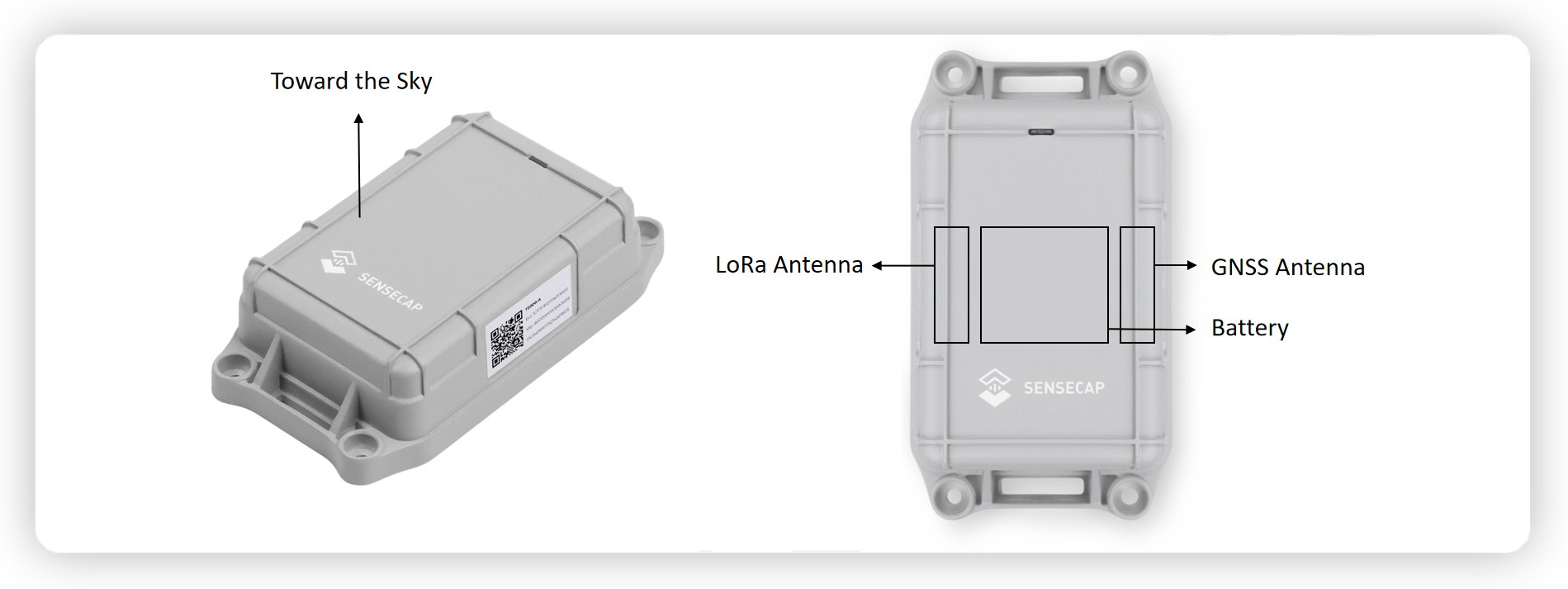
Why doesn't Wi-Fi or Bluetooth location display on the SenseCraft App map?
- Wi-Fi and Bluetooth location requires a third-party map parsing service, which must be invoked by users for parsing. Currently, the SenseCraft App supports GNSS positioning display only.
For more details on GNSS positioning, please refer to the blog: How Accurate is the SenseCAP T2000 GNSS Positioning?
Battery Related
What is the difference between T2000-A/B and T2000-C battery?
-
T2000-A/B
- Powered by an 8000mAh primary battery.
- Designed for long-term deployment without recharging.
-
T2000-C
- Powered by a 4000mAh rechargeable battery.
- Equipped with a 0.5W solar panel for continuous outdoor operation.
- Suitable for deployments where sunlight is available and maintenance needs to be minimized.
How efficient is the solar charging on the T2000-C?
- The T2000-C uses a 0.5W solar panel with a rechargeable battery to support long-term outdoor operation.
- The solar panel can generate up to about 60mA charging current, producing roughly 60mAh of energy per hour under good sunlight conditions.(this data is for reference only)
What factors affect the solar charging efficiency?
-
Solar charging performance can vary depending on:
- Sunlight exposure and intensity
- Panel orientation and installation angle
- Shading from nearby objects
- Dust, dirt, or debris on the solar panel
- Ambient temperature (battery charging works between 0–45°C)
-
For best performance, install the device in a location with direct sunlight and periodically check the panel surface.
Can the T2000-C operate continuously with solar power?
- In low-power configurations (such as longer uplink intervals), solar charging can even maintain or increase battery level during daily operation.
- However, frequent reporting intervals (for example, every 1 minute) may consume more power than the solar panel can replenish.
- For more detailed analysis of the solar charging performance, please refer to the following blog: How Efficient Is the Solar Charging on the SenseCAP T2000‑C?
The estimated battery life can be calculated using the following Battery Life Calculator.
Tech Support & Product Discussion
Thank you for choosing our products! We are here to provide you with different support to ensure that your experience with our products is as smooth as possible. We offer several communication channels to cater to different preferences and needs.